Home >
News > p-Xylene-Selective Metal–Organic Frameworks: A Case of Topology-Directed Selectivity
p-Xylene-Selective Metal–Organic Frameworks: A Case of Topology-Directed Selectivity
Summary:
The authors from KU Leuven, Versailles, Edinburgh, Marseille and Kiel developed MIL-125(Ti)-NH₂ and analogues with octahedral + tetrahedral cages, achieving topology-directed p-xylene selectivity (αpX/mX ≈ 3) for liquid-phase C₈-alkylaromatic separation.
Background:
1. Industrial p-xylene (pX) recovery demands adsorbents that overcome near-identical boiling points; FAU-zeolites give only moderate para-selectivity via packing, while MFI-zeolites suffer low capacity.
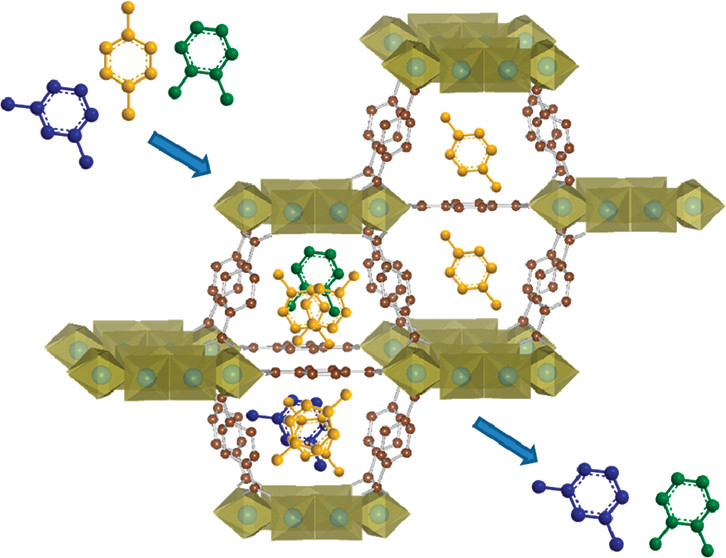
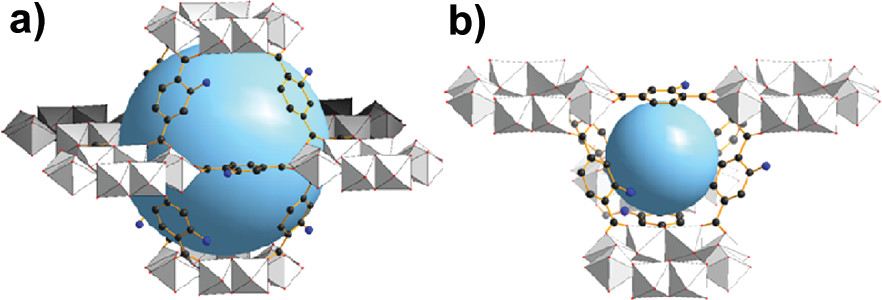
2. The team computationally screened >25 MOFs, predicted MIL-125(Ti)-NH₂ would couple shape-selective tetrahedral cages (≈0.61 nm cruciform pores) with favourable π/CH packing in 1.25 nm octahedral cages, then verified the concept experimentally.
Research Content:
1. Synthesis: Solvothermal reaction of Ti(OiPr)₄ with 2-aminoterephthalic acid in DMF/MeOH (150 °C, 16 h) followed by solvent-exchange activation gave crystalline MIL-125(Ti)-NH₂; MIL-125(Ti) and CAU-1(Al)-NH₂ were prepared for comparison.
2. Characterizations:
1) N₂@77 K BET 1380 m² g⁻¹ (MIL-125(Ti)-NH₂), pore-size distribution confirms micro-cages ≈0.6 nm and ≈1.2 nm.
2) PXRD & SEM show 200–500 nm octahedral crystallites stable over 15 adsorption/regeneration cycles.
3) TGA, Raman and microcalorimetry evidence framework integrity and stronger adsorption enthalpy for pX (−52.6 kJ mol⁻¹) versus mX/oX.
3. Application: Breakthrough & batch tests with equimolar xylene/heptane at 298 K gave pX uptake 12 wt %, mX 4 wt %, separation factor αpX/mX ≈ 3; pulse chromatography extends selectivity to ethyltoluenes & cymenes (αp-cym/m-cym >10).
4. Mechanism: GCMC simulations show pX fits both cages—tetrahedral cages exclude mX/oX (kinetic diam. 0.64–0.65 nm) while octahedral cages favour pX packing and stronger framework–adsorbate interactions; molecular sieving + packing synergy yields overall para-selectivity.
Outlook:
The work demonstrates topology-guided MOF design as a fast route to replace or complement FAU-zeolites in SMB pX purification, and generalizes the concept to other alkylaromatics, paving the way for next-generation adsorbents with tunable cage shapes.
p-Xylene-Selective Metal–Organic Frameworks: A Case of Topology-Directed Selectivity
Authors: Frederik Vermoortele, Michael Maes, Peyman Z. Moghadam, Matthew J. Lennox, Florence Ragon, Mohammed Boulhout, Shyam Biswas, Katrien G. M. Laurier, Isabelle Beurroies, Renaud Denoyel, Maarten Roeffaers, Norbert Stock, Tina Düren, Christian Serre, Dirk E. De Vos
DOI: 10.1021/ja207287h
Link: https://pubs.acs.org/doi/10.1021/ja207287h
The above review is for academic progress sharing. For any errors or copyright issues, please contact us for correction or removal.
SEO keywords (≤60 char): MIL-125(Ti)-NH₂ MOF, p-xylene selective, cage topology, SMB separation
SEO description (25 words): MIL-125(Ti)-NH₂ MOF with octahedral/tetrahedral cages separates p-xylene via topology-directed sieving and packing for industrial liquid-phase xylene purification.

