Home >
News > Synthesis of metal–organic frameworks in water at room temperature: salts as linker sources
Synthesis of metal–organic frameworks in water at room temperature: salts as linker sources
Summary:
The authors from Instituto de Catálisis y Petroleoquímica (ICP-CSIC) and Addis Ababa University developed high-quality carboxylate-based MOFs with nanocrystallinity, ordered mesoporosity, and low unreacted linker content, achieving room-temperature aqueous synthesis and application progress in porous material preparation.
Background:
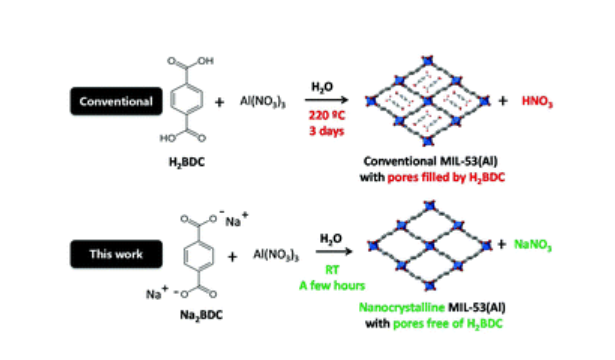
1. To address the limitations of conventional MOF synthesis (high temperature, organic solvent dependence, and residual unreacted linkers), previous researchers explored non-solvothermal methods but lacked universality and failed to prepare 3-D highly porous MOFs in water at room temperature.
2. The authors proposed an innovative method using organic salts (or protonated linkers + base) as anion linker sources, realizing room-temperature aqueous synthesis of high-quality MOFs and solving the aforementioned problems.
Research Content:
1.Synthesis: The authors synthesized X-MIL-53-Al (X=none, -NH₂, -NO₂), MOF-74, and MOF-5 using organic salt linker sources (or protonated linkers + stoichiometric NaOH) via room-temperature aqueous precipitation or organic solvent-based reactions.
2.Characterizations:
1) BET results: MIL-53(Al) (1048 m²/g), NH₂-MIL-53(Al) (686 m²/g), NO₂-MIL-53(Al) (775 m²/g), MOF-74 (1039 m²/g), MOF-5 (626 m²/g); MIL-53(Al) has mesopore size 31 nm.
2) SEM/TEM tests show MIL-53(Al) particle size 20–30 nm, MOF-74 1×3 μm, MOF-5 1–10 μm.
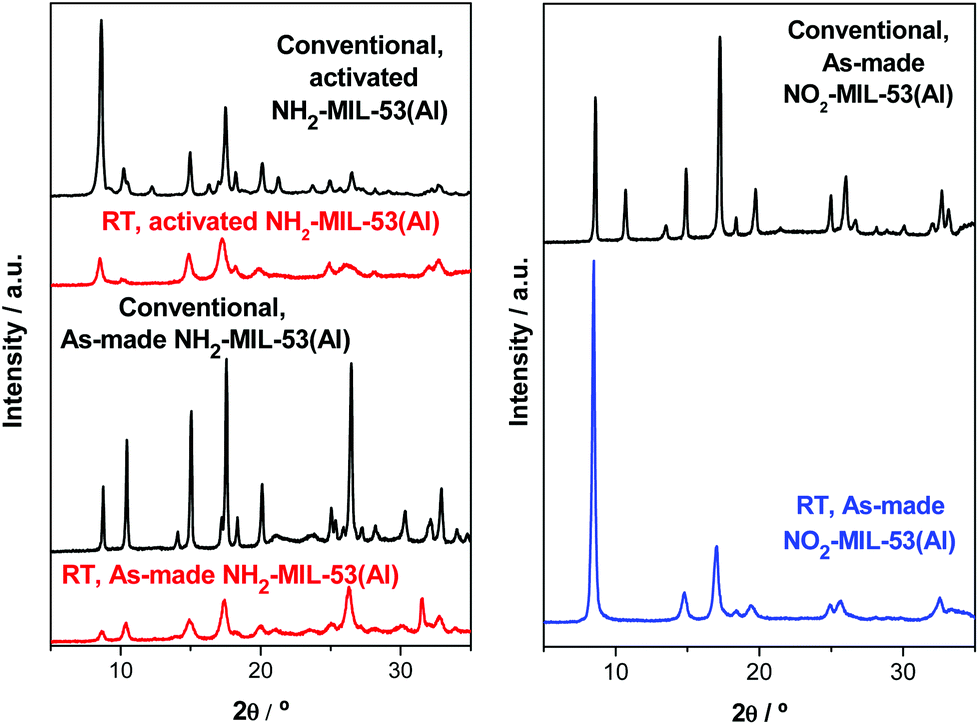
3) TGA: MIL-53(Al) has 13.7 wt% unreacted linker (conventional: 30.3 wt%); PXRD confirms crystal structure and high interpenetration of MOF-5.
3.Application: The materials show potential in heterogeneous catalysis, gas adsorption, and industrial porous material fields due to their structural advantages.
4.Mechanism: Organic salts improve linker solubility and deprotonation efficiency, altering MOF formation kinetics; the balance of thermodynamics and diffusion enables controlled synthesis.
Outlook:
This research innovatively achieves green, low-cost MOF synthesis, breaks through traditional process limitations, and provides a universal strategy for industrial application of MOFs.
Synthesis of metal–organic frameworks in water at room temperature: salts as linker sources
Authors: Manuel Sánchez-Sánchez, Negash Getachew, Kenya Díaz, Manuel Díaz-García, Yonas Chebudeb, Isabel Díaz
DOI: 10.1039/c4gc01861c
Link: https://pubs.rsc.org/en/content/articlelanding/2015/gc/c4gc01861c
The above review is for academic progress sharing. For any errors or copyright issues, please contact us for correction or removal.

