Home >
News > Corrugated 2D MOFs with reversible water-breathing topology
Corrugated 2D MOFs with reversible water-breathing topology
Summary:
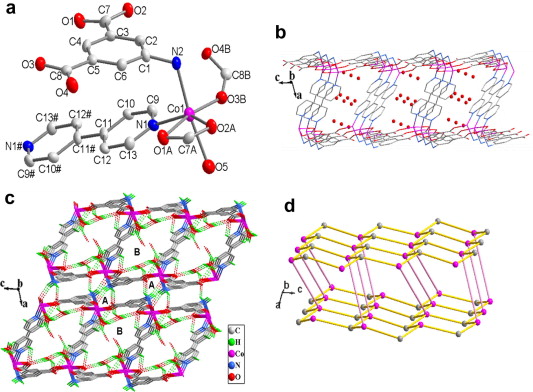
The authors from Nanjing University developed two corrugated 2D-bilayer (6³)(6⁵8) topological coordination polymers, [Co(AIP)(BPY)₀.₅·H₂O]ₙ·2nH₂O (1) and [Ni(AIP)(BPY)₀.₅·H₂O]ₙ·2nH₂O (2), exhibiting water-triggered reversible crystal-to-crystal transformations and 22–24 % microporosity, achieving repeatable water-adsorption/desorption performance.
Background:
1. To obtain flexible yet robust porous solids, prior studies focused on MOFs with dynamic “breathing” behavior; however, reversible single-crystal transformations retaining permanent porosity remain scarce.
2. The authors now propose a one-pot hydrothermal self-assembly route employing 5-aminoisophthalate (AIP) and 4,4′-bipyridine (BPY) to generate isostructural Co/Ni frameworks that reversibly swell/shrink upon hydration.
Research Content:
1. Synthesis: Hydrothermal reaction (180 °C, 72 h) of CoCl₂·6H₂O or NiCl₂·6H₂O with H₂AIP and BPY in H₂O produced red (1) or green (2) block crystals.
2. Characterizations:
1) N₂ sorption (77 K) gives BET 420–450 m² g⁻¹; pore size 8.8 × 8.1 Ų.
2) Single-crystal XRD shows 2D corrugated bilayers pillared by BPY into 3D supramolecular net with 24 % solvent-accessible void.
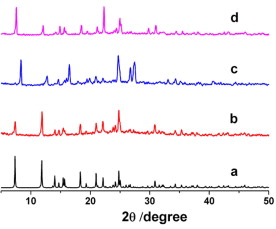
3) TGA indicates stability to 400 °C; in-situ PXRD reveals reversible peak shift (d-spacing shrinkage 0.3 Å) upon dehydration (120 °C) and full recovery after 3 d H₂O vapor.
3. Application: Cyclic vacuum/steam tests demonstrate reversible water uptake ≈14 wt % with colour switch (1: red ↔ blue; 2: green ↔ yellow), suggesting reusable desiccant or sensor function.
4. Mechanism: Desorption removes coordination & lattice H₂O, cooperatively shrinking the bilayer via weakened H-bonding and π–π stacking; re-hydration restores original H-bond network and layer spacing, driven by aromatic & amino-carboxylate supramolecular interactions.
Outlook:
The work delivers rare (3,4)-connected (6³)(6⁵8) topology MOFs that combine crystalline flexibility with permanent microporosity, providing a blueprint for robust reversible water-adsorbent materials and stimuli-responsive sensors.
Two corrugated 2D bilayer (6³)(6⁵8) topological coordination polymers: Synthesis, structure, and water-induced reversible transformation
Authors: Yunxia Hu, Wenwei Zhang, Xiaofei Zhang, Zhilin Wang, Yizhi Li, Junfeng Bai
DOI: 10.1016/j.inoche.2008.12.005
Link: https://www.sciencedirect.com/science/article/abs/pii/S1387700308004498
The above review is for academic progress sharing. For any errors or copyright issues, please contact us for correction or removal.

