Home >
News > Pillared Bilayer MOF: Transformation, Adsorption 、 Microcalorimetry
Pillared Bilayer MOF: Transformation, Adsorption 、 Microcalorimetry
Summary:
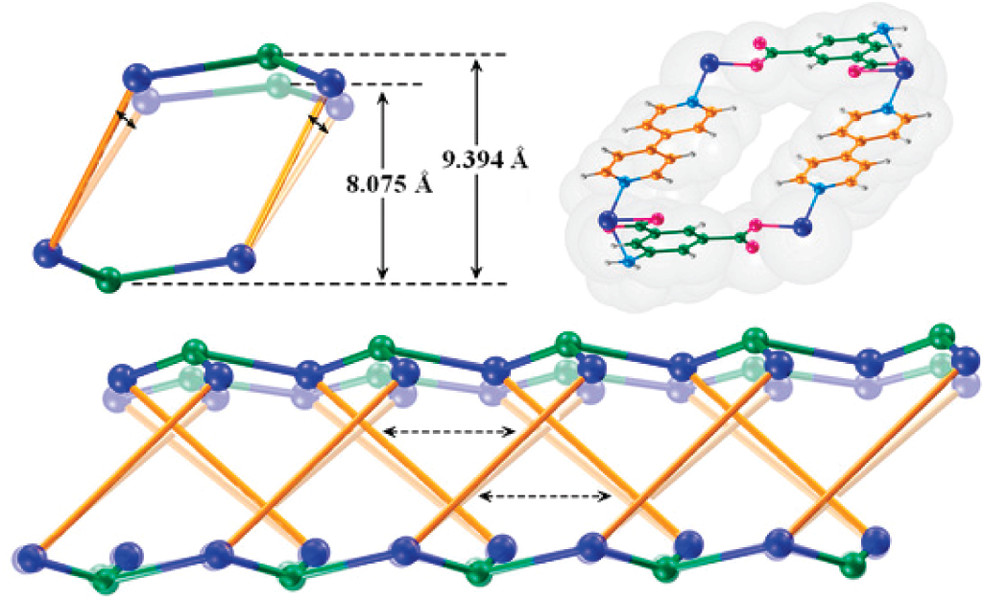
The authors from Guangxi Normal University, Guangdong University of Technology, Northwest University and Sun Yat-sen University developed a flexible 2D pillared-bilayer Co-MOF, [Co(5-NH2-bdc)(bpy)0.5(H2O)]·3H2O, exhibiting reversible single-crystal-to-single-crystal (SCSC) shrink–expand transformations upon apical ligand substitution and guest exchange, achieving shape-selective vapor adsorption and microcalorimetric quantification of host–guest energetics.
Background:
1. Rigid MOFs cannot undergo large pore deformation without crystal fracture, limiting their use in stimuli-responsive separation or sensing. Previous flexible frameworks mostly lose crystallinity upon guest removal, hampering precise structural elucidation.
2. The authors now propose a “pillared bilayer” strategy that immobilizes coordinatively unsaturated Co(II) centers while preserving long-range order, enabling SCSC visualization of pore breathing and quantitative thermodynamic data.
Research Content:
1. Synthesis: Hydrothermal reaction of Co(NO3)2·6H2O, 5-aminoisophthalic acid, 4,4′-bipyridine and NaOH at 130 °C for 72 h yields millimeter-sized single crystals of 1.
2. Characterizations:
1) N2 sorption at 77 K shows surface-only uptake, indicating ~1.8 × 5.0 Ų windows in the dehydrated form 2; dynamic MeOH/EtOH/benzene vapor isotherms reveal gate-opening with uptakes of 1.7/1.2/0.7 mol per formula unit.
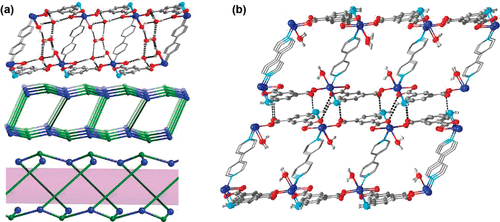
2) SXRD documents retention of single crystallinity across six SCSC states (1 → 2 → 3–6 → rehydrated); unit-cell volume shrinks 10.4 % on dehydration and expands 5–9 % on guest inclusion.
3) Microcalorimetry gives endothermic ΔHθm = +12.7 to +25.9 kJ mol⁻¹ for crystalline-state ligand exchange, evidencing entropy-driven diffusion.
3. Application: Dehydrated MOF 2 acts as a shape-recognition sponge, selectively adsorbing linear MeCN or 2-propynyl alcohol versus bulky guests, and can store oversized alcohols via pillar shear motion.
4. Mechanism: Apical Co–OH2 cleavage triggers bpy pillar rotation, converting Co(II) from octahedral to square-pyramidal; re-coordination of MeOH, EtOH or weak PPA reverses the process, with hydrogen-bonding networks stabilizing each state.
Outlook:
The work delivers a thermally robust, structurally trackable platform for studying flexible adsorption at molecular resolution and provides quantitative enthalpic benchmarks for designing next-generation stimuli-responsive porous crystals.
Apical Ligand Substitution, Shape Recognition, Vapor-Adsorption Phenomenon and Microcalorimetry for a Pillared Bilayer Porous Framework That Shrinks or Expands in Crystal-to-Crystal Manners upon Change in the Cobalt(II) Coordination Environment
Authors: Ming-Hua Zeng, Sheng Hu, Qing Chen, Gang Xie, Qi Shuai, Sheng-Li Gao, Li-Yuan Tang
DOI: 10.1021/ic801794e
Link: https://pubs.acs.org/doi/10.1021/ic801794e
The above review is for academic progress sharing. For any errors or copyright issues, please contact us for correction or removal.

