Home >
News > From Metal–Organic Frameworks to Single‐Atom Fe Implanted N‐doped Porous Carbons: Efficient Oxygen Reduction in Both Alkaline and Acidic Media
From Metal–Organic Frameworks to Single‐Atom Fe Implanted N‐doped Porous Carbons: Efficient Oxygen Reduction in Both Alkaline and Acidic Media
Summary:
The authors from University of Science and Technology of China & Argonne National Laboratory developed single-atom Fe implanted N-doped porous carbon (FeSA-N-C) with 1.76 wt % Fe, achieving record oxygen-reduction activity and stability in both alkaline and acidic media, surpassing Pt/C.
Background:
1. To address the low-metal-loading bottleneck of single-atom catalysts (SACs), previous MOF-pyrolysis routes produced aggregated nanoparticles or micropore-only carbons with poor mass-transfer.
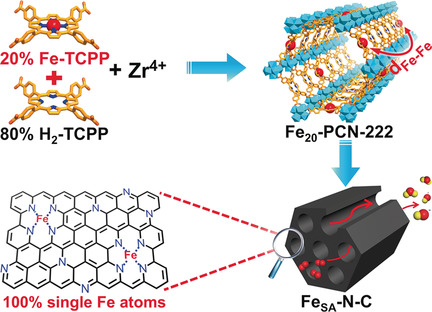
2. The authors now propose a mixed-ligand porphyrinic MOF strategy that spatially separates Fe-TCPP linkers, enabling quantitative conversion to atomically dispersed Fe-N4 sites after pyrolysis.
Research Content:
1. Synthesis:
Fe20-PCN-222 (20 mol % Fe-TCPP + 80 mol % H2-TCPP) was pyrolyzed at 800 °C, etched with HF to remove ZrO2, yielding FeSA-N-C.
2. Characterizations:
1) BET 532 m2 g−1; hierarchical 1–2 nm micropores & ~9 nm oriented mesochannels.
2) SEM/TEM: rod morphology (~200 nm) inherited; mesopores 3.2 nm aligned along c-axis.
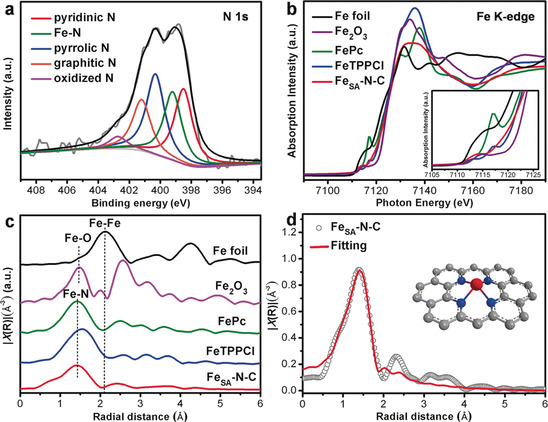
3) HAADF-STEM: only bright single-Fe dots; XANES/EXAFS: Fe-N4 coordination (CN≈4); XPS: Fe-Nx, pyridinic & graphitic N; Raman ID/IG = 0.95 (high graphitization).
3. Application:
ORR in 0.1 M KOH: E1/2 = 0.891 V, Jk@0.85 V = 23.27 mA cm−2 (vs 0.848 V & 5.61 mA cm−2 for Pt/C); 4 e− pathway, <5.5 % H2O2, 5000-cycle stability & methanol tolerance.
In 0.1 M HClO4: E1/2 = 0.776 V (only 5 mV below Pt/C), Jk@0.75 V = 9.60 mA cm−2, <1 % H2O2, 6 mV decay after 5000 cycles.
4. Mechanism:
Single Fe-N4 sites are the exclusive active centers (SCN− poisoning test); hierarchically oriented mesopores accelerate O2/electrolyte diffusion and expose all atomic Fe sites, while high graphitization ensures fast electron transfer, jointly delivering superior ORR kinetics.
Outlook:
This mixed-ligand MOF pyrolysis route realizes high-loading SACs with engineered pore orientation, setting a benchmark for non-noble ORR catalysts and opening a general pathway toward atomically dispersed metals for energy devices.
From Metal–Organic Frameworks to Single‐Atom Fe Implanted N‐doped Porous Carbons: Efficient Oxygen Reduction in Both Alkaline and Acidic Media
Authors: Long Jiao, Gang Wan, Rui Zhang, Hua Zhou, Shu-Hong Yu, Hai-Long Jiang
DOI: 10.1002/anie.201803262
Link: https://onlinelibrary.wiley.com/doi/10.1002/anie.201803262
The above review is for academic progress sharing. For any errors or copyright issues, please contact us for correction or removal.

