Home >
News > Crystal morphology-directed framework orientation in porous coordination polymer films and freestanding membranes via Langmuir–Blodgettry
Crystal morphology-directed framework orientation in porous coordination polymer films and freestanding membranes via Langmuir–Blodgettry
Summary:
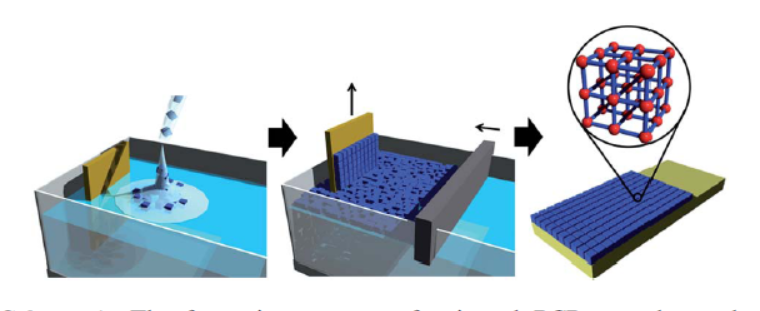
The authors from Kyoto University (iCenter & ERATO Kitagawa Integrated Pores Project) developed a morphology-directed Langmuir–Blodgett (LB) assembly strategy for porous coordination polymers (PCPs), achieving centimeter-scale, highly-oriented films and freestanding membranes for separation & sensing platforms.
Background:
1. To address the difficulty of aligning PCP micro-crystals on substrates, previous studies used interface synthesis, micro-contact printing or dip-pen lithography, achieving patterned coatings but suffering from limited scalability, surface pre-modification and restricted framework types.
2. The authors now propose an LB-based, surface-modification-free approach and obtain dense monolayers whose crystal orientation is dictated solely by particle morphology.
Research Content:
1. Synthesis:
– [Cu3(btc)2]n (truncated octahedron & cube), [Al12O(OH)18(H2O)3(Al2(OH)4)(btc)6]n (hexagonal prism) and [Cu2(bdc)2(bpy)]n (plate) were solvothermally/microwave-grown, then dispersed in MeOH (100 mg mL⁻¹) for LB processing.
2. Characterizations:
1) N₂ sorption shows permanent micro-porosity retained after LB transfer.
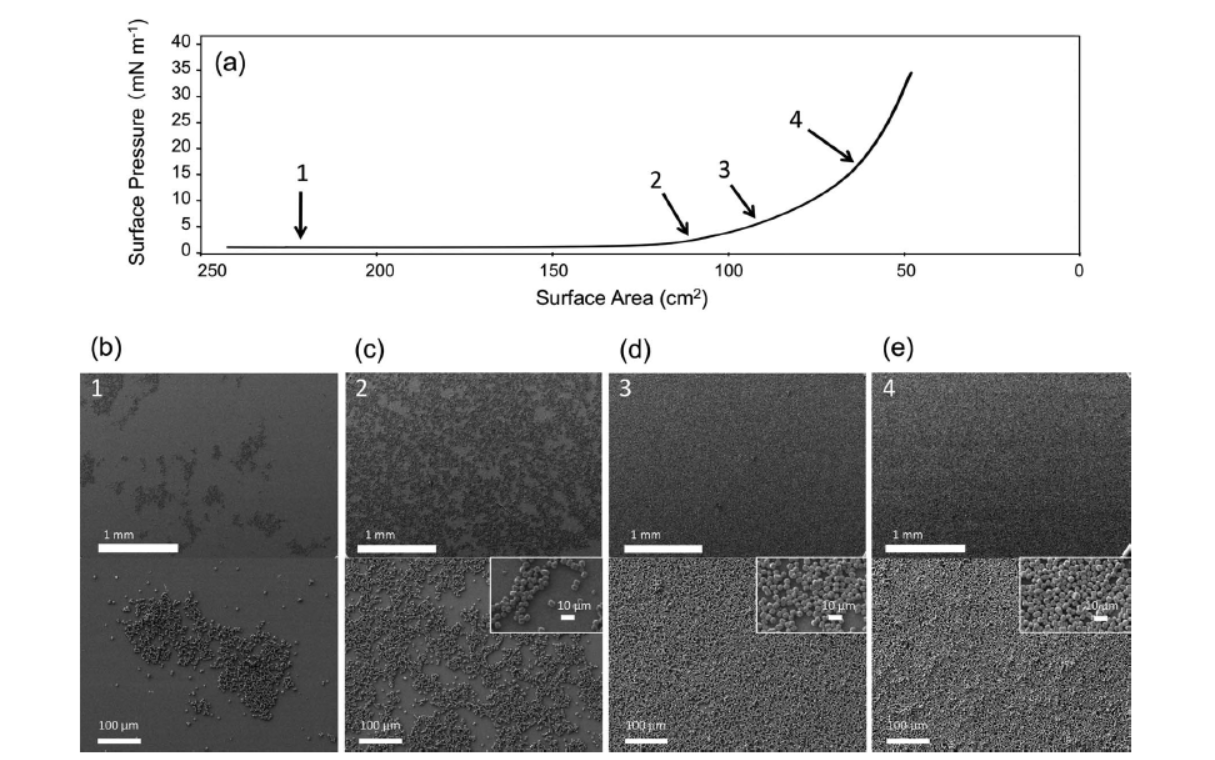
2) SEM: uniform monolayers (particle density tuned by surface pressure); crystal facets ({100}, {111}, {001}) lie parallel to substrate as predicted by habit.
3) Out-of-plane XRD: exclusively (h00) or (hhh) reflections confirm vertical texture; no additional peaks, proving single-crystalline orientation over cm² areas.
3. Application:
– Freestanding sheets were produced by lifting the LB film onto a 250 µm-hole Cu grid; continuous membranes bridge the openings, promising for gas separation, nanofiltration and oriented-catalyst hosts.
4. Mechanism:
– Morphology dictates the lowest-energy facet contacting water/air interface; capillary and compression forces lock orientation before transfer; high surface pressure (≈20 mN m⁻¹) yields close-packed, crack-tolerant arrays.
Outlook:
The work delivers a cheap, scalable route to translate PCP channel anisotropy from single crystal to macroscopic devices, paving the way for aligned separation membranes and functional hierarchical hybrids.
Crystal morphology-directed framework orientation in porous coordination polymer films and freestanding membranes via Langmuir–Blodgettry
Authors: Manuel Tsotsalas, Ayako Umemura, Franklin Kim, Yoko Sakata, Julien Reboul, Susumu Kitagawa, Shuhei Furukawa
DOI: 10.1039/c2jm16333k
Link: https://pubs.rsc.org/en/content/articlelanding/2012/jm/c2jm16333k
The above review is for academic progress sharing. For any errors or copyright issues, please contact us for correction or removal.

