Home >
News > Shape-Memory Nanopores Induced in Coordination Frameworks by Crystal Downsizing
Shape-Memory Nanopores Induced in Coordination Frameworks by Crystal Downsizing
Summary:
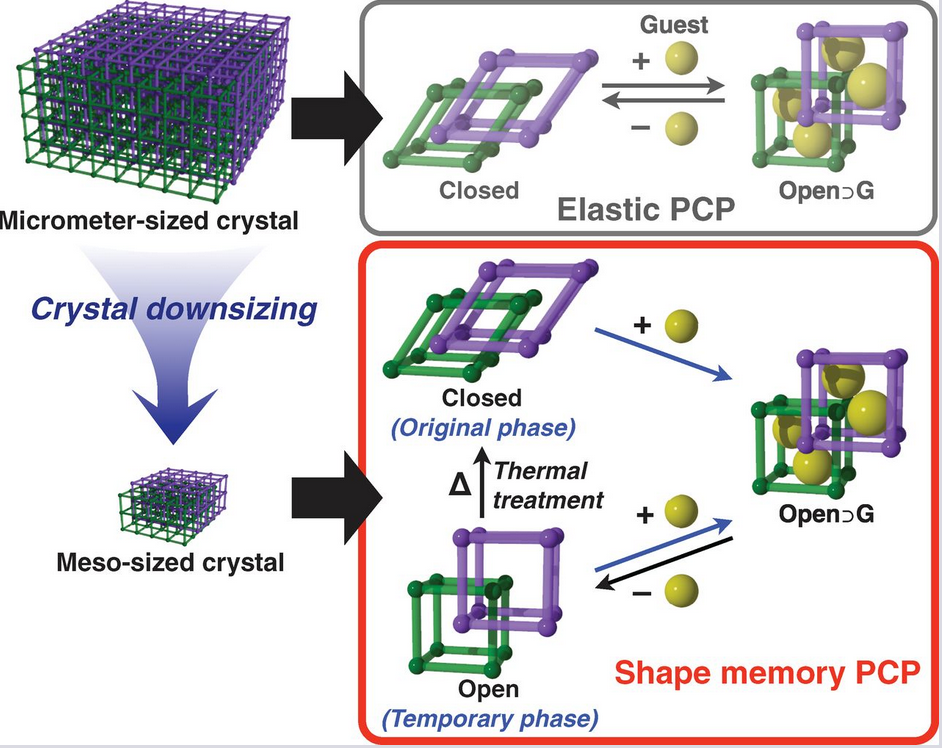
The authors from Kyoto University’s iCeMS & ERATO Kitagawa Project developed meso-scale [Cu₂(bdc)₂(bpy)]ₙ coordination frameworks that exhibit a crystal-size-gated shape-memory nanopore effect, achieving switchable gas/liquid sorption without gate-opening hysteresis.
Background:
1. To control pore flexibility, prior work relied on guest-responsive “elastic” PCPs that fully recover after desorption; however, transient open-dried phases could not be trapped, limiting programmable sorption.
2. The authors proposed crystal-downsizing (50–300 nm) to kinetically suppress framework relaxation and thereby isolate a metastable open-dried phase that is reversibly inter-convertible with the closed phase upon mild heating.
Research Content:
1. Synthesis:
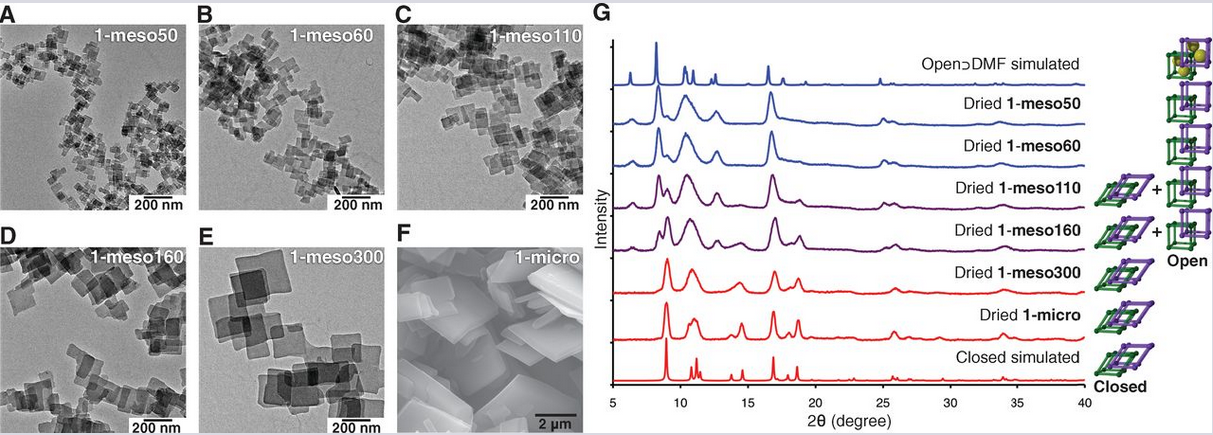
Coordination-modulation precipitation (acetic-acid/Cu²⁺ ratio r = 10–50) yielded monodisperse plate-like crystals (1-meso50 to 1-meso300) and μm-sized 1-micro.
2. Characterizations:
1) BET: open-dried 1-meso50 gives type-I methanol isotherm (no gate); closed phase shows gate-opening at P/P₀ 0.10–0.17.
2) SEM/TEM: 50 × 50 × 20 nm³ (1-meso50) → 300 × 300 × 30 nm³ (1-meso300); electron diffraction confirms shortest axis along Cu–N direction.
3) Variable-temperature synchrotron PXRD & DSC: open-dried → closed phase at 200 °C with 20-cycle reversibility and no capacity loss; CO₂ shows identical switchability.
3. Application:
Demonstrated 20-cycle on-demand methanol/CO₂ capture–release between “shape-memory open” and “closed” states for smart sorbent devices.
4. Mechanism:
Downsizing reduces lattice-defect nucleation sites, enlarges martensitic energy barrier, and increases surface-enthalpy contribution, kinetically trapping the open-dried phase; thermal activation overcomes the barrier to restore the closed phase.
Outlook:
This work establishes crystal-size engineering as a general lever to program PCP flexibility and metastability, opening routes to size-tuned, gate-free, shape-memory sorbents and sensors.
Shape-Memory Nanopores Induced in Coordination Frameworks by Crystal Downsizing
Authors: Yoko Sakata, Shuhei Furukawa, Mio Kondo, Kenji Hirai, Nao Horike, Yohei Takashima, Hiromitsu Uehara, Nicolas Louvain, Mikhail Meilikhov, Takaaki Tsuruoka, Seiji Isoda, Wataru Kosaka, Osami Sakata, Susumu Kitagawa
DOI: 10.1126/science.1231451
Link: https://www.science.org/doi/10.1126/science.1231451
The above review is for academic progress sharing. For any errors or copyright issues, please contact us for correction or removal.

