

Product: PyTTA–DHTA-COF
Synonyms: 1,4-Benzenedicarboxaldehyde, 2,5-dihydroxy-, polymer with 4,4′,4′′,4′′′-(1,3,6,8-pyrenetetrayl)tetrakis[benzenamine]
CAS:1610471-71-0
Basic Information
| Unit MF. | C40H30N4.C8H6O4 | Unit MW. | 732.83 | ||
| Coordination Metal | None | Linkers |
1) CAS:1610471-69-6 4,4′,4″,4‴-(pyrene-1,3,6,8-tetrayl)tetraaniline (PyTTA); |
||
| Pore Size | 2.1 nm | Pore Volume | 1.91 cm³/g (Result from nitrogen adsorption test at 77 K) | ||
| Surface Area | 2013 m²/g | ||||
| Analog Structure | 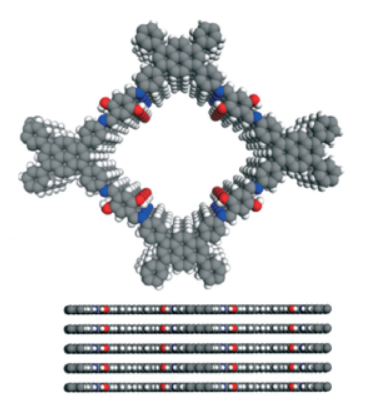 |
||||
Product Property
| Appearance | Red Powder | |||
| Particle Size | ||||
Stability
1) Solution Stability: Maintains excellent crystallinity (no significant change in PXRD pattern) after soaking in 1 M NaOH solution at room temperature for 12 h;
Preservation
1) Store in a dry and sealed condition at room temperature, avoiding humid environment (since proton conduction of the material depends on humidity, which may affect storage stability)
2) It is recommended to activate the material in a room-temperature vacuum oven for 24 h before use.
Other Features
1) Fluorescence: NA
Applications
1) Proton Exchange Membrane Material: High intrinsic proton conduction can be achieved through sulfonation modification, applicable for proton exchange membrane fuel cells
2) Porous Adsorption Material: High specific surface area (2013 m²/g) and regular pores, suitable for gas adsorption or small molecule separation
3) Functionalized Carrier: Pore walls contain hydroxyl groups, and other functional groups (e.g., sulfonic acid groups) can be introduced via post-synthetic modification to expand application scenarios
2) Porous Adsorption Material: High specific surface area (2013 m²/g) and regular pores, suitable for gas adsorption or small molecule separation
3) Functionalized Carrier: Pore walls contain hydroxyl groups, and other functional groups (e.g., sulfonic acid groups) can be introduced via post-synthetic modification to expand application scenarios
Characterizations
References
1) Zhang, Yuwei; Li, Chunzhi; Liu, Zhaohan; Yao, Yuze; Hasan, Md. Mahmudul; Liu, Qianyu; Wan, Jieqiong; Li, Zhongping; Li, He; Nagao, Yuki; CrystEngComm, 2021, 23, 6234-6238, DOI: 10.1039/d1ce00957e; Intrinsic proton conduction in 2D sulfonated covalent organic frameworks through a postsynthetic strategy;
2) Chen, Xiong; Huang, Ning; Gao, Jia; Xu, Hong; Xu, Fei; Jiang, Donglin; Chem. Commun., 2014, 50, 6161-6163, DOI: 10.1039/c4cc01825g; Towards covalent organic frameworks with predesignable and aligned open docking sites;
