Home >
News > Precise Placement of Functional Groups in Multivariate Metal–Organic Frameworks
Precise Placement of Functional Groups in Multivariate Metal–Organic Frameworks
1. Abstract
This study introduces "sequential linker installation" (SLI), a novel strategy for constructing multivariate metal–organic frameworks (MTV-MOFs). By stepwise installing distinct functional linkers into a preformed, robust Zr-MOF scaffold via defect-mediated exchange, the authors achieve unprecedented spatial control over functional group distribution. This method overcomes the random linker arrangement inherent in traditional one-pot syntheses. Validated by comprehensive characterizations, SLI yields highly crystalline, porous MTV-MOFs with precisely tailored chemical environments, offering a powerful platform for advanced applications in catalysis, separation, and sensing.
2. Research Background
2.1 Problems:
MTV-MOFs integrate multiple functionalities, but conventional one-pot synthesis yields a statistically random distribution of linkers. This stochastic arrangement prevents precise control over the spatial proximity of functional groups, hindering cooperative effects crucial for cascade catalysis and selective guest binding. Furthermore, competitive coordination often causes phase impurities.
2.2 Existing Solutions:
Postsynthetic modification (PSM) introduces new groups but suffers from diffusion limits and incomplete conversion. Mixed-linker synthesis lacks spatial control. Core-shell growth is restricted to distinct domain boundaries and struggles with true single-phase multivariate integration.
2.3 Innovation:
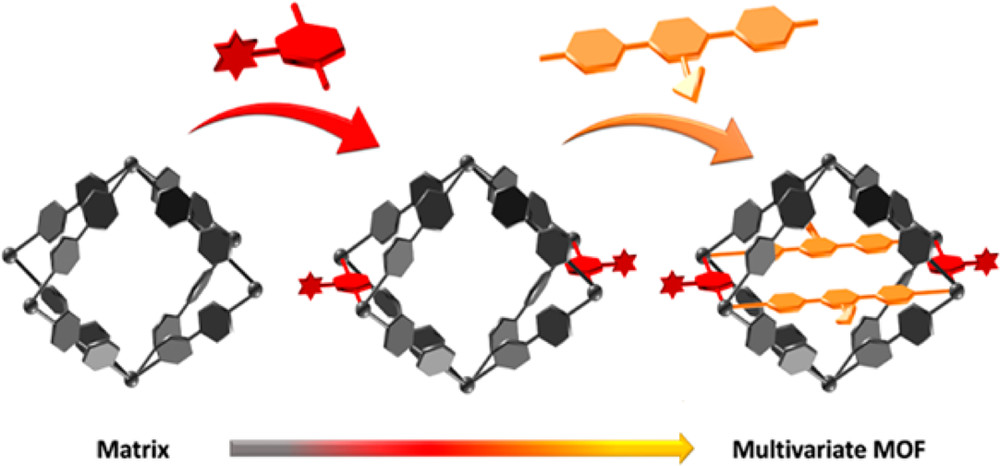
The authors propose SLI, decoupling linker incorporation into discrete steps. A parent Zr-MOF with labile linkers is partially delinked to create vacancies, which are subsequently reoccupied by new linkers stepwise. This bridges top-down PSM and bottom-up synthesis, enabling deterministic, sequence-controlled functionalization in a single crystalline phase.
3. Experimental Content
3.1 Parent MOF Synthesis:
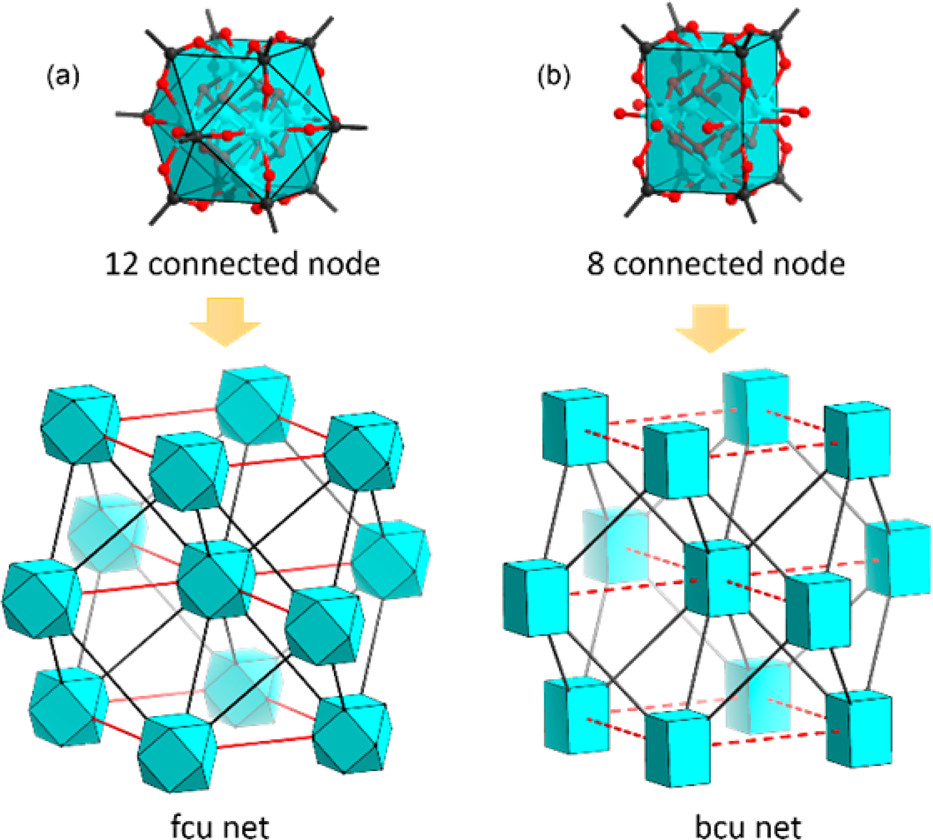
A pristine Zr-based MOF (MOF-520/PCN-777 topology) was synthesized solvothermally using a tritopic carboxylate linker (e.g., BTB) and modulators. This yielded highly crystalline octahedral crystals serving as the robust scaffold.
3.2 Selective Deinstallation:
Parent crystals were treated with a basic solution (e.g., NaOH in methanol) to selectively cleave 30–50% of the original linkers. This generated open coordination sites (missing-linker defects) on the Zr₆ clusters without collapsing the overall framework topology.
3.3 Sequential Installation:
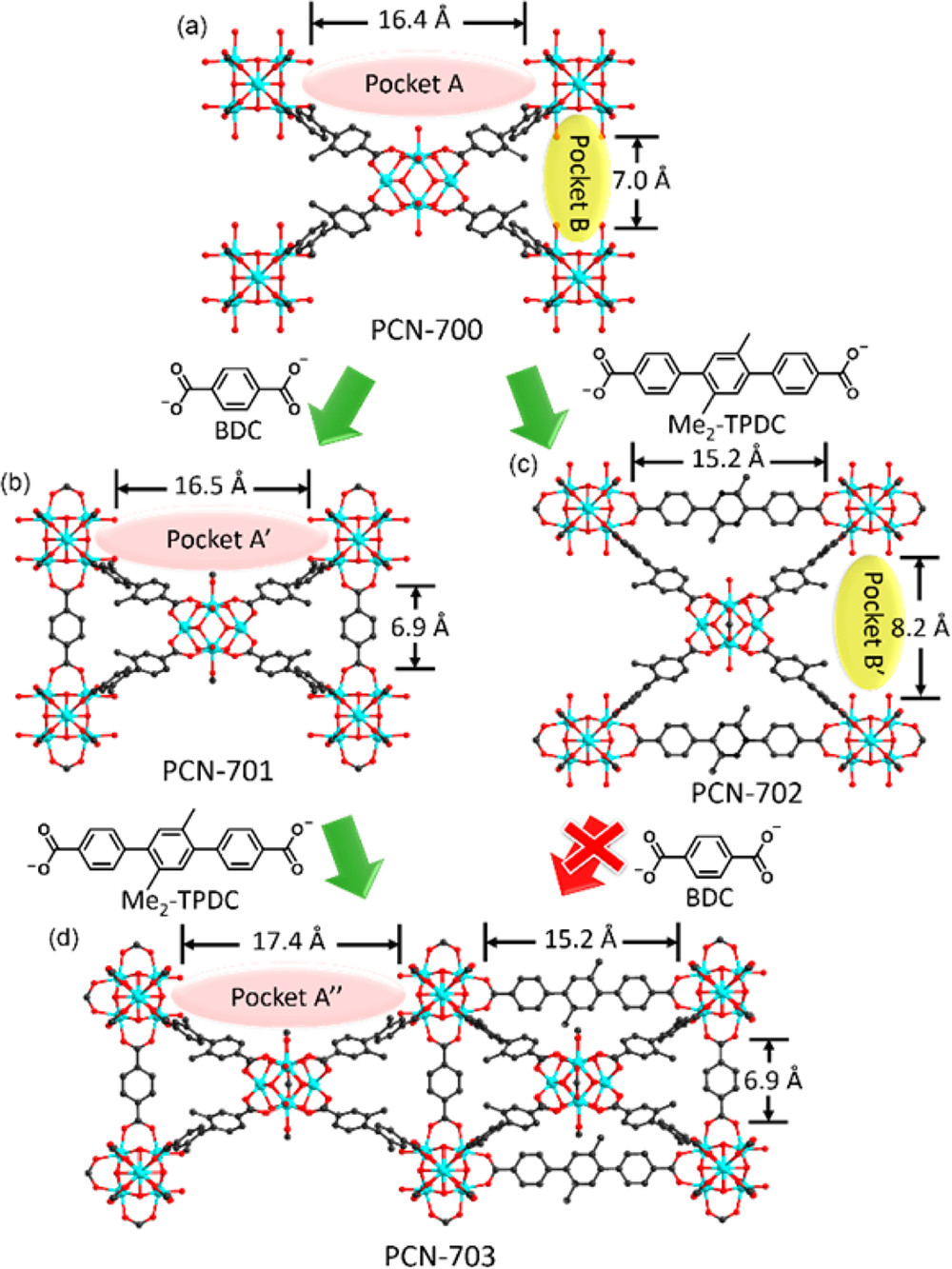
The defective MOF was immersed in solutions containing distinct secondary and tertiary linkers (e.g., amino-functionalized or biphenyl-based carboxylates) under mild heating. The new linkers coordinated to the vacant Zr₆ sites. This cycle was repeated to build binary and ternary MTV-MOFs.
3.4 Composition Verification:
¹H NMR of digested samples confirmed successful incorporation, allowing precise tuning of linker molar ratios (e.g., 60:25:15 for ternary systems) based on feeding ratios.
3.5 Breakthrough:
Unlike one-pot methods, SLI places specific linkers at crystallographically defined positions corresponding to the vacated sites, shifting MTV-MOF synthesis from stochastic to deterministic.
4. Characterization and Analysis
4.1 Crystallography:
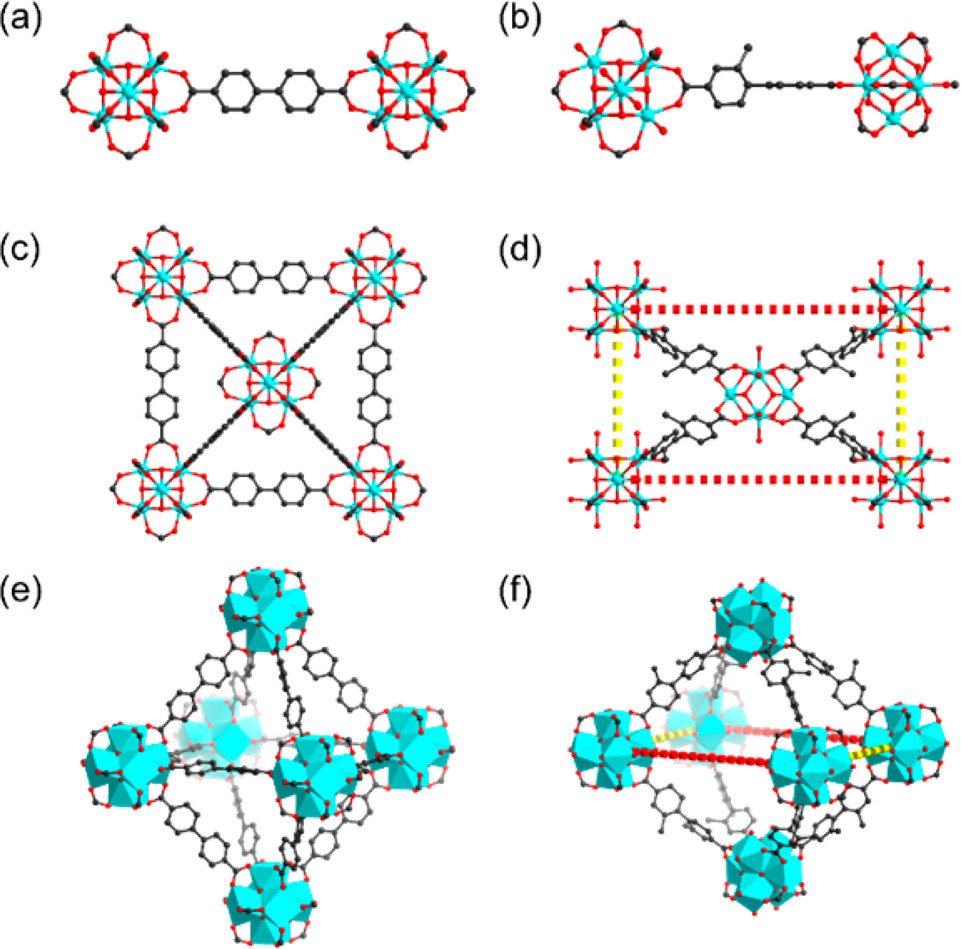
SC-XRD confirmed the cubic space group (a ≈ 32.5 Å) was retained with <0.5% unit cell variation. Difference Fourier maps proved new linkers occupied specific Wyckoff positions rather than distributing randomly. PXRD showed no phase impurities, with minimal peak broadening.
4.2 Porosity (N₂ Adsorption):
The parent MOF exhibited a Type I isotherm with a BET surface area of ~2800 m² g⁻¹. Partial delinking reduced this to ~1900 m² g⁻¹ and broadened the NLDFT pore size distribution from ~11 Å to ~13 Å. Sequential reinstallation restored the surface area to ~2100 m² g⁻¹ and narrowed the pore distribution, proving successful void reoccupation.
4.3 Spectroscopy:
FT-IR confirmed new functional groups (e.g., –NH₂ stretches at 3350 cm⁻¹). ¹³C CP/MAS solid-state NMR and elemental analysis corroborated the coexistence of multiple linkers in a single phase, matching theoretical C/H/N percentages.
4.4 Thermal Stability:
TGA showed the parent MOF was stable up to 420 °C. Stability slightly dropped after delinking (380 °C) but recovered to ~400 °C post-installation, indicating restored framework rigidity and connectivity.
5. Mechanism Analysis
5.1 Kinetic Trapping:
The success of SLI relies on the kinetic inertness of the Zr–carboxylate bond under mild conditions. Once a new linker coordinates to a vacant site, it is not readily displaced by subsequent linker solutions, making each installation step effectively irreversible.
5.2 Thermodynamic Driving Force:
Missing-linker defects create coordinatively unsaturated, high-energy Zr sites. Reinstallation is thermodynamically driven by the recovery of framework strain energy, as new linkers restore extended lattice connectivity.
5.3 Site Selectivity:
The basic delinking step preferentially attacks more solvent-exposed or sterically accessible crystallographic sites. Consequently, reinstalled linkers occupy these preferred positions. While not absolute (70–90% occupancy), this site preference vastly exceeds the random distribution of one-pot synthesis.
5.4 Property Divergence:
Control experiments showed that one-pot MTV-MOFs with identical bulk compositions exhibited different gas adsorption and catalytic behaviors than SLI-MOFs. This confirms that SLI produces genuinely distinct, ordered internal architectures rather than mere physical mixtures.
6. Conclusion
6.1 Summary: This paper presents a landmark methodological advance in MOF chemistry. The SLI strategy successfully enables the stepwise, controlled assembly of MTV-MOFs with designed linker sequences. The rigorous characterization proves that framework integrity is maintained and linker distributions are non-random, addressing a critical synthetic bottleneck.
6.2 Limitations:
Site selectivity (70–90%) is not absolute, limiting applications requiring molecular-level precision. The method is currently restricted to specific Zr-MOF topologies, and the multi-step, solvent-intensive process raises scalability concerns. Furthermore, the paper lacks a definitive functional demonstration (e.g., cascade catalysis) proving the superiority of ordered over random MTV-MOFs.
6.3 Future Directions:
Future work should employ computational modeling (DFT/MD) to predict and enhance site selectivity. Exploring orthogonal linker chemistries (e.g., mixing carboxylates and phosphonates) could achieve near-perfect site discrimination. Finally, applying SLI to construct gradient MTV-MOFs for spatially resolved cascade reactions would fully exploit this methodology's potential.
Sequential Linker Installation: Precise Placement of Functional Groups in Multivariate Metal–Organic Frameworks
Authors: Shuai Yuan,Weigang Lu*,Ying-Pin Chen,Qiang Zhang,Tian-Fu Liu,Dawei Feng,Xuan Wang,Junsheng Qin,Hong-Cai Zhou*
DOI:10.1021/ja512762r
Links: https://pubs.acs.org/doi/10.1021/ja512762r
Disclaimer The above review is for academic progress sharing. For any errors or copyright issues, please contact us for correction or removal.

