Home >
News > Pore-Engineered Luminescent MOF Sensors for PFAS Recognition in Water
Pore-Engineered Luminescent MOF Sensors for PFAS Recognition in Water
Abstract
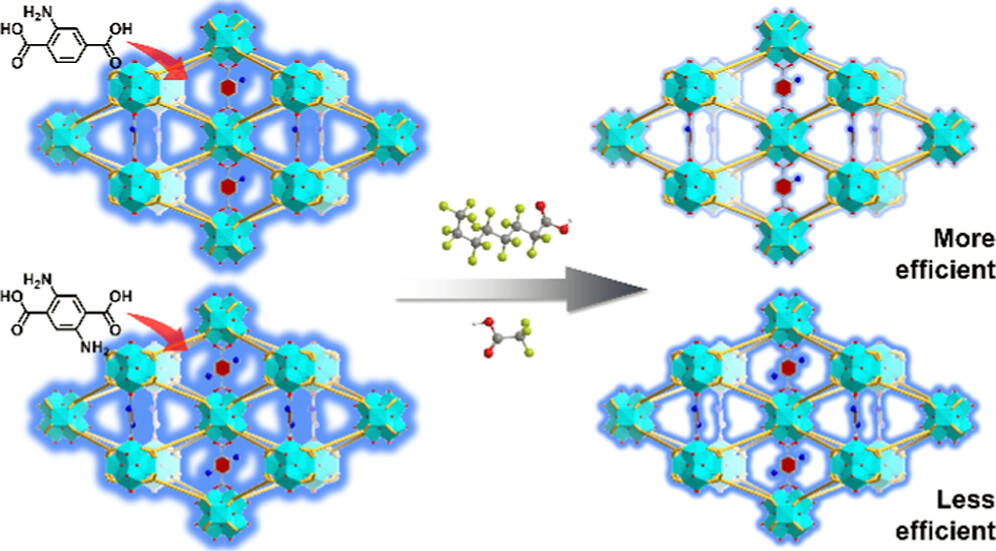
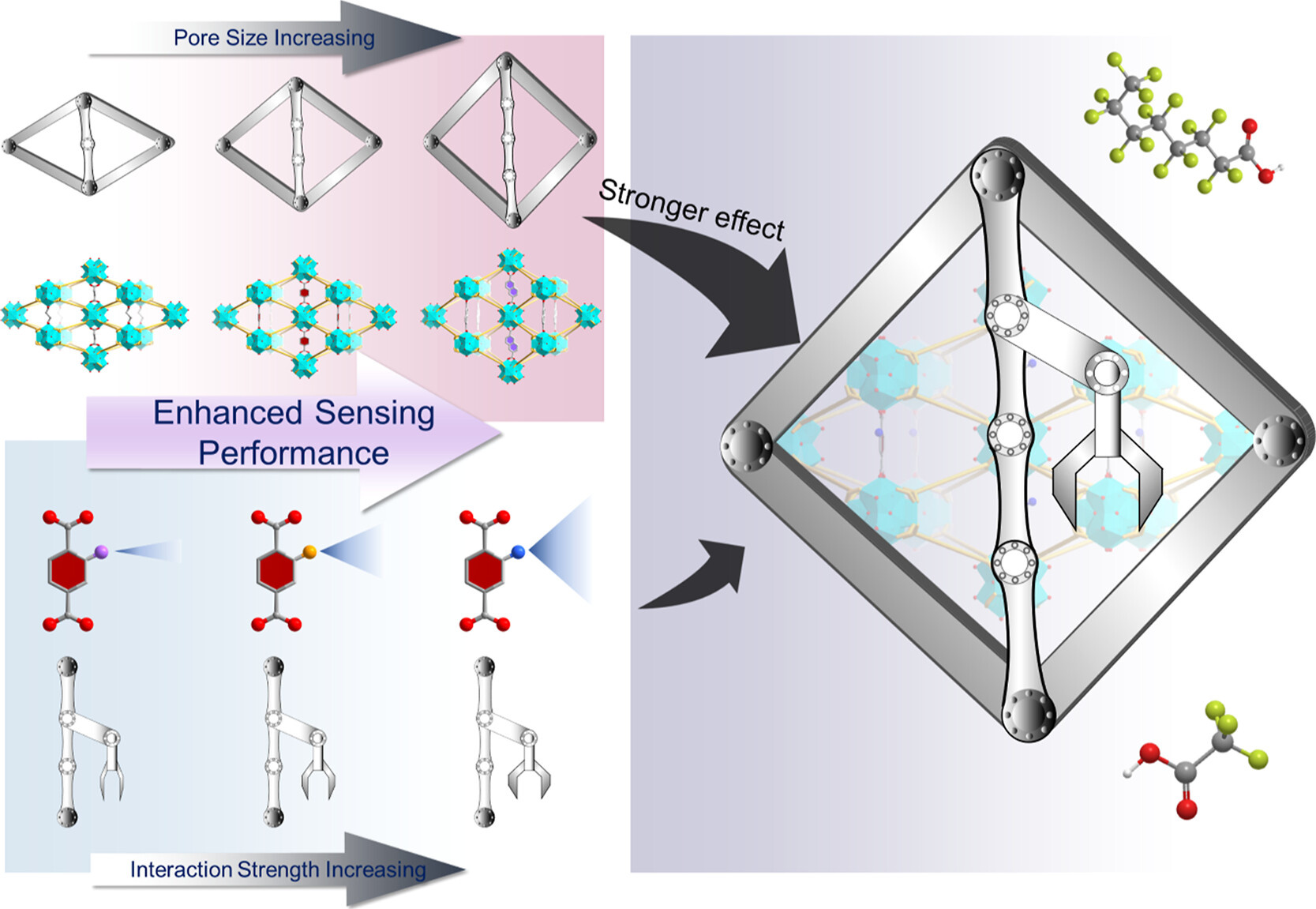
Per- and polyfluoroalkyl substances (PFAS) are persistent environmental contaminants posing severe threats to ecological integrity and public health. Luminescent sensing utilizing porous materials has emerged as a highly efficient strategy for their daily monitoring due to its simplicity and sensitivity. However, the lack of systematic investigations into the pore structure–function relationship governing PFAS detection has hindered the rational design of advanced sensors. Herein, the authors employed a modular linker installation strategy to precisely engineer the pore environments of metal–organic frameworks (MOFs) without compromising structural integrity. A comprehensive library of 13 PCN-700 derivatives with systematically regulated pore volumes, functional groups, and functional group densities was constructed. The study reveals that enhanced pore accessibility directly boosts sensing performance, while amino functional groups significantly improve sensitivity, achieving up to a 3-fold higher quenching efficiency via strengthened host–guest interactions. Furthermore, adjusting functional group densities uncovers a critical trade-off between binding affinity and pore accessibility. By decoupling these structural contributions, this work establishes fundamental design principles for developing robust, high-performance MOF-based luminescent sensors for aqueous PFAS monitoring.
Research Background
1. Problems in the relevant field:
Per- and polyfluoroalkyl substances (PFAS) are synthetic organofluorides widely used in industrial and consumer products due to their exceptional chemical stability and amphiphilicity. However, this inertness leads to severe environmental persistence, bioaccumulation, and widespread distribution. Long-term exposure is linked to developmental toxicity, endocrine disruption, and various cancers. Detecting PFAS is exceptionally challenging because they exist at trace environmental concentrations and are "spectroscopically silent," exhibiting negligible absorption in the ultraviolet–visible (UV–vis) region, which invalidates conventional competitive absorption-based sensing methods.
2. Existing solutions proposed by other researchers:
Luminescent sensing has emerged as a promising alternative for trace contaminant detection, offering rapid readouts and convenient operation. Metal–organic frameworks (MOFs) are ideal candidates due to their tunable pores and modular structures. Among pore engineering techniques, "linker installation" allows precise tuning of pore environments while preserving the parent framework's integrity. Despite these advances, previous studies have largely failed to systematically investigate the structural matching between MOF pores and PFAS molecules, primarily due to the synthetic difficulties in decoupling pore volume from chemical functionality.
3. Innovations and new ideas of this work:
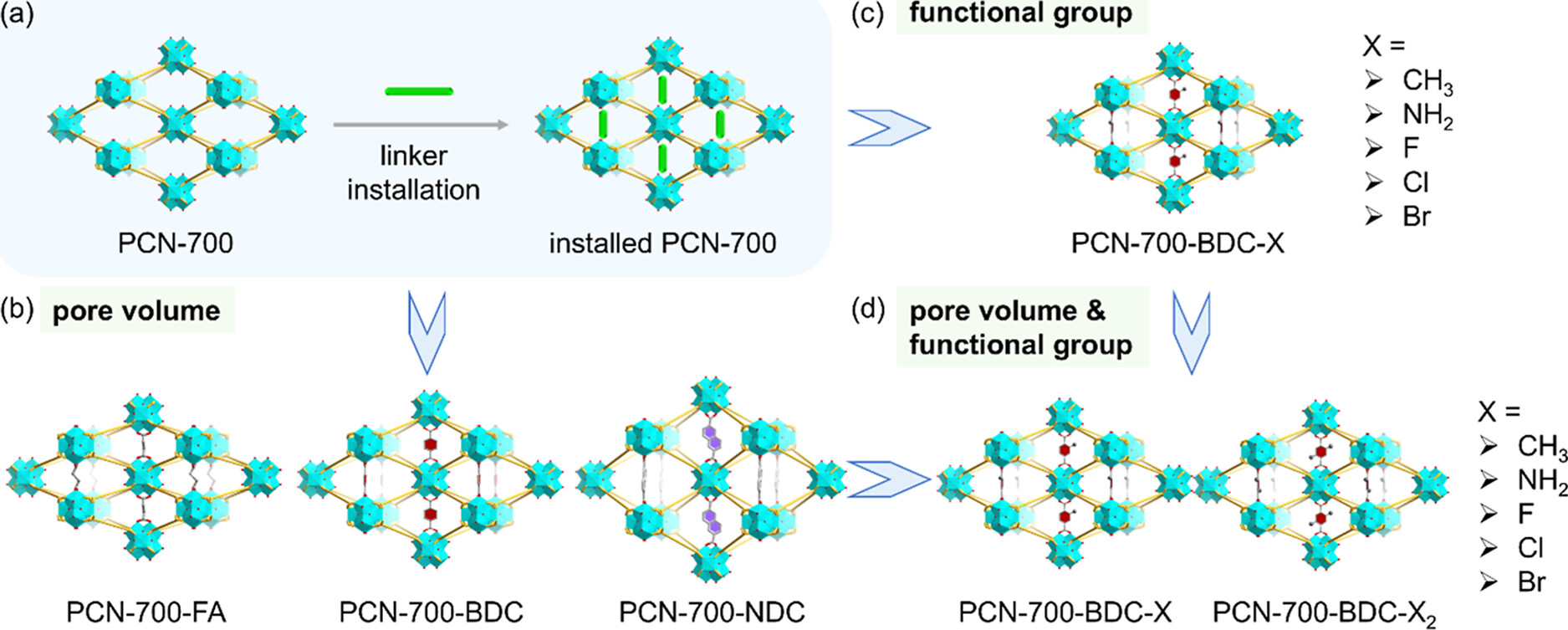
To bridge this knowledge gap, the authors utilized a linker installation strategy to construct a library of 13 PCN-700 derivatives. By orthogonally varying linker lengths (to tune pore volume) and functional groups (–CN, –CH₃, –NH₂, –NO₂, –F), they successfully decoupled the effects of pore accessibility and chemical affinity. This systematic approach not only identifies the dominant structural factors for PFAS recognition but also reveals a crucial trade-off between functional group density and molecular diffusion, providing a clear blueprint for the rational design of next-generation PFAS sensors.
Experimental Section
1. Material Synthesis and Linker Installation:
The parent PCN-700 framework was synthesized solvothermally. Subsequently, a library of 13 PCN-700 derivatives was constructed via sequential linker installation. Functionalized dicarboxylate linkers (BDC-X, where X = –CN, –CH₃, –NH₂, –NO₂, –F) and linkers of varying lengths (formate, BDC, NDC) were incorporated into the predefined binding sites of the Zr₆ clusters, ensuring atomic-level precision without collapsing the parent topology.
2. Pore and Functionality Modulation:
By installing linkers of different lengths and steric bulks, the pore volumes were systematically regulated. Concurrently, the density of specific functional groups (e.g., –NH₂) was adjusted within the framework to evaluate the balance between the number of active binding sites and the resulting steric hindrance within the pore channels.
3. PFAS Sensing Evaluation:
The 13 derivatives were dispersed in aqueous solutions containing target PFAS analytes. Luminescence quenching responses, kinetics, and selectivity were systematically recorded using fluorescence spectroscopy to evaluate sensing performance and establish quantitative structure–function relationships.
Characterization and Analysis
1. Structure and Porosity: SC-XRD and PXRD confirmed the retention of the PCN-700 topology across all 13 derivatives. N₂ adsorption–desorption isotherms revealed that the parent PCN-700 possesses a high BET surface area of ~2850 m² g⁻¹ and a pore volume of 1.15 cm³ g⁻¹. Upon linker installation, the BET surface areas systematically decreased to 1400–1800 m² g⁻¹ for bulkier derivatives, with pore sizes tuning from ~15.2 Å down to ~8.5 Å, directly correlating with the installed linker length.
2. Luminescent Sensing Performance:
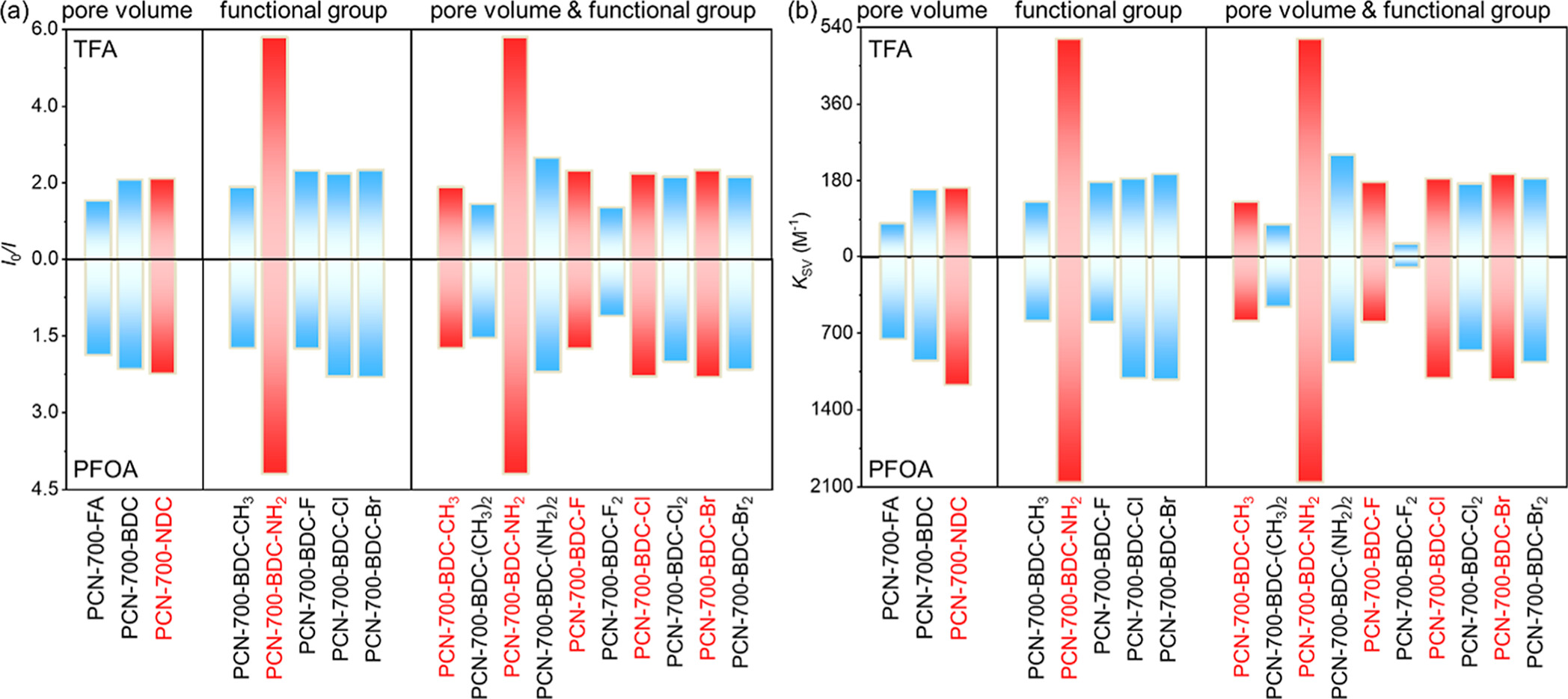
Fluorescence spectroscopy demonstrated that the amino-functionalized derivative (PCN-700-BDC-NH₂) achieved a 3-fold higher quenching efficiency compared to the unfunctionalized analogue. The Stern–Volmer quenching constant (Ksv) for PFAS detection reached 4.5×10⁴M−1, with a low limit of detection (LOD) calculated at 12 nM (~4 ppb), well below regulatory thresholds.
3. Chemical State and Stability:
XPS confirmed the successful incorporation of functional groups, evidenced by the N 1s peak at 399.5 eV for the –NH₂ groups. The MOFs maintained over 92% of their initial crystallinity and luminescence intensity after 5 consecutive adsorption-desorption cycles in aqueous media, demonstrating excellent chemical and photostability.
Mechanism Analysis
1. Pore Accessibility Dominance:
Analysis of the 13 derivatives proved that larger pore volumes facilitate faster diffusion of PFAS molecules into the framework interior. This enhanced mass transport serves as the primary driver for higher quenching efficiencies, as it maximizes the contact probability between the analytes and the luminescent centers.
2. Amino-Enhanced Host–Guest Interactions:
The –NH₂ groups in PCN-700-BDC-NH₂ form strong hydrogen bonds and electrostatic interactions with the polar head groups of PFAS. This concentrates the analytes near the fluorophores, triggering highly efficient electron/energy transfer that results in the observed 3-fold amplification in luminescence quenching.
3. Steric Trade-off Effect:
Excessive functional group loading narrows the pore channels (reducing pore size below the kinetic diameter of certain PFAS), creating a steric barrier. This impedes molecular diffusion and ultimately diminishes the overall sensing performance, highlighting the necessity of balancing binding affinity with pore accessibility.
Conclusion
1. Summary of the Work:
1.1 The authors successfully constructed a comprehensive library of 13 PCN-700 derivatives via a modular linker installation strategy, enabling the precise decoupling of pore volume, functional group identity, and functional group density.
1.2 The study establishes that pore accessibility is the dominant factor in PFAS sensing, while amino functionalization significantly boosts sensitivity (up to 3-fold) through strengthened host–guest interactions, albeit with a critical trade-off at high functionalization densities.
2. Peer Review Comments on Limitations:
While the systematic structural analysis is highly commendable, the manuscript has a few limitations. First, the sensing performance was primarily evaluated in idealized aqueous solutions; the impact of complex real-water matrices (e.g., humic acids, competing inorganic ions, and varying pH) on the sensor's selectivity and stability is not sufficiently detailed. Second, the long-term photostability and continuous flow-through regeneration capabilities of the MOF sensors require more rigorous testing for practical environmental deployment.
3. Suggestions for Future Research:
3.1 Real-World Validation: Future work should evaluate the sensors in authentic environmental samples, such as river water, groundwater, and wastewater effluents, to assess anti-interference capabilities.
3.2 Theoretical Calculations: Incorporating Density Functional Theory (DFT) or molecular dynamics (MD) simulations would provide deeper quantitative insights into the exact binding energies and diffusion kinetics of PFAS within the tailored pores.
3.3 Device Integration: To transition from fundamental research to practical application, the optimized MOF powders should be integrated into solid-state devices, such as mixed-matrix membranes, test strips, or portable microfluidic chips, enabling rapid, on-site PFAS monitoring.
Pore-Engineered Luminescent MOF Sensors for PFAS Recognition in Water
Authors:Zongsu Han,Kun-Yu Wang,Jiatong Huo,Wenyue Cui,Zhaoyi Liu,Yihao Yang,Rong-Ran Liang,Wei Shi*,Hong-Cai Zhou*
DOI:10.1021/jacs.5c20085
Links: https://pubs.acs.org/doi/10.1021/jacs.5c20085
Disclaimer The above review is for academic progress sharing. For any errors or copyright issues, please contact us for correction or removal.

