Home >
News > Practical Metal-Organic Framework Adsorbents for Thermodynamically Governed Methane-Hydrogen Separation
Practical Metal-Organic Framework Adsorbents for Thermodynamically Governed Methane-Hydrogen Separation
This study explores metal-organic frameworks (MOFs) for methane/hydrogen separation, a key process in hydrogen production and transportation. The researchers used atomic simulations to assess MOF performance under real pressure swing adsorption (PSA) conditions, selecting materials with good synthesis feasibility, stability and scalability. Grand Canonical Monte Carlo (GCMC) and molecular dynamics (MD) simulations, combined with breakthrough experiments, validated the material performance. Many screened MOFs exceed commercial Zeolite 13X in methane/hydrogen selectivity and methane working capacity. The team revealed the relationships between MOF pore structure, chemical properties and separation capability, and confirmed qualified diffusion kinetics for PSA operation. This work identifies promising MOF candidates and provides molecular-level guidance for hydrogen purification technology development.
.jpeg)
Research Background
1. Industrial and technical problems
Hydrogen is a vital clean energy, and steam methane reforming (SMR) is the main hydrogen production method, which produces methane-contaminated hydrogen. Hydrogen is also transported by mixing with natural gas in pipelines, requiring efficient methane/hydrogen separation. Traditional separation techniques consume large amounts of energy, while conventional adsorbents like zeolites have low separation selectivity. Since methane and hydrogen are nonpolar molecules, their weak interaction with adsorbents further raises separation difficulty.
2. Previous research solutions
MOFs with adjustable pores and surface chemistry have been studied for gas separation. Researchers also adopted computational screening to find potential MOFs for methane/hydrogen separation. However, most prior simulations relied on flawed material databases, used inaccurate ideal selectivity evaluation, and screened MOFs unfit for industrial production.
3. Innovations of this work
This work selected stable, low-cost and scalable MOFs based on Al, Fe and Zn. It simulated two industrial gas ratios (25:75 and 90:10 CH₄/H₂) and adopted binary mixed gas simulations closer to real conditions. The study combined simulations and experiments for mutual verification, evaluated both thermodynamics and kinetics, tested water vapor tolerance, and classified MOFs to match different industrial demands.
Experimental Content
1. MOF selection & structural optimization: 35 pristine and modified MOFs were chosen. DFT calculations via VASP optimized their structures, and Zeo++ calculated key pore parameters. Zeolite 13X was set as the control sample.
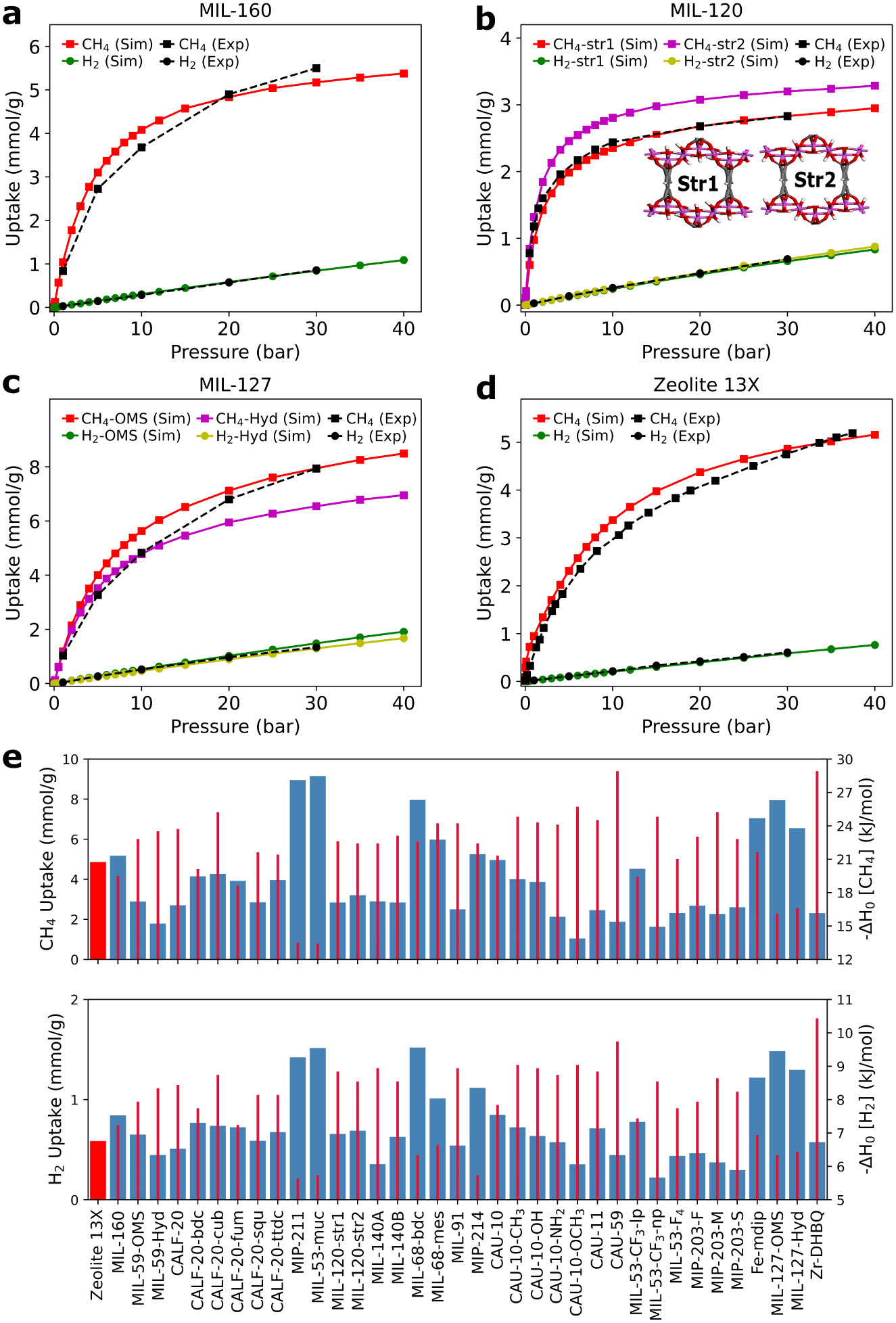
2. GCMC adsorption simulation: Simulations ran at 298 K, 1–40 bar. Researchers tested single-component, binary CH₄/H₂ mixtures and ternary gas with 5% humidity, calculating adsorption isotherms and zero-coverage adsorption enthalpies with standard force fields.
3. MD diffusion simulation: Four representative MOFs were tested for methane diffusion under 298 K NVT ensemble. Self-diffusion coefficients were calculated from molecular displacement data.
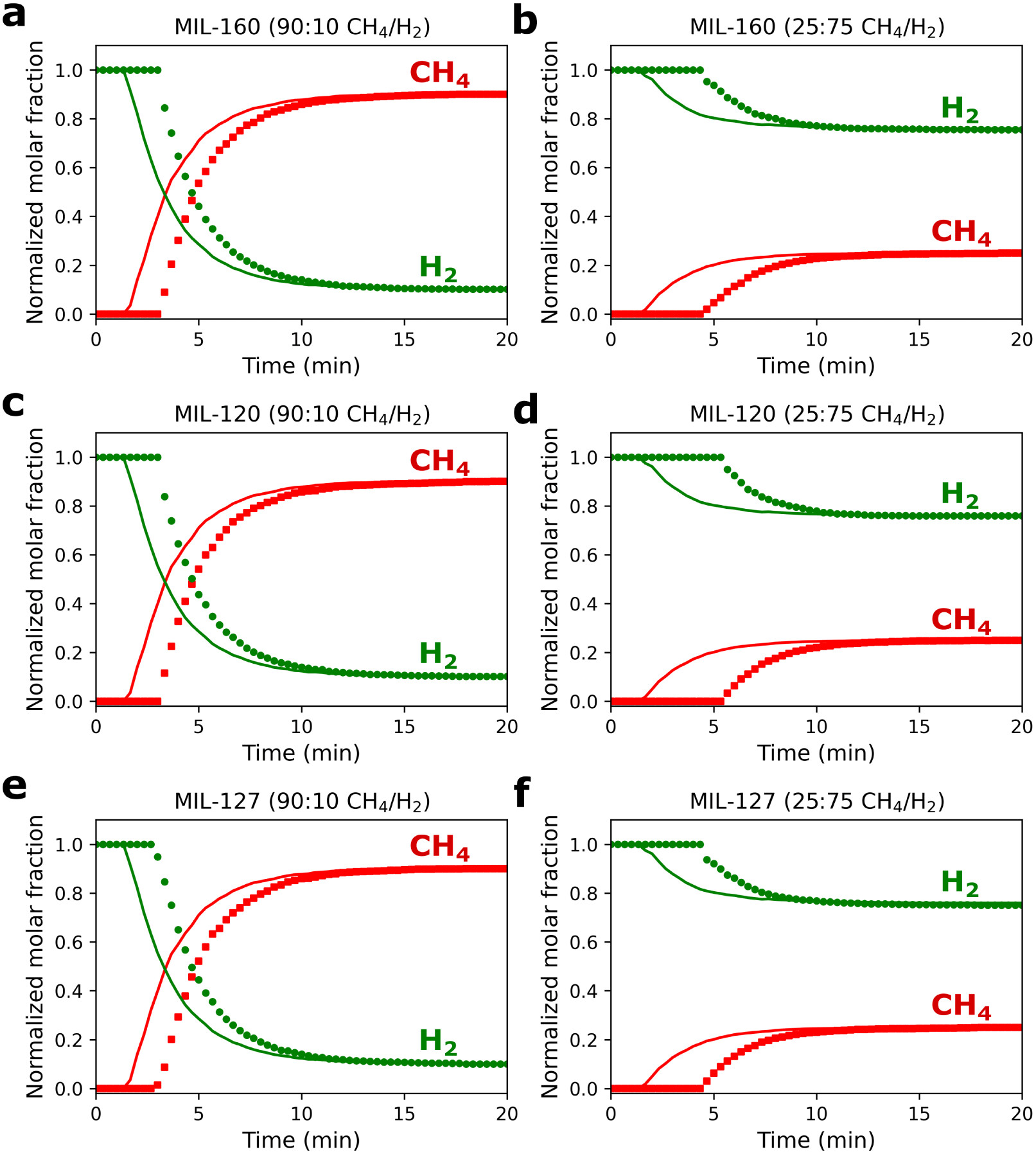
4. Fixed-bed breakthrough experiment: Three typical MOFs were synthesized and tested on a self-built platform to measure actual selectivity and working capacity, verifying simulation accuracy.
5. Core outcomes: Simulations matched experimental data well. Target MOFs outperformed Zeolite 13X. Methane diffusion coefficients ranged from 10−8 to 10−9m2/s, meeting PSA kinetic requirements. Most high-performance MOFs resisted moisture interference effectively.
Characterization and Analysis
1. Pore structure: All MOF pore sizes are larger than 3.8 Å (methane’s kinetic diameter). Pore volume and void fraction show a strong positive correlation with methane working capacity (correlation coefficient = 0.95 for 90:10 mixture).
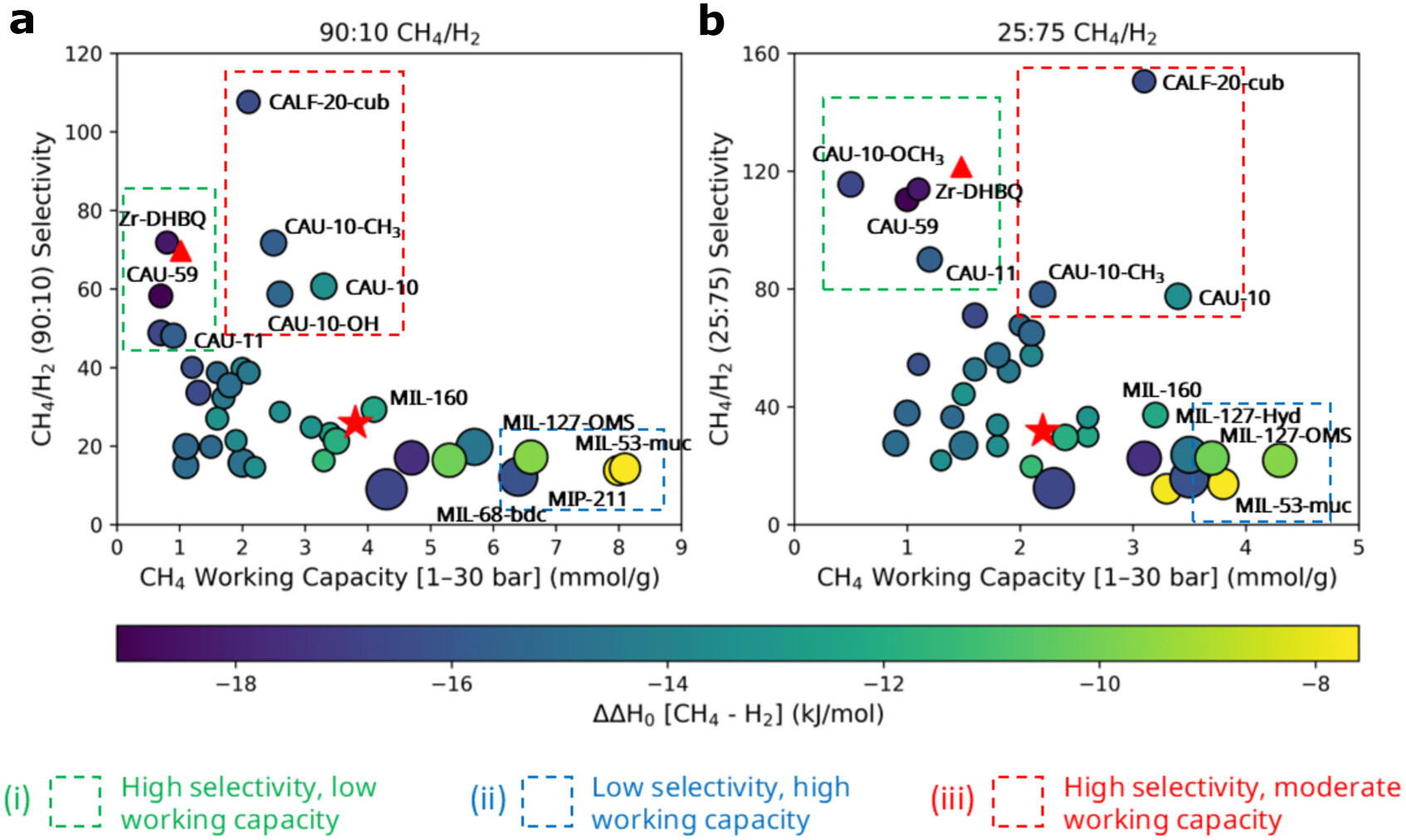
2. Adsorption thermodynamics: At 30 bar, multiple large-pore MOFs have methane uptake over 6 mmol/g, while hydrogen uptake is below 1.5 mmol/g. Methane’s zero-coverage adsorption enthalpy is −13.3 ~ −28.8 kJ/mol, much stronger than hydrogen (−5.6 ~ −10.4 kJ/mol). MIL-160(Al) has 29.0 and 35.6 selectivity for two gas ratios, with working capacity of 4.07 mmol/g and 2.93 mmol/g respectively. Actual mixed gas selectivity is far higher than ideal selectivity.
3. Diffusion kinetics: Methane diffusion slows down as gas loading increases. Large-pore MIP-211(Al) has the fastest diffusion; narrow-pore CAU-10(Al) is the slowest. CAU-11(Al) shows fast diffusion at low loading due to its special framework structure.
4. Moisture resistance: Core MOFs maintain stable adsorption performance under 5% relative humidity, showing good hydrophobicity.
Overall, pore volume determines adsorption capacity, pore size controls selectivity, and pore geometry plus host-guest interactions jointly affect molecular diffusion.
Mechanism Analysis
1. Separation mechanism: The separation follows a thermodynamic-driven physical adsorption mechanism. Methane interacts more strongly with MOF frameworks and is preferentially adsorbed. Adsorbed methane blocks pores and further restricts hydrogen adsorption. Weak van der Waals dispersion forces dominate the host-guest interaction instead of strong chemical bonding.
2. Structure-performance correlation: Smaller pores create stronger molecular confinement and higher selectivity; larger pore volume brings higher adsorption capacity, forming an inherent trade-off between selectivity and capacity. A larger enthalpy difference between methane and hydrogen corresponds to higher selectivity. Linkers with higher hydrophobicity also improve separation performance.
3. Diffusion mechanism: Methane diffusion rate is governed by pore size, host-guest interaction strength and framework flexibility. Wider pores, weaker adsorption and flexible structures accelerate molecular migration.
Summary
1. This work built a combined simulation-experiment system to evaluate 35 practical MOFs for two mainstream methane/hydrogen separation scenarios, and verified the reliability of the simulation method.
2. The studied MOFs are divided into three types: high selectivity & low capacity, low selectivity & high capacity, and balanced performance, which can adapt to different PSA process demands. Multiple MOFs exhibit better performance than commercial Zeolite 13X.
3. The research clarified the structure-performance rules of MOFs, and confirmed target materials have qualified kinetics and moisture resistance for industrial application.
Viable Metal–Organic Framework Adsorbents for Thermodynamics-Driven Methane/Hydrogen Separation
Authors: Prantar DuttaAdriano HenriqueWritakshi MandalLaura BuenoRosana V. PintoYann MagninSandra BarbouteauGeorges MouchahamChristian SerreJosé A. C. Silva*Guillaume Maurin*
DOI:10.1021/acs.chemmater.5c03403
Links: https://pubs.acs.org/doi/10.1021/acs.chemmater.5c03403
Disclaimer The above review is for academic progress sharing. For any errors or copyright issues, please contact us for correction or removal.

