Home >
News > Calf-20-Me for Separating of Kr/Xe
Calf-20-Me for Separating of Kr/Xe
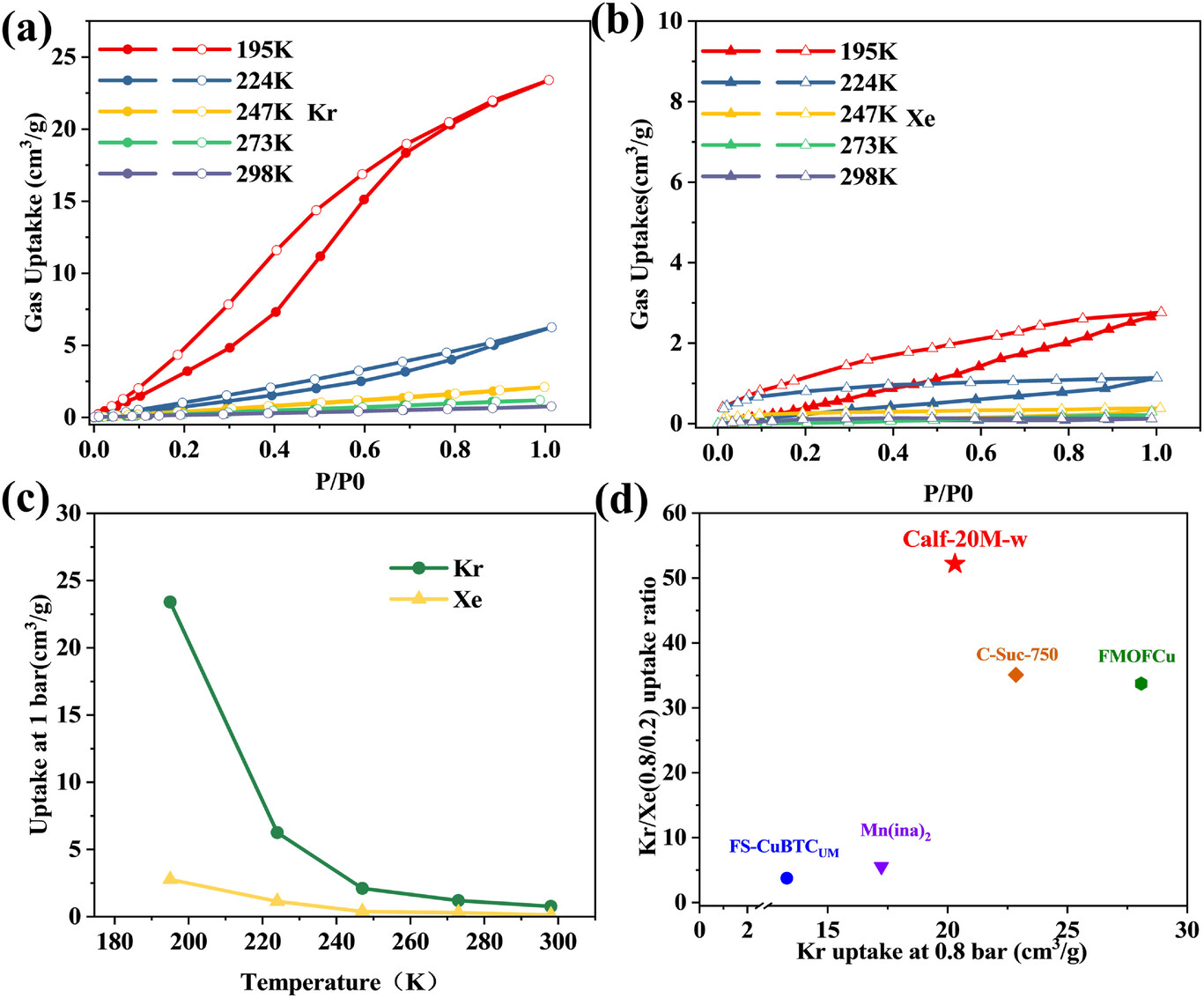
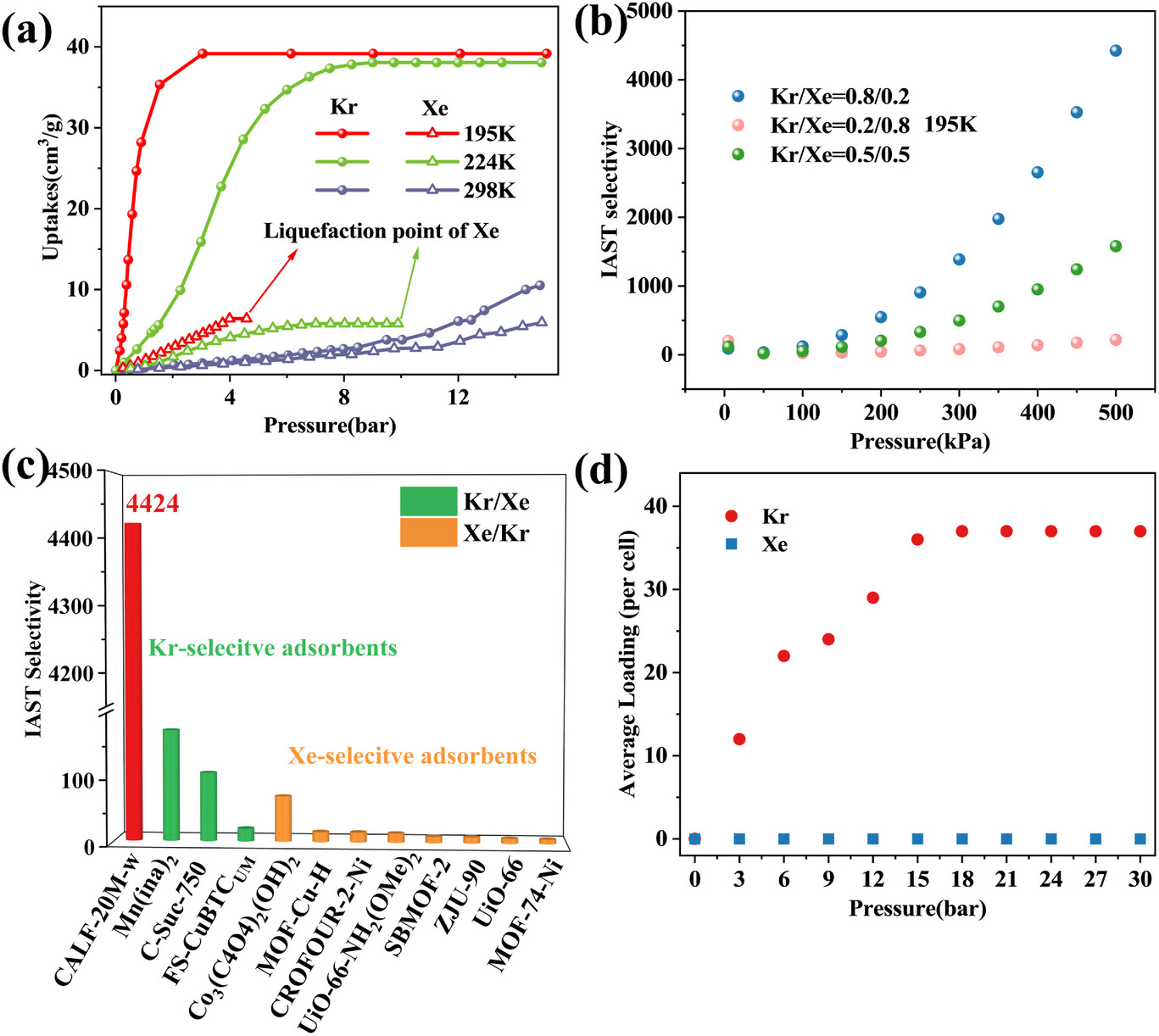
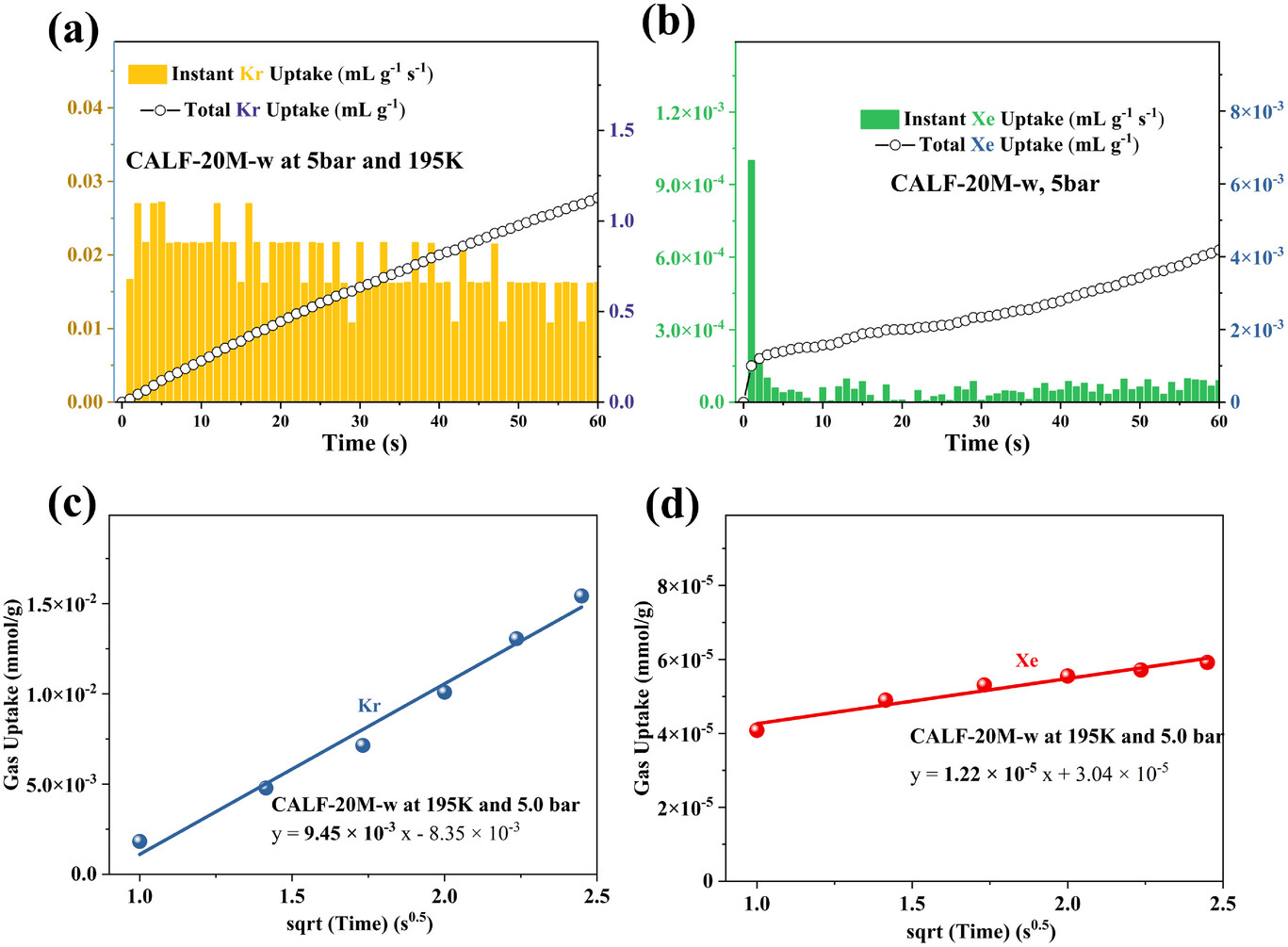
This study introduces CALF-20M-w, a highly robust and radiation-resistant metal-organic framework (MOF) specifically engineered for the molecular sieving separation of krypton (Kr) and xenon (Xe) under elevated industrial pressures. Overcoming the pervasive challenge of Xe-Kr co-adsorption in conventional porous materials, CALF-20M-w features a precisely tailored pore aperture of 3.7 Å. This dimension strategically bridges the kinetic diameters of Kr (3.6 Å) and Xe (4.1 Å), enabling a record-breaking Kr/Xe uptake ratio of 52.2 and an unprecedented adsorption selectivity of 4424 at 195 K and 5 bar. Grand Canonical Monte Carlo (GCMC) simulations elucidate that Kr atoms readily occupy favorable binding sites within the intersecting channels, whereas Xe atoms are strictly sterically excluded across a broad pressure range of 1–30 bar. Dynamic breakthrough experiments coupled with Pressure Swing Adsorption (PSA) simulations validate its capability to continuously yield >99.9% pure Xe. Furthermore, CALF-20M-w exhibits extraordinary structural integrity under extreme β-irradiation (72 kGy/h) and γ-irradiation (240 kGy), vastly outperforming benchmark MOFs like UiO-66 and ZIF-8, thereby establishing a new paradigm for nuclear waste off-gas management.
Research Background
1. Problems in the field:
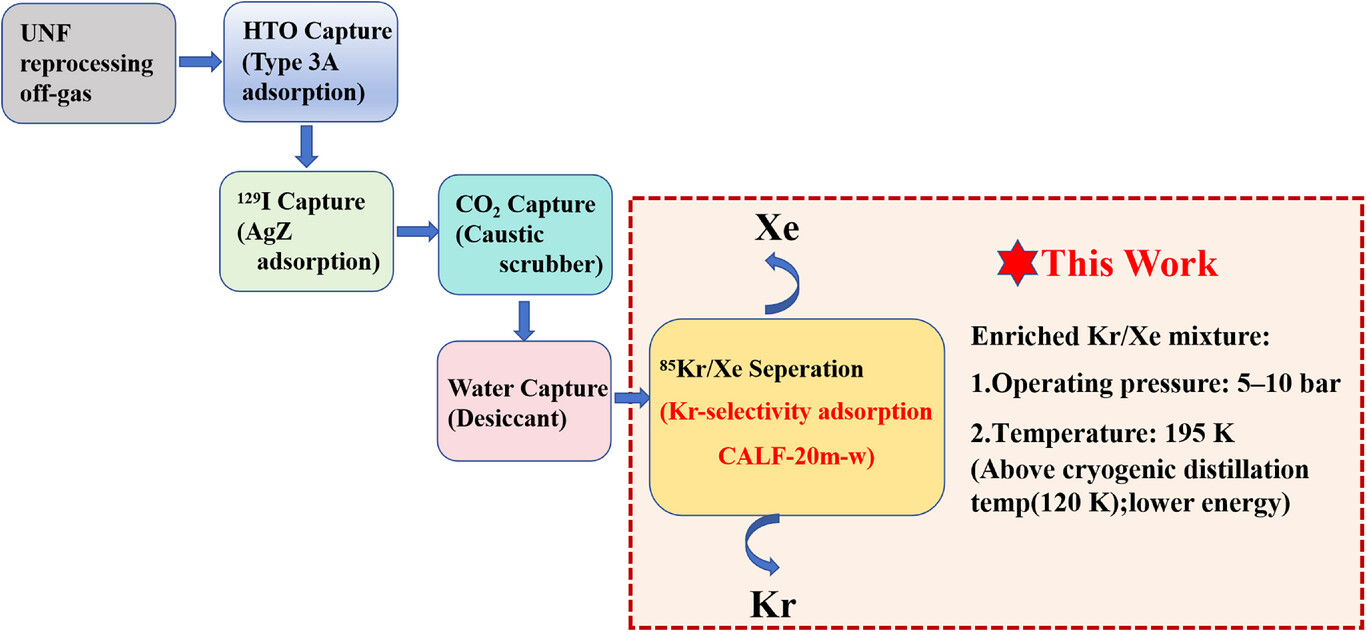
The reprocessing of spent nuclear fuel (SNF) generates significant quantities of radioactive 85Kr (half-life 10.8 years) and stable Xe isotopes. Currently, their recovery relies on cryogenic distillation at ~120 K, which is highly energy-intensive and poses severe safety risks due to ozone accumulation and potential explosions. In adsorption-based alternatives, most porous materials (zeolites, carbons, MOFs) inherently prefer Xe over Kr due to Xe's larger polarizability, leading to undesirable Xe-Kr co-adsorption at elevated pressures.
2. Existing solutions:
Physisorption technology has been proposed as a greener, energy-efficient alternative. Researchers have developed various Kr-selective adsorbents to prioritize the capture of the longer-lived 85Kr while yielding pure Xe. However, existing Kr-selective materials generally suffer from low adsorption capacity, poor selectivity at high pressures (5-10 bar), and inadequate radiation stability, rendering them unsuitable for the harsh, high-radiation environments of actual SNF off-gas treatment.
3. Innovation of this work:
The authors rationally designed CALF-20M-w with a strict 3.7 Å molecular sieving pore size. By operating at 195 K and 5-10 bar, the process significantly cuts energy consumption compared to cryogenic distillation. The material achieves record Kr/Xe selectivity via the steric exclusion of Xe and demonstrates unprecedented resistance to high-dose ionizing radiation, providing a highly viable, robust strategy for practical industrial nuclear waste management.
Experimental Section
1. Material Synthesis:
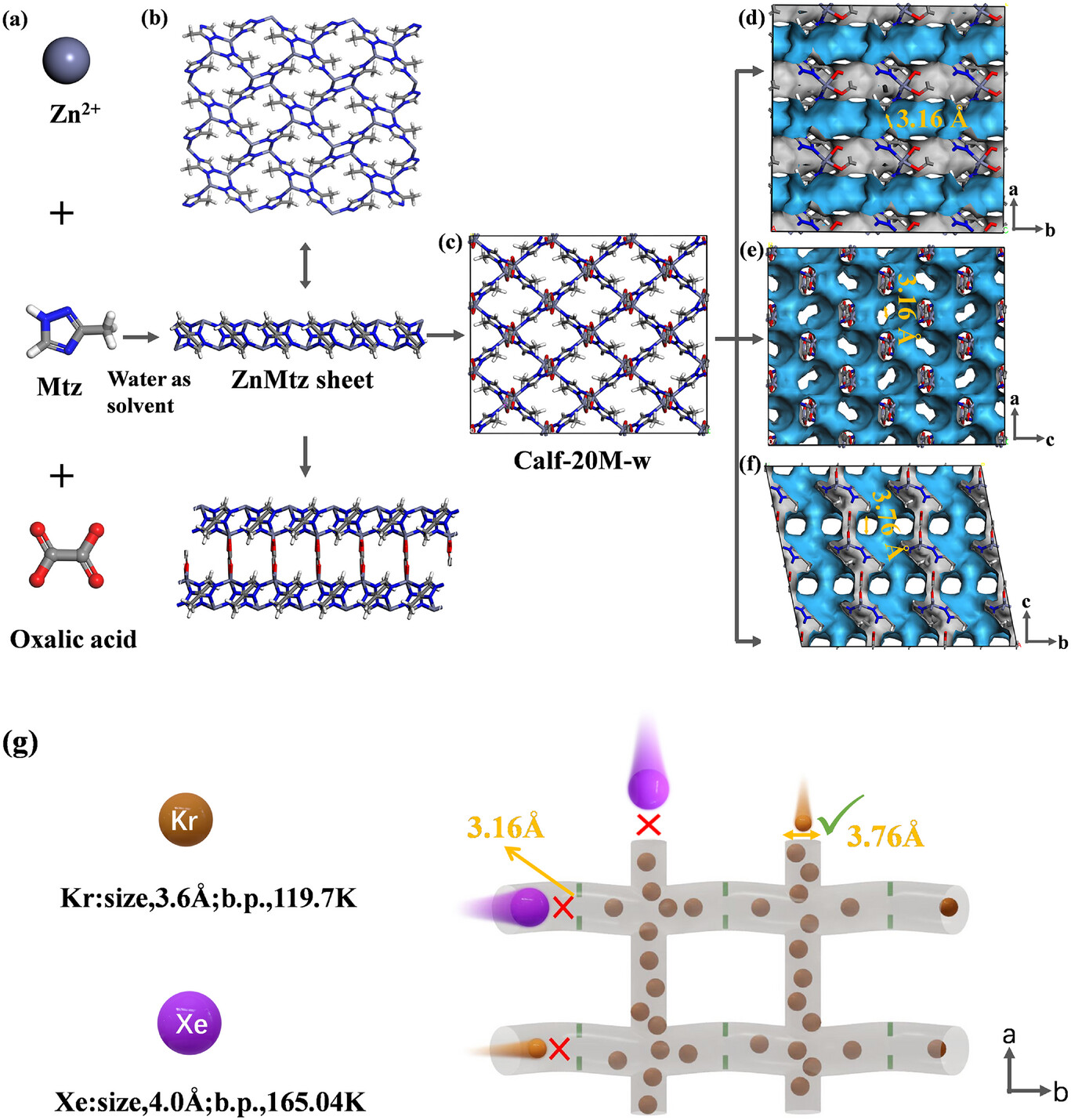
CALF-20M-w was synthesized via a scalable, environmentally benign aqueous route. The precise tuning of the metal nodes and organic linkers yielded a highly crystalline framework with a uniform pore aperture of 3.7 Å, perfectly positioned between the kinetic diameters of Kr and Xe.
2. Gas Adsorption and Selectivity:
Single-component and binary gas adsorption isotherms were measured. At 195 K and 5 bar, CALF-20M-w exhibited a Kr/Xe uptake ratio of 52.2 and an exceptional adsorption selectivity of 4424. Crucially, it maintained high Kr selectivity across a wide pressure range (1-30 bar) without any Xe co-adsorption.
3. Dynamic Breakthrough and PSA Simulation:
Dynamic breakthrough experiments using Kr/Xe mixtures were conducted under simulated industrial conditions. The results, corroborated by Pressure Swing Adsorption (PSA) simulations, demonstrated that CALF-20M-w can continuously produce >99.9% pure Xe while effectively trapping Kr, validating its industrial feasibility.
4. Radiation Resistance Tests:
The material was subjected to extreme β-irradiation (72 kGy/h) and γ-irradiation (total dose 240 kGy). Post-irradiation PXRD and gas sorption tests confirmed that CALF-20M-w retained its crystallinity and separation performance, significantly outperforming benchmark MOFs like UiO-66 and ZIF-8. These results achieve a major breakthrough in the longevity of adsorbents in radioactive environments.
Characterization and Analysis
1. Structural Characterization: Powder X-ray diffraction (PXRD) confirmed the high crystallinity and phase purity of CALF-20M-w. Rietveld refinement validated the precise pore aperture of 3.7 Å, which is the structural foundation for its molecular sieving capabilities.
2. Porosity and Surface Area: N₂ adsorption-desorption isotherms at 77 K revealed a BET surface area of 1150 m² g⁻¹ and a total pore volume of 0.52 cm³ g⁻¹. The narrow pore size distribution centered strictly at 3.7 Å confirms the uniform micro-porous structure essential for precise molecular sieving.
3. Thermal and Chemical Stability: Thermogravimetric analysis (TGA) and variable-temperature PXRD demonstrated robust thermal stability up to 300 °C. The material maintained its structural integrity in humid and acidic conditions, which is crucial for real-world off-gas streams containing trace moisture and NOx.
4. Radiation Stability Analysis: Post-irradiation PXRD patterns showed no peak shifting, broadening, or amorphization after 240 kGy γ-irradiation. The BET surface area remained above 1100 m² g⁻¹, proving that the robust coordination bonds effectively dissipate radiation energy without structural collapse, revealing an intrinsic radiation-hardening mechanism.
Mechanism Analysis
1. Molecular Sieving Effect:
Grand Canonical Monte Carlo (GCMC) simulations and Density Functional Theory (DFT) calculations revealed that Kr atoms (3.6 Å) can easily diffuse into and occupy the highly favorable binding sites within the intersecting 1D channels of CALF-20M-w. Conversely, the larger Xe atoms (4.1 Å) experience severe steric hindrance and are completely excluded from entering the 3.7 Å pores.
2. Pressure Independence:
Unlike thermodynamic-driven adsorbents that lose selectivity at high pressures, the steric exclusion mechanism of CALF-20M-w remains dominant even under elevated pressures (1-30 bar), where thermodynamic driving forces might otherwise force Xe co-adsorption in 3. larger-pore materials.
3. Radiation Resistance Mechanism:
The exceptional radiation tolerance is attributed to the strong coordination bonds and the efficient phonon-mediated energy dissipation within the dense, highly crystalline framework. This structural rigidity prevents the accumulation of radiation-induced radical defects that typically degrade the organic linkers in UiO-66 and ZIF-8.
Summary
The authors successfully developed CALF-20M-w, a water-stable, radiation-resistant MOF with a tailored 3.7 Å pore size for the precise molecular sieving of Kr/Xe. It achieves record-breaking selectivity at elevated pressures and temperatures (195 K, 5 bar), significantly outperforming existing materials and cryogenic distillation in energy efficiency and safety.
Radiation-Resistant Kr-Selective MOF With Record Kr/Xe Selectivity at Elevated Pressure
Authors:Qihang Tian, Yinhui Li, Qingkuan Meng, Shizhen Liu, Yongzheng Wang, Bin Chen, Heping Ma
DOI: 10.1002/advs.202600073
Links: https://doi.org/10.1002/advs.202600073
Disclaimer The above review is for academic progress sharing. For any errors or copyright issues, please contact us for correction or removal.

