Home >
News > Multi‑emission MOF Fluorescent Sensor Array for PFAS Detection
Multi‑emission MOF Fluorescent Sensor Array for PFAS Detection
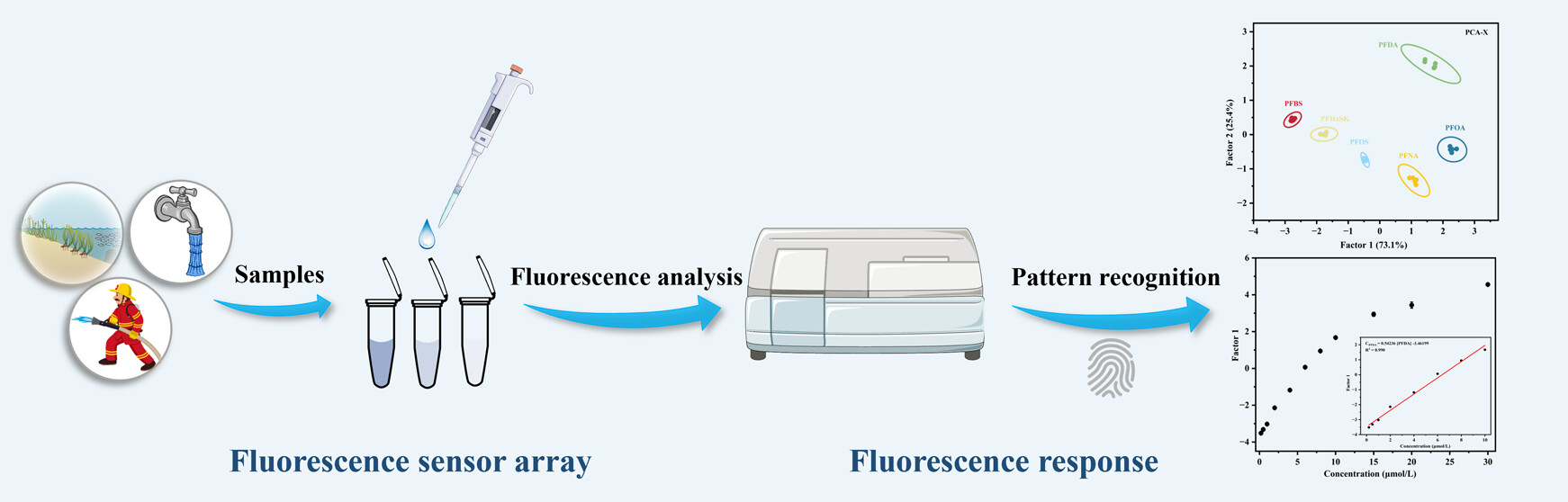
Per‑ and polyfluoroalkyl substances (PFASs) are globally concerning persistent organic pollutants that threaten environmental safety and human health due to their wide applications, strong bioaccumulation, and high stability. This work developed two zirconium‑based metal–organic frameworks (Zr‑MOFs), UiO‑67‑NH₂ and PCN‑999, as hosts to encapsulate pH‑sensitive fluorescent dyes via an in‑situ encapsulation strategy. Nile Red and fluorescein isothiocyanate (FITC) were loaded into UiO‑67‑NH₂ to prepare FR@UiO‑67‑NH₂, and a rhodamine 6G derivative (RGH) was embedded into PCN‑999 to obtain RGH@PCN‑999. The two composites exhibited excellent water stability and multi‑emission characteristics, forming a five‑channel fluorescent sensor array under single‑wavelength excitation. Based on differential fluorescence quenching responses, the array achieved highly sensitive detection and accurate discrimination of six PFASs, with a discrimination concentration as low as 0.5 μM and a detection limit down to 21.8 nM. It was successfully applied to identify and semi‑quantify PFASs in complex real matrices including tap water, lake water, and firefighting protective clothing washing liquor. Multiple characterizations verified that the sensing mechanism is dominated by static fluorescence quenching.
Research Background
1. Core problems in the field
1.1 PFASs are widely used in industrial and consumer products and show extreme persistence, bioaccumulation, toxicity, and long‑distance migration, posing severe risks to ecosystems and human health. Rapid, sensitive, and accurate detection of PFASs in aqueous environments is urgently needed.
1.2 Traditional “lock‑and‑key” fluorescent sensors struggle to distinguish structurally similar PFASs and their mixtures, suffering from poor anti‑interference and low throughput.
1.3 Existing MOF‑based fluorescent sensor arrays for PFASs usually have few emission channels, insufficient sensitivity, complex operation, and single response mechanisms, limiting their performance in complex matrices.
2. Previous solutions by other researchers
2.1 Researchers have developed PFAS sensors based on organic luminophores, carbon quantum dots, and molecularly imprinted polymers, but most can only achieve single‑component quantitative detection rather than multi‑component discrimination.
2.2 Several fluorescent sensor arrays using porphyrin‑based MOFs or single‑emission MOFs have been reported for PFAS recognition, but they suffer from low sensitivity, limited emission channels, and weak discrimination ability.
2.3 Luminescent MOFs (LMOFs) have been used in sensing biomolecules, VOCs, and antibiotics, but few designs integrate pH‑sensitive dyes to construct multi‑emission channels for high‑performance PFAS array sensing.
3. Innovation and improvements of this work
3.1 In‑situ encapsulation of pH‑sensitive dyes into two Zr‑MOFs to construct dual/ triple‑emission composites, forming a five‑channel sensor array under single excitation, greatly improving detection efficiency.
3.2 The open Zr metal sites and dye encapsulation synergistically enhance PFAS capture and fluorescence response, boosting sensitivity and anti‑interference in complex matrices.
3.3 Achieved accurate discrimination of six PFASs and their multi‑component mixtures at trace levels, with successful semi‑quantitative detection in real environmental and firefighting‑related water samples.
Experimental Section
1. Synthesis of MOFs and Dye@MOF Composites
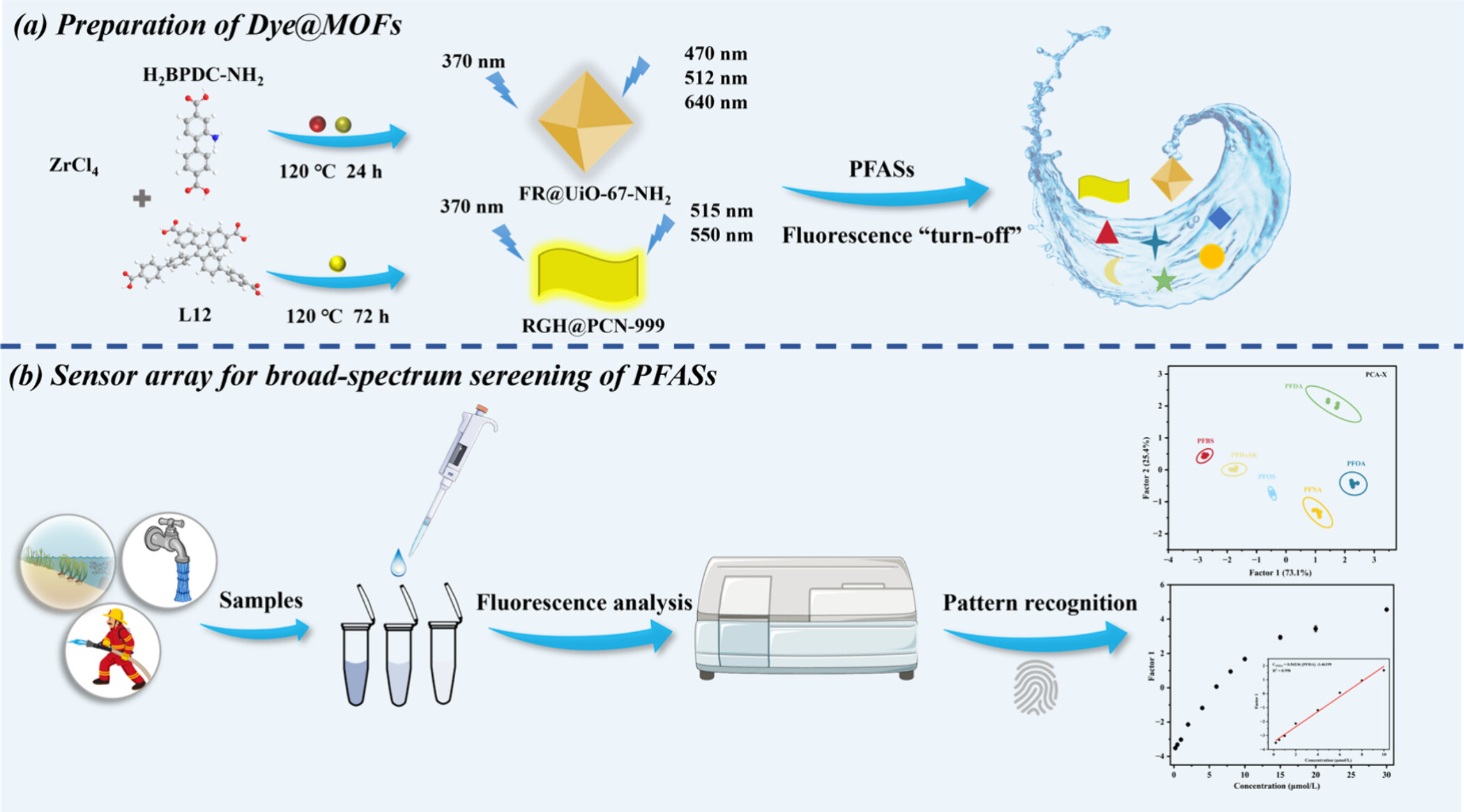
UiO‑67‑NH₂ was synthesized solvothermally from ZrCl₄, H₂BPDC‑NH₂, and benzoic acid at 120 °C for 24 h. FR@UiO‑67‑NH₂ was prepared by adding FITC (10.0 mg) and Nile Red (5.0 mg) in the same procedure.
PCN‑999 was synthesized from ZrCl₄, ligand L12, and formic acid at 120 °C for 72 h. RGH@PCN‑999 was obtained by adding 15.0 mg RGH during synthesis.
Result: Two uniform Dye@MOF composites with intact crystal structure and no dye leaching were successfully prepared.
2. Fluorescence Sensing Procedure for PFASs
FR@UiO‑67‑NH₂ (80 ppm) and RGH@PCN‑999 (30 ppm) aqueous dispersions were prepared.
PFAS solutions were added, incubated for 10–30 min, and fluorescence intensities at 470, 512, 640, 515, and 550 nm were recorded.
Data were processed by PCA, HCA, and heatmap analysis for pattern recognition.
Result: Distinct differential fluorescence responses were observed for six PFASs, forming unique “fingerprint” signals.
3. Optimization of Sensing Conditions
Optimized parameters: dye dosage, incubation time, probe concentration, and pH.
Optimum conditions: FR@UiO‑67‑NH₂ (FITC/Nile Red = 2:1, 80 ppm, pH 3, 10 min); RGH@PCN‑999 (15 mg RGH, 20 ppm, pH 3, 30 min).
Result: Fluorescence quenching efficiency was maximized, ensuring high sensitivity and reliability.
4. Discrimination and Quantitative Detection of PFASs
Tested six PFASs: PFBS, PFHxSK, PFOA, PFOS, PFNA, PFDA.
Linear range: 0.2–10 μM; LOD as low as 21.8 nM; discrimination down to 0.5 μM.
Successfully distinguished binary and multi‑component PFAS mixtures with different molar ratios with 100% classification accuracy.
Breakthrough: Greatly improved sensitivity and multi‑component discrimination ability compared with previous MOF arrays.
5. Real Sample Analysis
Tested matrices: tap water, lake water, firefighting protective clothing washing liquor.
Samples were centrifuged, BaCl₂‑treated, and filtered before detection.
Result: Six PFASs were accurately identified without interference; semi‑quantification was achieved with recoveries of 85%–108%.
Characterization and Analysis
1. Morphology and Structure Characterization
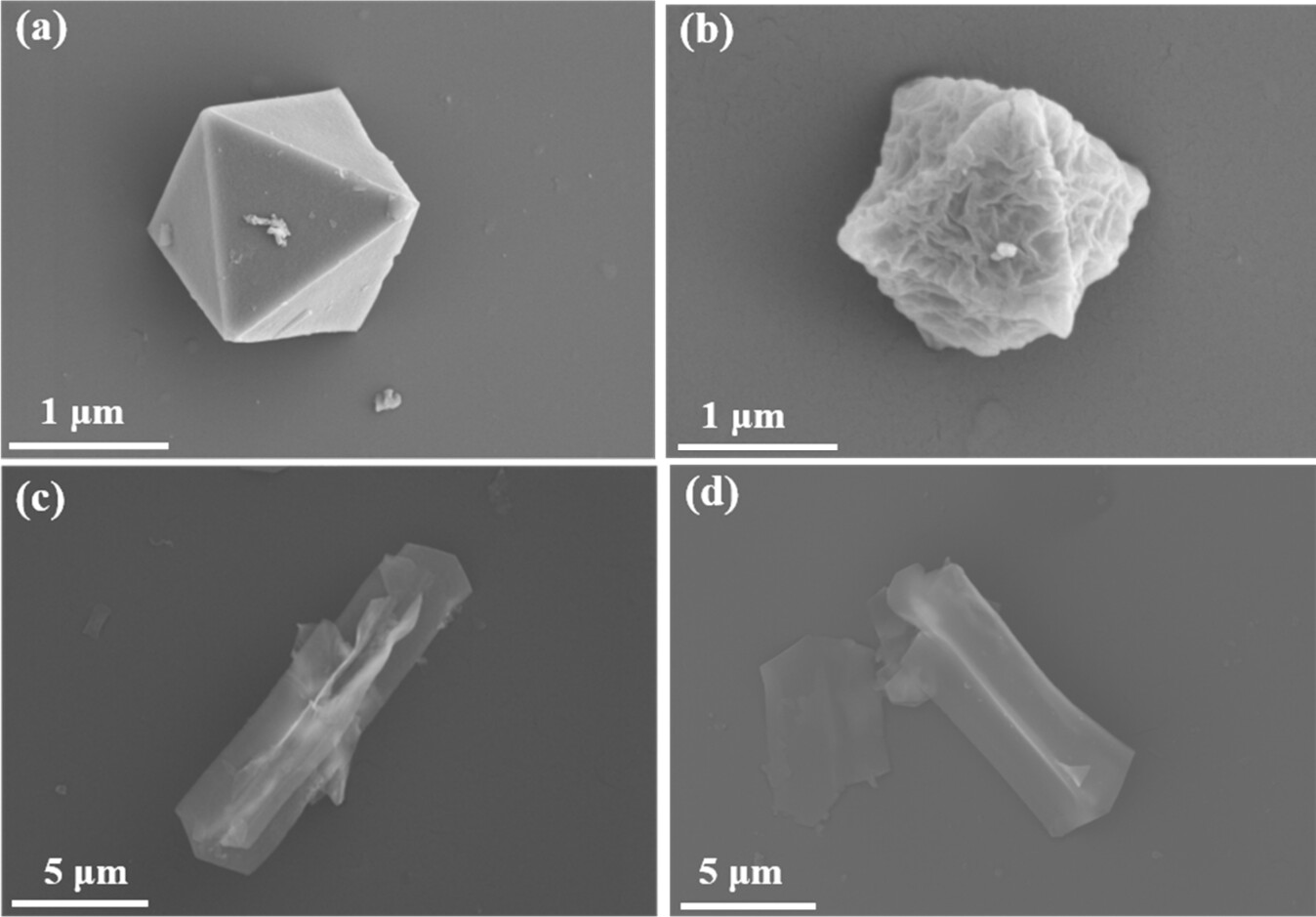
SEM: UiO‑67‑NH₂ shows octahedral morphology (~1 μm); PCN‑999 is rod‑like (~10 μm). Dye loading does not destroy morphology.
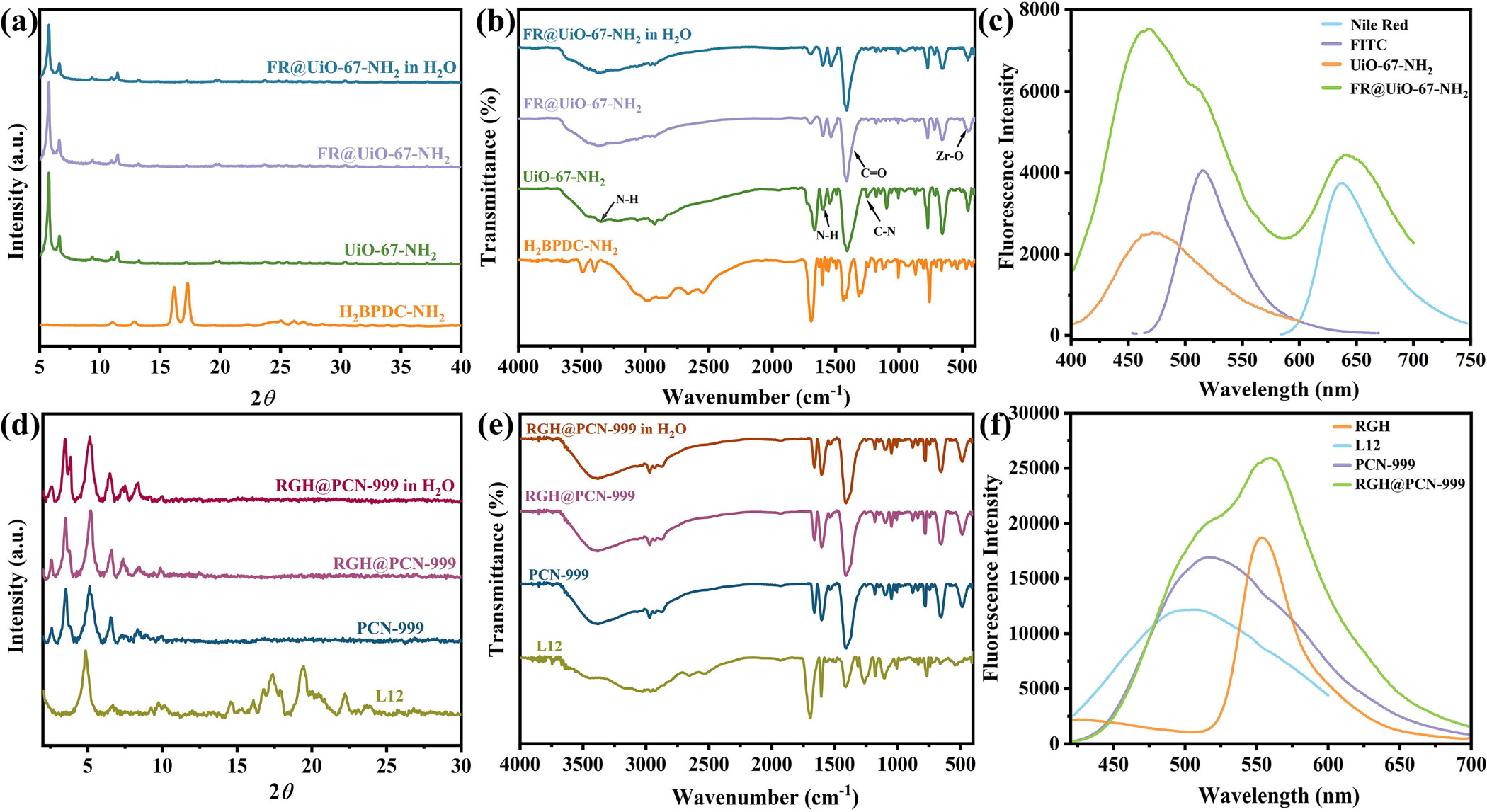
PXRD: Dye@MOFs maintain consistent diffraction patterns with parent MOFs, confirming crystal integrity.
EDS mapping: Zr, C, O, N, S are uniformly distributed, proving homogeneous dye encapsulation.
2. Surface and Pore Structure Parameters
BET surface area: UiO‑67‑NH₂ 398.1 m² g⁻¹ → FR@UiO‑67‑NH₂ 262.2 m² g⁻¹; PCN‑999 131.6 m² g⁻¹ → RGH@PCN‑999 93.89 m² g⁻¹.
Pore size: UiO‑67‑NH₂ 4.06 nm → 2.10 nm; PCN‑999 4.84 nm → 3.19 nm.
Conclusion: Dyes occupy MOF cavities, confirming successful encapsulation at the molecular level.
3. Spectral and Electrochemical Properties
FT‑IR: No new strong peaks but subtle shifts, indicating strong host–guest interaction rather than physical adsorption.
Fluorescence spectra: FR@UiO‑67‑NH₂ shows triple emission; RGH@PCN‑999 shows dual emission, forming five total channels.
Zeta potential: UiO‑67‑NH₂ 23 mV → FR@UiO‑67‑NH₂ 1.07 mV; PCN‑999 −15 mV → RGH@PCN‑999 8.85 mV, confirming charge modulation by dyes.
4. Stability and Selectivity Tests
Water/pH/storage stability: Structure and fluorescence remain stable for 15 days; no dye leakage.
Selectivity: High concentrations of metal ions, surfactants, and other PFASs do not interfere with PFAS identification.
Conclusion: The array has excellent stability and anti‑interference for practical applications.
Mechanism Analysis
1. Exclusion of invalid mechanisms
PXRD and SEM confirm MOF framework remains intact after PFAS addition, ruling out framework collapse‑induced quenching.
PFASs show no UV–vis absorption in the emission range, excluding FRET and inner filter effect (IFE).
2. Static fluorescence quenching mechanism
Stern–Volmer constants (Ksv) are 3.24×10⁴–4.21×10⁵ M⁻¹, indicating strong interaction.
Fluorescence lifetime shows negligible changes before/after PFOA addition, confirming static quenching.
3. Interaction between PFASs and Dye@MOFs
Electrostatic interaction: Negatively charged PFASs adsorb on positively charged Dye@MOFs, shifting zeta potential to negative values.
Lewis acid–base coordination: Carboxylic/sulfonic groups of PFASs coordinate with unsaturated Zr sites, verified by FT‑IR and XPS peak shifts.
Hydrophobic effect: Quenching efficiency increases with PFAS chain length (PFDA > PFNA > PFOS > PFOA > PFHxSK > PFBS), due to stronger hydrophobic interaction.
4. Multi‑channel response principle
pH‑sensitive dyes expand emission channels and enable proton exchange with weakly ionized PFASs, promoting selective capture into MOF nanocages and enhancing response differences.
Summary
1. Main achievements
Two multi‑emission Dye@MOF composites (FR@UiO‑67‑NH₂ and RGH@PCN‑999) were successfully synthesized via in‑situ encapsulation.
A five‑channel fluorescent sensor array was constructed for highly sensitive and selective detection of six PFASs, with LOD down to 21.8 nM.
The array accurately discriminates individual PFASs and their multi‑component mixtures, and works well in tap water, lake water, and firefighting washing liquor.
The sensing mechanism is confirmed as static fluorescence quenching driven by electrostatic attraction, coordination, and hydrophobic interaction.
2. Limitations and unsolved problems
Only six common PFASs were investigated; the response to more PFAS categories and precursors remains unclear.
Semi‑quantification in real samples is achieved, but full quantitative analysis for multi‑component mixtures needs further improvement.
The sensor array is solution‑based; portable solid‑state devices for on‑site detection are not developed.
3. Future research suggestions
Extend the application to more PFASs and transformation products.
Combine with machine learning to improve accuracy for complex multi‑component quantification.
Integrate the array into hydrogels, test strips, or smartphone‑based portable platforms for field detection.
Ultrathin A Multiemission MOF-Based Fluorescent Sensor Array Functionalized with pH-Sensitive Dyes for Highly Sensitive Detection and Identification of PFASs
Authors: Jiayi FanXinwen JiaMengyun LuQuanming YinFenghua Dai*Ajuan Yu*
DOI: 10.1021/acs.analchem.5c06375
Links: https://pubs.acs.org/doi/10.1021/acs.analchem.5c06375
The above review is for academic progress sharing. For any errors or copyright issues, please contact us for correction or removal.

