Home >
News > Zn₈(CH₃COO)₈-siloxane cluster-based metal-organic frameworks for inverse propylene/propane separation
Zn₈(CH₃COO)₈-siloxane cluster-based metal-organic frameworks for inverse propylene/propane separation
Summary:
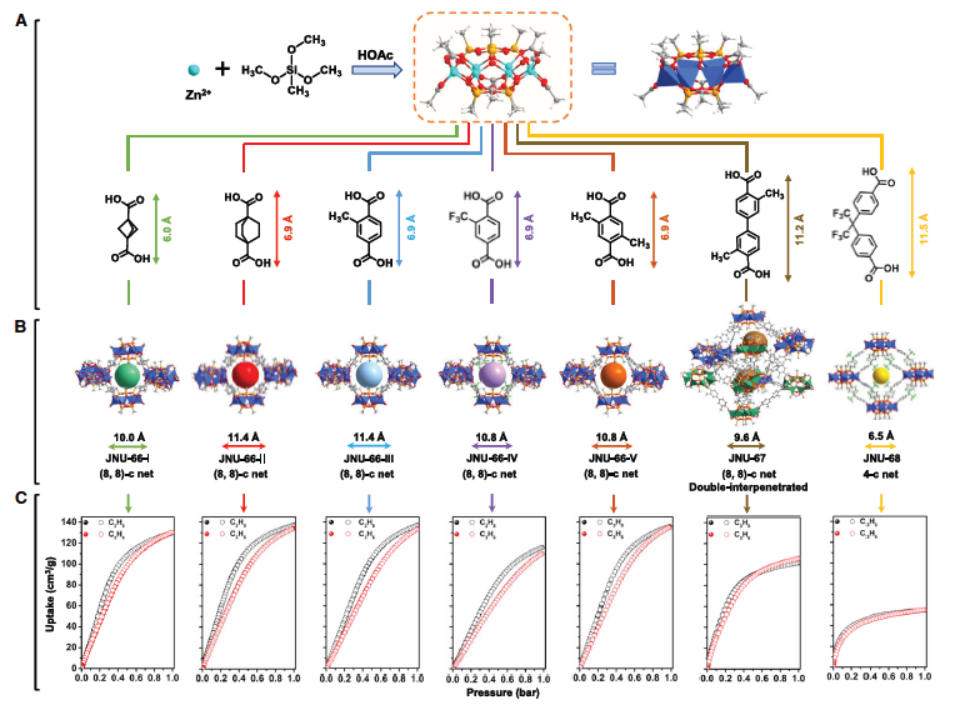
The authors from Jinan University, Shantou University Medical College : developed Zn₈(CH₃COO)₈-siloxane cluster-based MOFs (JNU-66 series) with high C₃H₈ selectivity, achieving efficient propylene/propane separation and polymer-grade C₃H₆ collection.
Background:
1. To address the high energy consumption of propylene/propane separation via cryogenic distillation, previous researchers developed MOF adsorbents, yet lacked systematic design strategies for C₃H₈-selective MOFs.
2. The authors proposed a computation-guided cluster-based strategy, identifying Zn-siloxane clusters to construct MOFs with outstanding separation performance.
Research Content:
1. Synthesis
The authors synthesized JNU-66 series MOFs via solvothermal method, using Zn-siloxane clusters and dicarboxylate linkers at 115°C for 48 hours.
2. Characterizations
1) BET surface area of JNU-66-II is 1708 m²/g, pore volume 0.70 cm³/g, pore size centered at 11.4 nm;
2) SEM/TEM tests show the material forms crystalline clusters with accessible active sites;
3) In situ FTIR/Raman confirm C-H⋅⋅⋅O interactions between gas molecules and clusters.
3. Application
The material achieved C₃H₈ adsorption capacity of 137 cm³/g, separation potential (Δq) of 28.8 cm³/g, and 0.54 kg-scale collection of ≥99.5% purity C₃H₆.
4. Mechanism
Triangularly arranged oxygen atoms on Zn₈Si₈O₁₆ clusters enable selective C₃H₈ adsorption; large pores accelerate mass transfer, ensuring fast kinetics and stability.

Outlook:
This research establishes a rational design strategy for C₃H₈-selective MOFs, bridging lab research and industrial application, and provides an energy-efficient solution for petrochemical separation.
Zn₈(CH₃COO)₈-siloxane cluster-based metal-organic frameworks for inverse propylene/propane separation
Authors: Xiao-Jing Xie, Qi-Yun Cao, Min-Yi Zhou, Yong-Liang Huang, Heng Zeng, Weigang Lu, Dan Li
DOI: 10.1016/j.chempr.2025.102862
Link: https://www.sciencedirect.com/science/article/pii/S245192942500453X
The above review is for academic progress sharing. For any errors or copyright issues, please contact us for correction or removal.

