Home >
News > Synergistic MOF-based Composite Enabling Significant Solar-to-Water Generation Enhancement in Climate-Resilient AWH
Synergistic MOF-based Composite Enabling Significant Solar-to-Water Generation Enhancement in Climate-Resilient AWH
Summary:
The authors from Shanghai Jiao Tong University and Sun Yat-Sen University developed a synergistic MOF-based composite sorbent (LiCl@Ni₂Cl₂(BTDD)) with high water uptake capacity and low desorption temperature characteristics, achieving significant solar-to-water generation enhancement (up to 91% improvement) in climate-resilient atmospheric water harvesting (AWH) applications across diverse climatic regions.
Background:
1. To address global freshwater scarcity affecting over four billion people, previous researchers developed various atmospheric water harvesting systems using MOFs, hydrogels, and hygroscopic salts. While MOFs offer fast kinetics and large surface areas, their capacity is limited by pore volume. Hygroscopic salts like LiCl provide high capacity but suffer from leakage and poor cycling stability. Composites such as LiCl@MIL-101 and LiCl@UiO-66 have been explored, yet their water uptakes remained limited (≤0.77 g g⁻¹ at 30% RH) due to lack of strong binding sites for both Li⁺ and Cl⁻ ions.
2. The authors in this work proposed an innovative composite strategy by impregnating LiCl into Ni₂Cl₂(BTDD) MOF, leveraging the MOF's completely exposed Ni²⁺ and Cl⁻ sites as binding sites for Cl⁻ and Li⁺ respectively, achieving ultra-high water uptake and low-temperature desorption performance.
Research Content:
1. Synthesis: The authors synthesized LiCl@Ni₂Cl₂(BTDD)_x (x = 10/20/30/40) using a scalable room-temperature impregnation method, immersing Ni₂Cl₂(BTDD) MOF in LiCl solutions (10-40 wt%) for 24 hours with magnetic stirring, followed by centrifugation and drying at 80°C.
2. Characterizations:
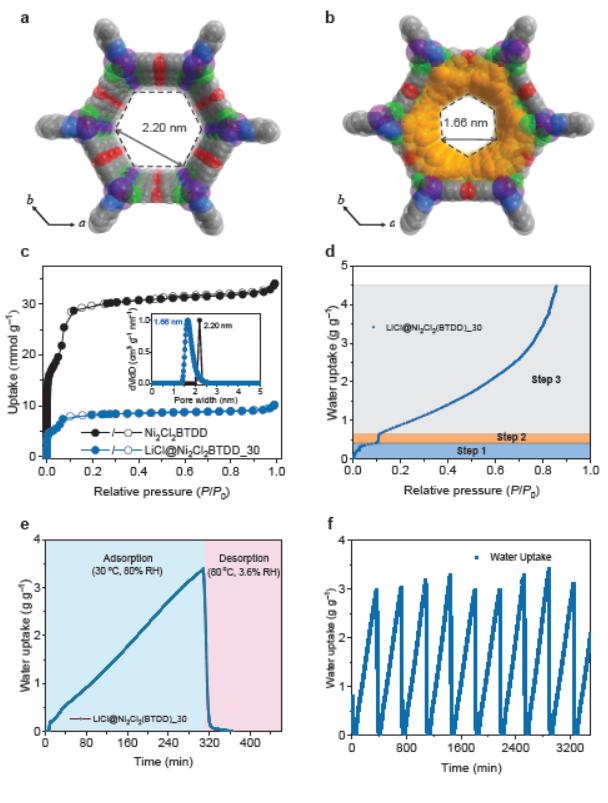
1) BET analysis showed Ni₂Cl₂(BTDD) has a pore volume of 1.18 cm³ g⁻¹ and surface area of 1839 m² g⁻¹, while LiCl@Ni₂Cl₂(BTDD)_30 exhibited reduced pore volume (0.35 cm³ g⁻¹) and surface area (504 m² g⁻¹). Pore size distribution shifted from 2.20 nm to ~1.66 nm, indicating LiCl monolayer formation on pore surfaces.
2) SEM images confirmed successful LiCl loading without surface aggregation; TOF-SIMS mapping verified uniform Li distribution within MOF pores.
3) PXRD confirmed structural integrity after LiCl loading and cycling; ICP-OES determined LiCl to MOF molar ratio of ~14:1.
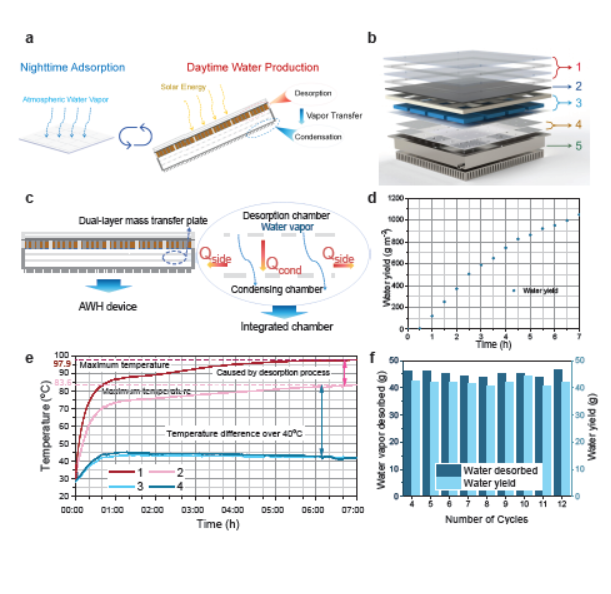
3. Application: The material achieved water uptake of 3.46 g g⁻¹ at 30°C/80% RH and 1.72 g g⁻¹ at 30°C/50% RH. In device testing, it produced >1 L m⁻² water yield under 1-sun conditions, with 91% efficiency improvement in Jinan field tests compared to pure MOF devices.
4. Mechanism: The three-step adsorption mechanism involves: (1) chemisorption of water on active LiCl sites at low humidity (P/P₀ < 0.11), (2) deliquescence of LiCl·H₂O at P/P₀ = 0.11, and (3) solution absorption at higher humidity. The confined LiCl solution exhibits low enthalpy of vaporization, enabling 94.7% desorption at 60°C. The Ni₂Cl₂(BTDD) structure provides binding sites for Li⁺ (at Cl⁻ sites) and Cl⁻ (at Ni²⁺ sites), preventing salt migration and ensuring cycling stability over 10 cycles.
Outlook:
This research presents a generalizable strategy for enhancing solar-driven AWH performance through synergistic material engineering. The developed composite achieves exceptional wide-range environmental stability, enabling efficient water production under varying climatic conditions with low-grade thermal energy. The work advances the practical deployment of AWH systems in decentralized water supply applications.
Synergistic MOF-based Composite Enabling Significant Solar-to-Water Generation Enhancement in Climate-Resilient AWH
Authors: Zhao Shao, Xi Feng, Primož Poredoš, Boxiong Jiang, Wen-Yu Su, Haotian Lv, Zhi-Shuo Wang, Hongbin Wang, Shuai Du, Dong-Dong Zhou, Jie-Peng Zhang, Ruzhu Wang
DOI: 10.1038/s41467-026-68946-8
Link: https://doi.org/10.1038/s41467-026-68946-8
The above review is for academic progress sharing. For any errors or copyright issues, please contact us for correction or removal.

