Home >
News > Rational design of a robust aluminum metal-organic framework for multipurpose water-sorption-driven heat allocations
Rational design of a robust aluminum metal-organic framework for multipurpose water-sorption-driven heat allocations
Summary:
The authors from Korea Research Institute of Chemical Technology, Université Montpellier, and other organizations developed a porous aluminum carboxylate metal-organic framework (KMF-1) with high water sorption capacity, low regeneration temperature, and excellent stability, achieving remarkable results in adsorption-driven cooling, heating, and thermal energy storage applications.
Background:
1. To address the growing global energy demand for heating and cooling, and the defects of conventional water adsorbents (e.g., inappropriate hydrophilicity, high regeneration temperature) and existing MOFs (e.g., insufficient working capacity, poor environmental friendliness), previous researchers explored adsorbent-based heat transfer technologies, but there was a lack of multipurpose materials with comprehensive excellent performance.
2. The authors proposed a rational design strategy combining computational prediction and experiment, synthesized KMF-1 using 2,5-pyrroledicarboxylic acid as a linker, and achieved breakthroughs in working capacity, energy efficiency, and stability.
Research Content:
1.Synthesis: The authors adopted a hydrothermal method; aluminum sulfate, 2,5-pyrroledicarboxylic acid (PyDC), and sodium hydroxide were used as reactants in a molar ratio of 1:1:2.5, refluxed at 120 °C for 12 h, and purified to obtain KMF-1 with a yield of 93%.
2.Characterizations:
1) BET surface area was 1130 m²/g, and total pore volume was 0.472 cm³/g.
2) SEM tests showed the particle size of KMF-1 ranged between 0.4 and 1 μm.
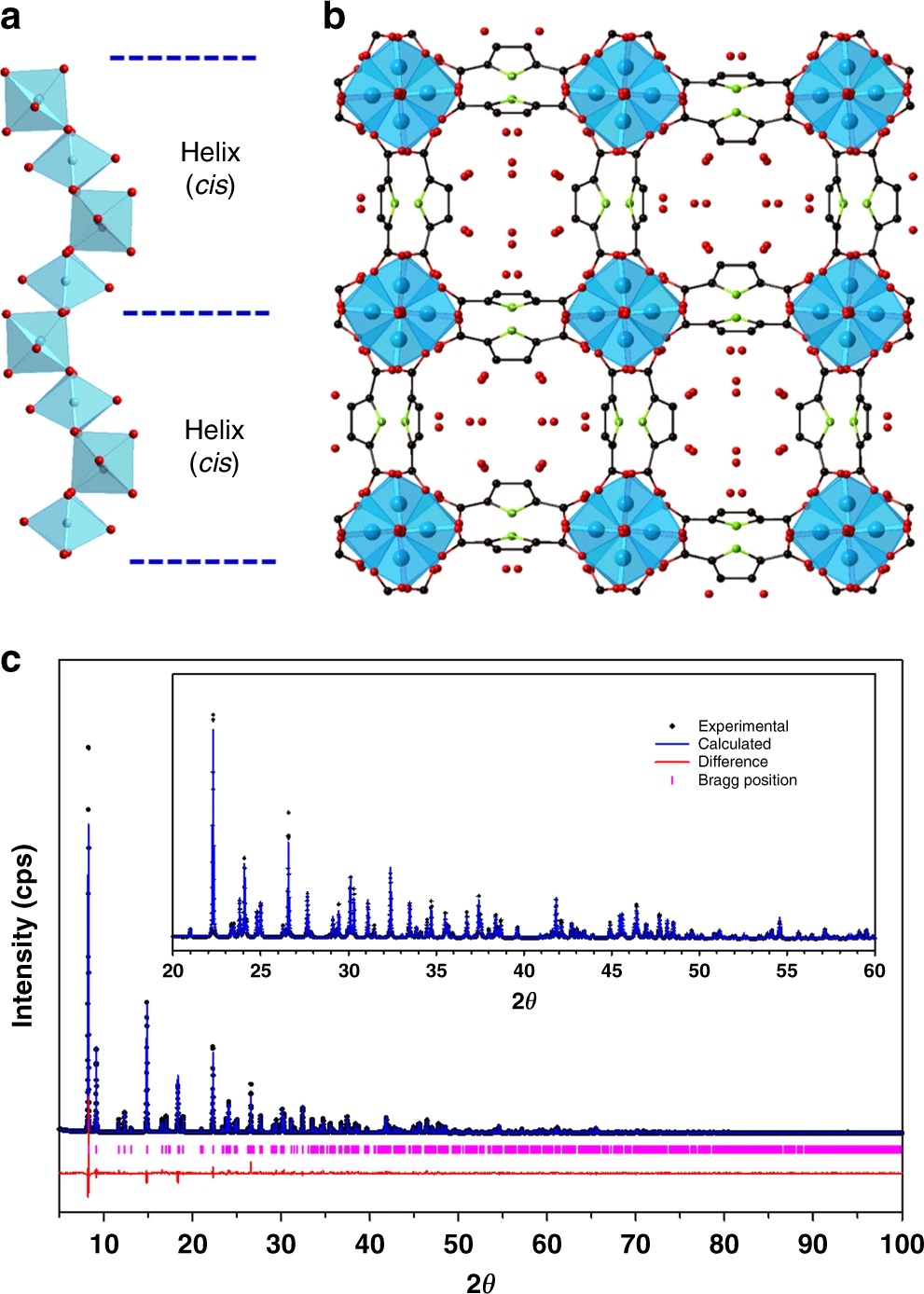
3) XRD confirmed its tetragonal crystal structure; TGA demonstrated thermal stability up to 300 °C; water sorption tests showed a steep S-shaped isotherm.
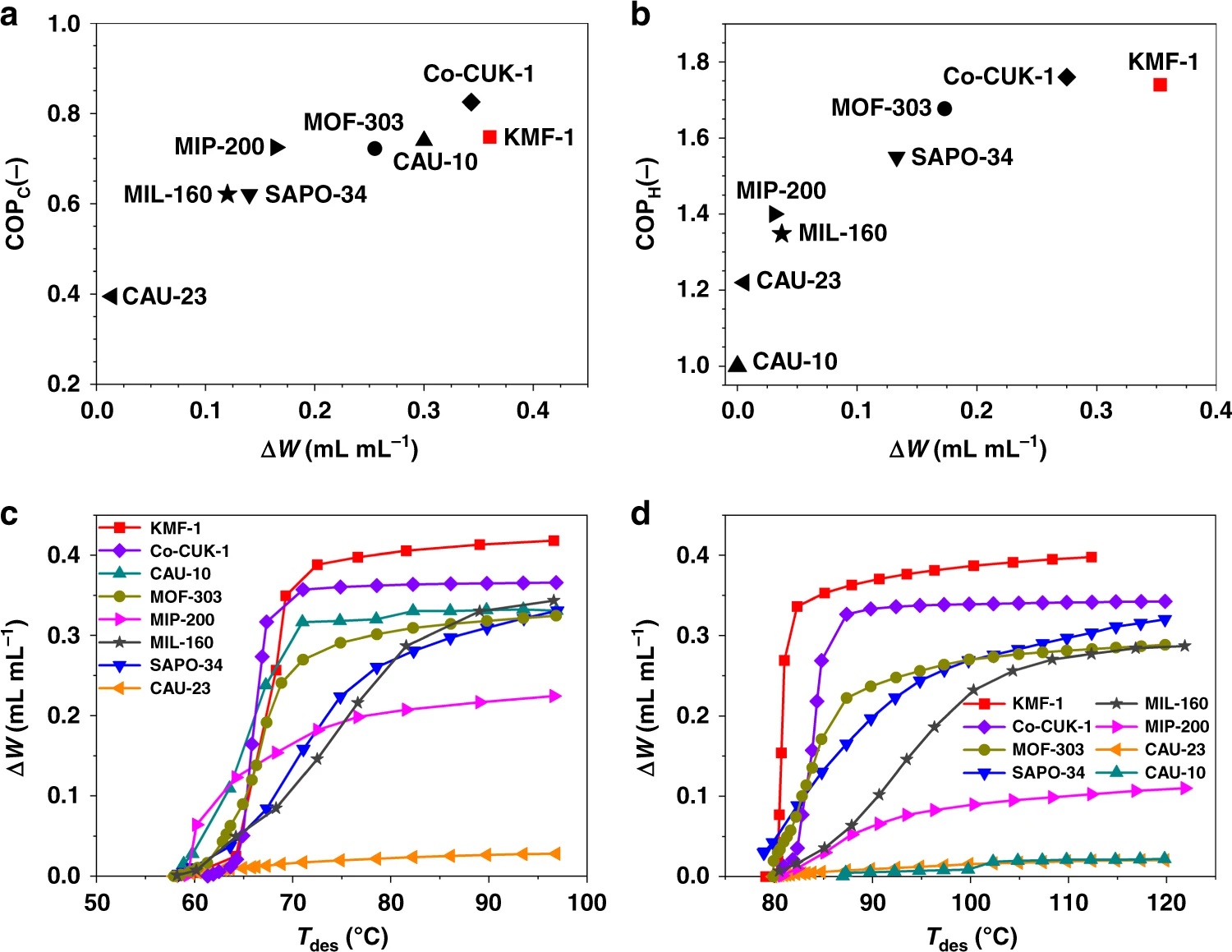
3.Application: In cooling applications, the volumetric working capacity was 0.36 mL/mL, COPₙ was 0.75, and SCPₘₐₓ reached 3.74 kW/kg; in heating applications, COPₕ was 1.74, SHPₘₐₓ was 5.34 kW/kg; the volumetric heat storage capacity was 348 kWh/m³.
4.Mechanism: The polar -NH groups in PyDC and μ-OH sites in the framework form hydrogen bonds with water molecules (average 2.7 per water molecule), and the 1D channel structure promotes efficient water adsorption/desorption, leading to excellent thermal performance.
Outlook:
This research develops a green-synthesized, scalable KMF-1 with comprehensive superior performance, breaking through the bottlenecks of existing adsorbents, and providing a key material for efficient utilization of solar/waste heat in cooling, heating, and energy storage fields.
Rational design of a robust aluminum metal-organic framework for multipurpose water-sorption-driven heat allocations
Authors: Kyung Ho Cho, D. Damasceno Borges, U-Hwang Lee, Ji Sun Lee, Ji Woong Yoon, Sung June Cho, Jaedeuk Park, Walter Lombardo, Dohyun Moon, Alessio Sapienza, Guillaume Maurin, Jong-San Chang
DOI: 10.1038/s41467-020-18968-7
Link: https://www.nature.com/naturecommunications/articles/s41467-020-18968-7
The above review is for academic progress sharing. For any errors or copyright issues, please contact us for correction or removal.

