Home >
News > Hydrophobic Metal−Organic Frameworks Enable Superior High-Pressure Ammonia Storage through Geometric Design
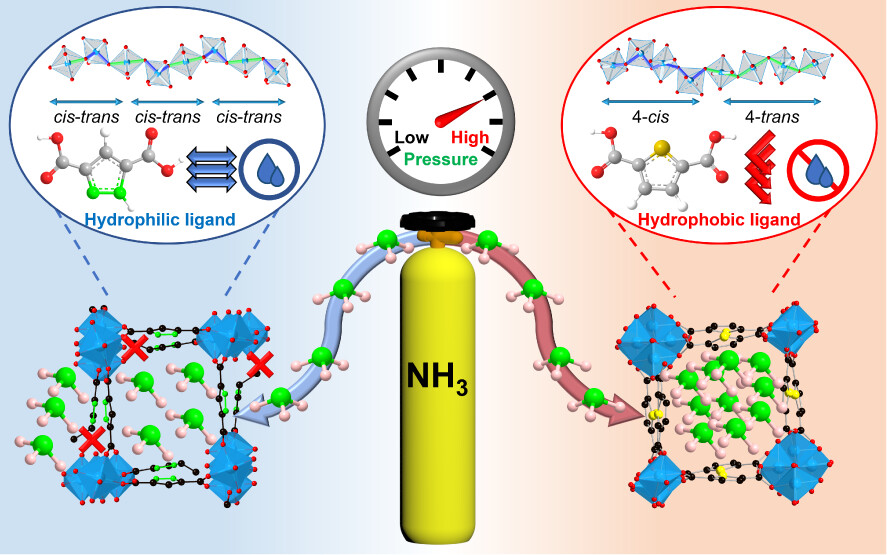
Hydrophobic Metal−Organic Frameworks Enable Superior High-Pressure Ammonia Storage through Geometric Design
Summary:
The authors from Gyeongsang National University, University of California San Diego, and Pohang Accelerator Laboratory developed hydrophobic aluminum-based metal-organic frameworks (MOFs) with optimized geometric design, achieving exceptional high-pressure ammonia storage capacity (17.4 mmol/g at 7 bar) with superior cycling stability (>95% retention over three cycles) compared to hydrophilic analogs.
Background:
1. To address the challenge of efficient and regenerable ammonia storage, previous researchers have extensively investigated hydrophilic MOFs with strong host-guest interactions, achieving high initial capacities. However, these materials often suffer from irreversible capacity losses (39-46%) due to structural degradation during cycling, and the fundamental roles of ligand hydrophilicity versus framework geometry remain unresolved.
2. The authors in this work proposed an innovative counterintuitive strategy utilizing hydrophobic MOFs with tailored 1D channel geometries. By systematically comparing four structurally analogous aluminum-based MOFs (CAU-23, KMF-1, MIL-160, MOF-303), they demonstrated that framework geometry rather than ligand hydrophilicity determines high-pressure ammonia storage performance.
Research Content:
1. Synthesis:
The authors synthesized four aluminum-based MOFs using solvothermal methods: CAU-23 (from 2,5-thiophenedicarboxylic acid), KMF-1 (from 1H-pyrrole-2,5-dicarboxylic acid), MIL-160 (from 2,5-furandicarboxylic acid), and MOF-303 (from 1H-pyrazole-3,5-dicarboxylic acid). An extended analog HE-CAU-23 was also synthesized via ligand extension strategy using (E)-5-(3-ethoxy-3-oxoprop-1-en-1-yl)thiophene-2-carboxylate.
2. Characterizations:
1) BET surface areas: CAU-23 (1261 m²/g), KMF-1 (1189 m²/g), MIL-160 (1252 m²/g), MOF-303 (1118 m²/g); pore diameter distributions centered around 0.5-0.7 nm (Figure S8).
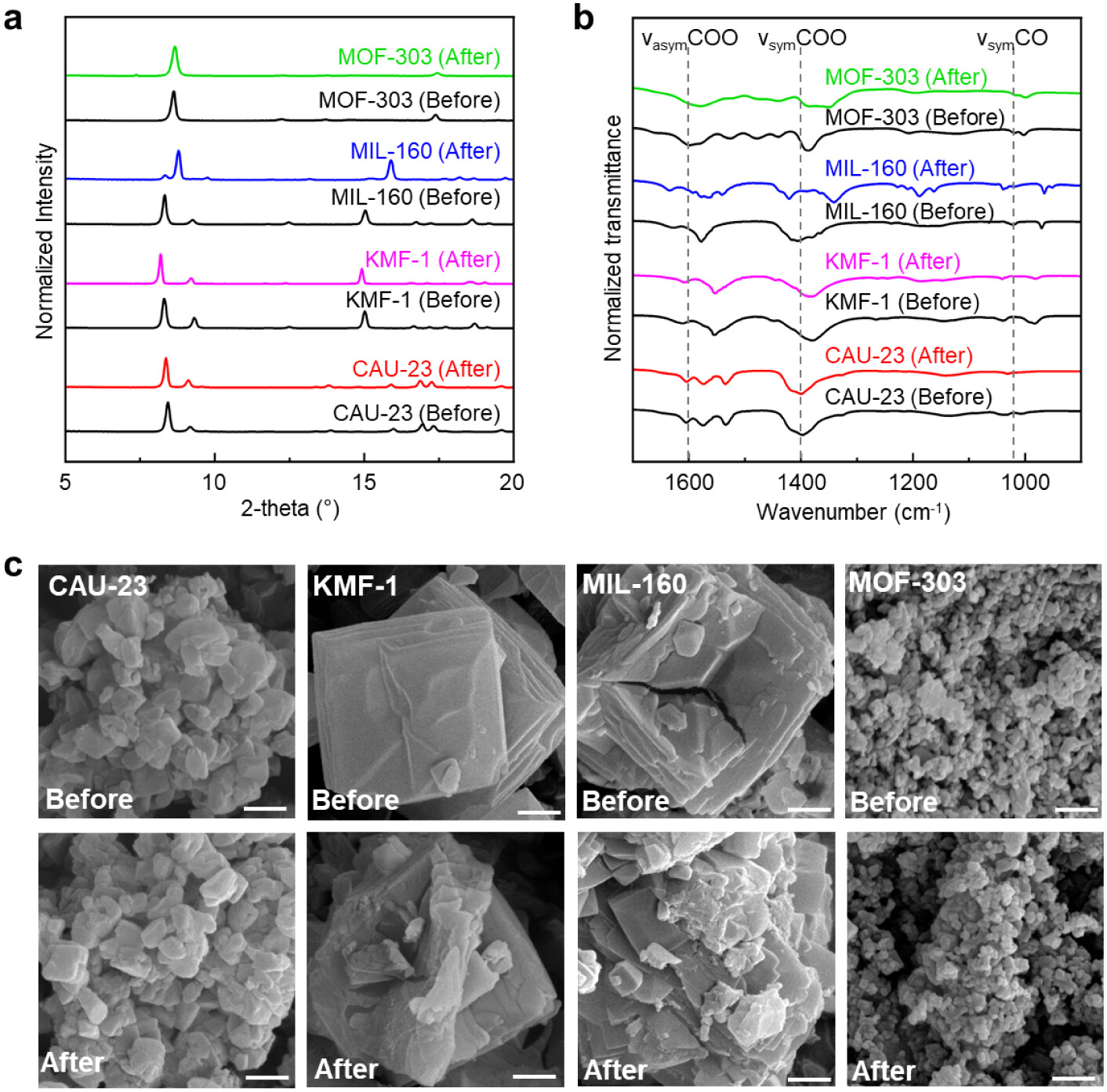
2) SEM images showed CAU-23 maintained crystal morphology after cycling, while MIL-160 exhibited severe morphological collapse and KMF-1 showed particle agglomeration (Figure 2c).
3) PXRD confirmed structural integrity of CAU-23 post-cycling (Rwp = 11.47%), while MIL-160 showed significant degradation (Rwp = 26.43%); IR spectroscopy revealed preserved coordination environments in CAU-23 versus chemical alterations in hydrophilic analogs; XPS confirmed no residual nitrogen in CAU-23 after desorption.
3. Application:
High-pressure NH3 adsorption at 303 K and 7 bar showed CAU-23 achieved 17.4 mmol/g (volumetric: 18.6 mmol/cm³), comparable to hydrophilic MOF-303 (18.5 mmol/g). CAU-23 retained 95% capacity over three cycles, while MIL-160 and MOF-303 suffered 46% and 39% losses respectively. HE-CAU-23 achieved enhanced capacity of 21.2 mmol/g.
4. Mechanism:
Experimental analysis: Low-pressure isotherms and isosteric heats (Qst ~34 kJ/mol for CAU-23 vs. 39-45 kJ/mol for hydrophilic MOFs) confirmed weak host-guest interactions in CAU-23. DSC showed CAU-23 desorbs NH3 at lower temperatures (~55°C initial, ~83°C secondary) compared to hydrophilic analogs (~95-125°C), indicating facile regeneration.
Theoretical calculation: Grand canonical Monte Carlo (GCMC) simulations revealed that high pressure enables NH3 clustering through intermolecular hydrogen bonding (N-H···N), bypassing the need for strong host-guest interactions. CAU-23's unique 4-cis-4-trans helical geometry provides periodically modulated neck-cavity profiles enabling efficient pore filling under high pressure, with higher NH3 density distribution and accessible volume compared to MOF-303 and KMF-1.
Outlook:
This research establishes a paradigm shift toward hydrophobic MOFs with optimized geometry for high-performance gas storage, demonstrating that weak host-guest interactions can provide exceptional structural durability while maintaining high capacity. The ligand extension strategy (HE-CAU-23) validates the design principle's generalizability. These findings unlock new avenues for efficient, regenerable toxic gas storage technologies and adsorption-driven heat pumps, with potential for further enhancement through bidirectional linker extension.
Hydrophobic Metal−Organic Frameworks Enable Superior High-Pressure Ammonia Storage through Geometric Design
Authors: Mingyu Gu, Radhakrishnan Anbarasan, Ho-Jun Cho, Jinhyuk Choi, Cheongwon Bae, Duckjong Kim, Sang Yong Nam, Seth M. Cohen, Jae Hyun Park, and Juyeong Kim
DOI: 10.1021/jacs.5c18786
Link: https://pubs.acs.org/doi/10.1021/jacs.5c18786
The above review is for academic progress sharing. For any errors or copyright issues, please contact us for correction or removal.

