Home >
News > Shape-Memory Nanopores Induced in Coordination Frameworks by Crystal Downsizing
Shape-Memory Nanopores Induced in Coordination Frameworks by Crystal Downsizing
Summary:
The authors from Kyoto University (WPI-iCeMS, ERATO Kitagawa Integrated Pores Project) and collaborating institutions developed meso-sized flexible porous coordination polymers (PCPs) with shape-memory nanopores, achieving switchable sorption properties and controlled structural flexibility through crystal downsizing.
Background:
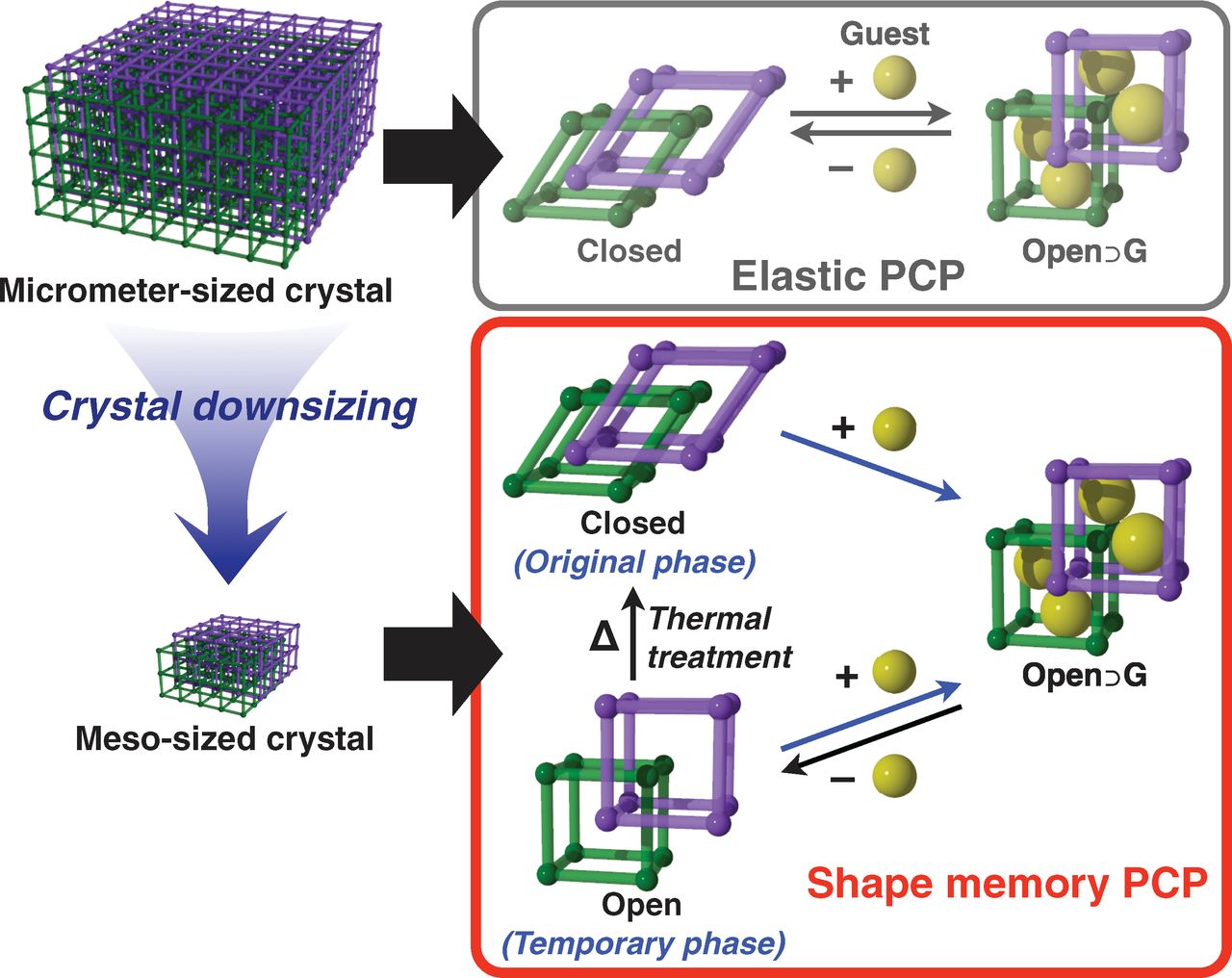
1. To address the challenge of regulating structural flexibility in porous coordination polymers, previous researchers have synthesized various flexible PCPs that exhibit framework elasticity—recovering original structures after guest desorption. However, these materials cannot maintain metastable deformed states without guest molecules, limiting their potential for intelligent responsive materials.
2. The authors in this study proposed an innovative crystal downsizing strategy to suppress structural mobility and successfully isolated an unusual metastable "open dried phase" in meso-sized crystals, inducing a molecular-scale shape-memory effect (MSME) in coordination frameworks.
Research Content:
1. Synthesis:
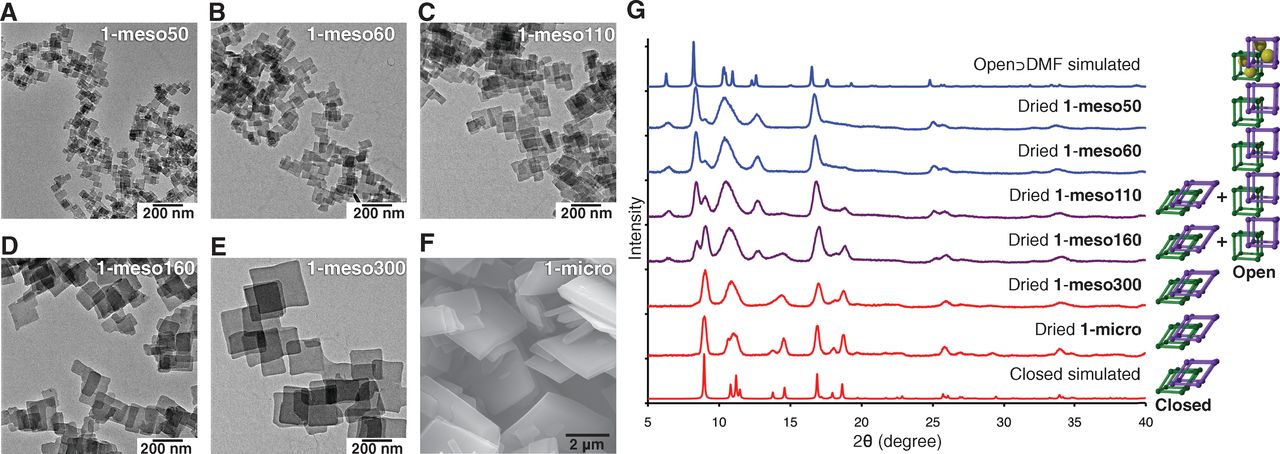
The authors synthesized two series of size-controlled crystals of [Cu₂(bdc)₂(bpy)]ₙ (1) and [Cu₂(bdc)₂(bpe)]ₙ (2) using coordination modulation method. By varying the acetic acid modulator concentration ratio (r = 10–50), they obtained meso-sized crystals ranging from ~50 nm to ~300 nm (1-meso50 to 1-meso300) and micrometer-sized crystals (1-micro). Similar modulation was applied to synthesize 2-meso50, 2-meso300, 2-meso700, and 2-micro.
2. Characterizations:
1) PXRD and Single-Crystal XRD: Confirmed the open phase (guest-included) and closed phase (guest-free) structures. The open dried phase was identified as isomorphic to the open phase but without guest molecules (Fig. 2, Fig. 3G).
2) SEM/TEM tests: Showed plate-like crystal morphology with particle sizes precisely controlled from 45±13 nm (1-meso50) to 296±56 nm (1-meso300), and thickness evaluated by Scherrer's equation (19–26 nm) (Fig. 3A–F, Table S1).
3) Thermogravimetric Analysis (TGA): Verified the absence of guest molecules in the open dried phase before decomposition (280°C) (Figs. S8–S19).
4) Variable Temperature XRD and DSC: Confirmed the metastable nature of the open dried phase and its irreversible conversion to the closed phase upon heating (Figs. S20–S22).
3. Application:
The material was tested for switchable methanol and CO₂ adsorption. The open dried 1-meso50 exhibited type I isotherm without gate-opening behavior, while the closed phase showed characteristic gate-type sorption with sharp uptake at P/P₀ = 0.10–0.17. Thermal treatment enabled reversible switching between these two sorption modes for over 20 cycles without degradation (Figs. 4, S34–S39). Similar behavior was observed for CO₂ adsorption (Figs. S40–S42).
4. Mechanism:
The analysis of experimental results revealed that crystal downsizing suppresses the cooperative structural transformation from the open dried phase to the closed phase. This suppression is attributed to kinetic hindering due to reduced nucleation sites in smaller crystals (heterogeneous nucleation and growth mechanism of martensitic transformation), as evidenced by widened hysteretic loops in smaller crystals (Fig. S60). Thermodynamic contributions from increased surface enthalpy may also play a role. The energy barrier between phases increases with decreasing crystal size, stabilizing the metastable open dried phase at room temperature (Fig. S59).
Outlook:
This research successfully demonstrates the induction of shape-memory effects in nanoporous coordination frameworks through crystal downsizing, enabling the isolation of two interconvertible empty phases with distinct sorption properties. The findings provide a novel strategy for designing intelligent functional materials with switchable and tunable adsorption behaviors responsive to thermal stimuli, with potential applications in gas storage, separation, and sensing technologies.
Shape-Memory Nanopores Induced in Coordination Frameworks by Crystal Downsizing
Authors: Yoko Sakata, Shuhei Furukawa, Mio Kondo, Kenji Hirai, Nao Horike, Yohei Takashima, Hiromitsu Uehara, Nicolas Louvain, Mikhail Meilikhov, Takaaki Tsuruoka, Seiji Isoda, Wataru Kosaka, Osami Sakata, Susumu Kitagawa
DOI: 10.1126/science.1231451
Link: https://www.science.org/doi/10.1126/science.1231451
The above review is for academic progress sharing. For any errors or copyright issues, please contact us for correction or removal.

