Home >
News > Three-Dimensional Covalent Organic Frameworks with lil Topology
Three-Dimensional Covalent Organic Frameworks with lil Topology
Summary:
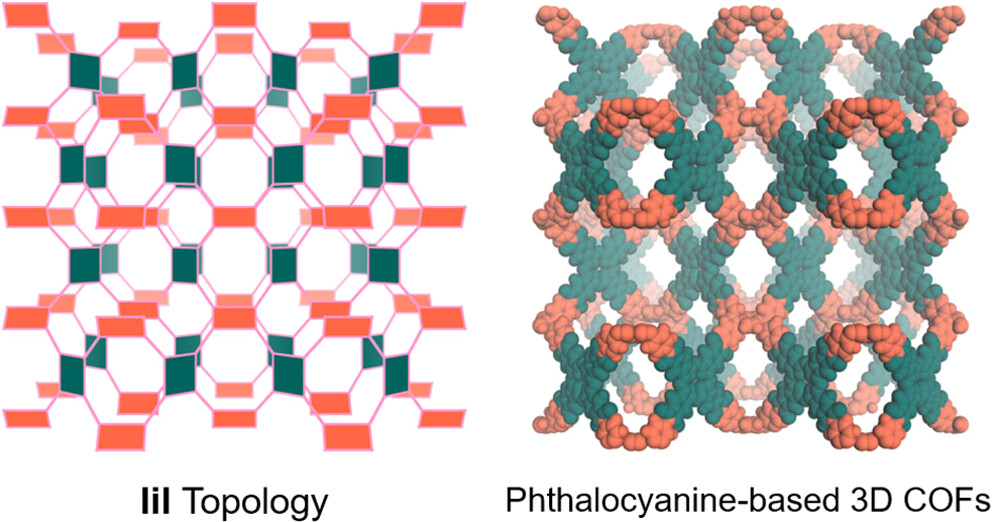
The authors from Zhejiang University developed two 3D covalent organic frameworks (CuPcOC-TABD-COF and CuPcOC-TAPB-COF) with lil topology, achieving excellent dielectric performance in high-energy-density capacitor applications.
Background:
1. To address the lack of new topologies in 3D COFs and the poor high-frequency dielectric performance of existing materials (e.g., high loss, severe dispersion), previous researchers developed 3D COFs with topologies like dia and fjh, yet lil topology remained unexplored, and dielectric materials struggled to balance high permittivity and low loss.
2. The authors proposed assembling \(D_{4h}\)- and \(C_{2h}\)-symmetric building blocks via diimide linkages, successfully synthesizing lil-topology 3D COFs with outstanding dielectric properties.
Research Content:
1.Synthesis: The authors used solvent thermal condensation, reacting CuPcOC with TABD/TAPB in NMP/mesitylene mixed solvent at 180°C for 5 days, yielding 85% and 88% respectively.
2.Characterizations:
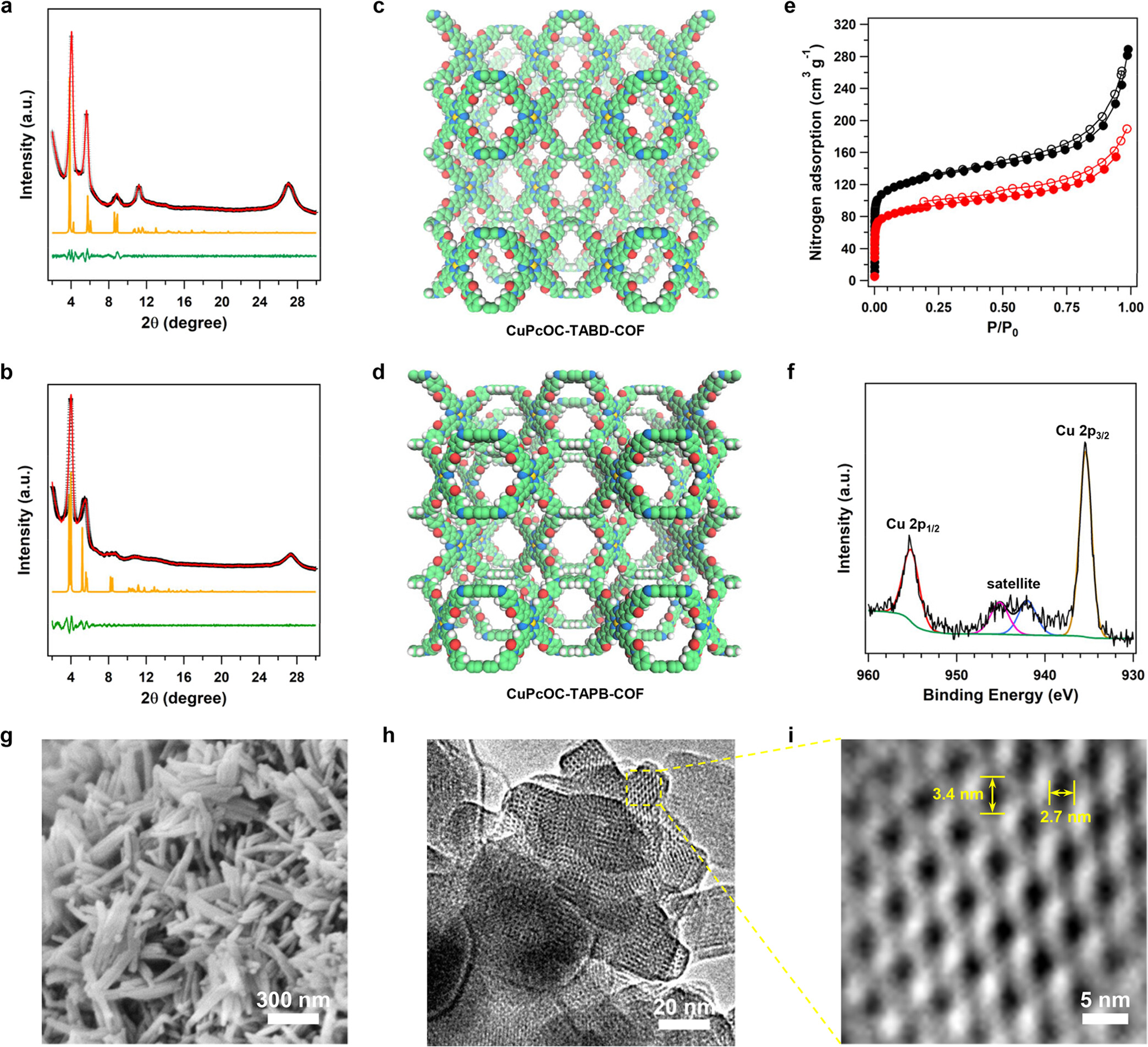
1) BET specific surface areas: 461.36 m²/g (CuPcOC-TABD-COF) and 330.15 m²/g (CuPcOC-TAPB-COF); pore sizes: 0.6–2.0 nm and 0.7–2.3 nm.
2) SEM/TEM showed uniform long rod-like morphology with ordered crystalline texture and Moire fringes.
3) Dielectric tests: 1 MHz frequency, dielectric constants 63 and 52, losses 0.009 and 0.016; breakdown strengths 466 and 425 MV/m.
3.Application: Tested as dielectric materials for high-energy-density capacitors, showing low dispersion and high stability at high frequencies.
4.Mechanism: Ordered crystalline structure enables long-range polaron delocalization; dense CuPc units provide high polarization, while stable polyimide linkages reduce molecular relaxation, synergistically optimizing dielectric performance.
Outlook:
This research first realizes lil-topology 3D COFs, breaks the dielectric performance bottleneck of phthalocyanine-based materials, and provides a new design strategy for high-performance dielectric materials in microelectronics.
Three-Dimensional Covalent Organic Frameworks with lil Topology
Authors: Xinyu Wu, Hanwen Wang, Ning Huang*
DOI: 10.1021/jacs.4c16422
Link: https://pubs.acs.org/doi/10.1021/jacs.4c16422
The above review is for academic progress sharing. For any errors or copyright issues, please contact us for correction or removal.

