Home >
News > A sustainable ultramicroporous MOF for hydrogen storage
A sustainable ultramicroporous MOF for hydrogen storage
Summary:
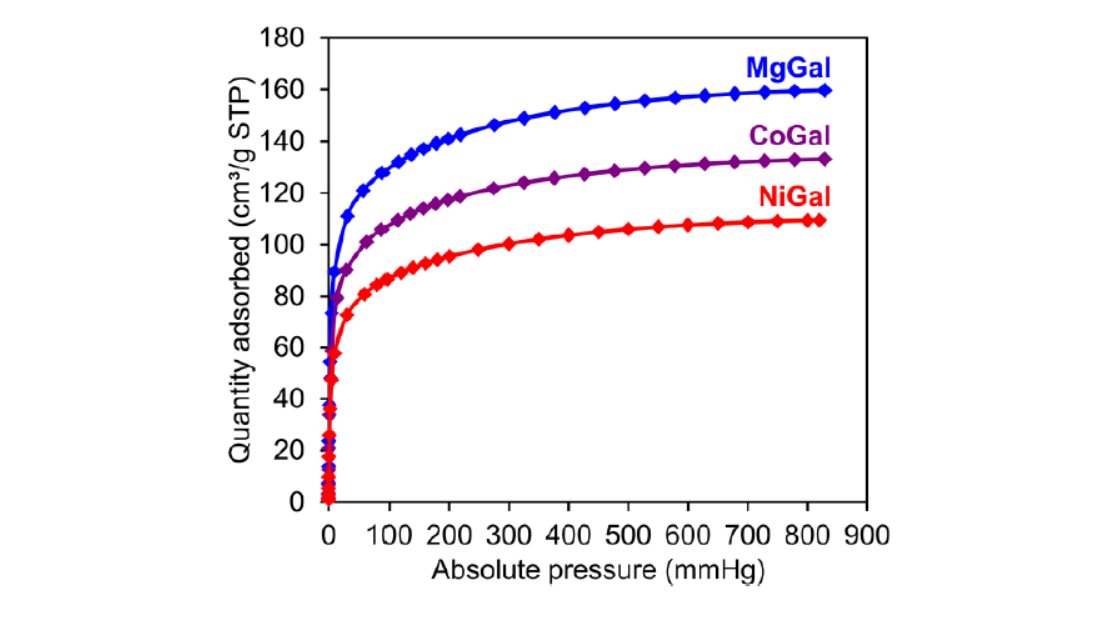
The authors from UCLouvain & DEMOKRITOS developed a sustainable ultramicroporous Mg-gallate (MgGal) MOF with 1.4 wt % H₂ uptake at 77 K/1 atm, achieving fast, reversible hydrogen storage without open metal sites.
Background:
1. To address the H₂-storage challenge, previous MOFs relied on open-metal sites (high Qst but low capacity and complex synthesis) or high-surface-area hosts (low Qst 5–7 kJ mol⁻¹).
2. The authors proposed confinement-driven physisynthesis inside <0.7 nm pores of a bio-sourced gallate framework, obtaining constant 8.6 kJ mol⁻¹ Qst and scalable mechanochemistry.
Research Content:
1. Synthesis:
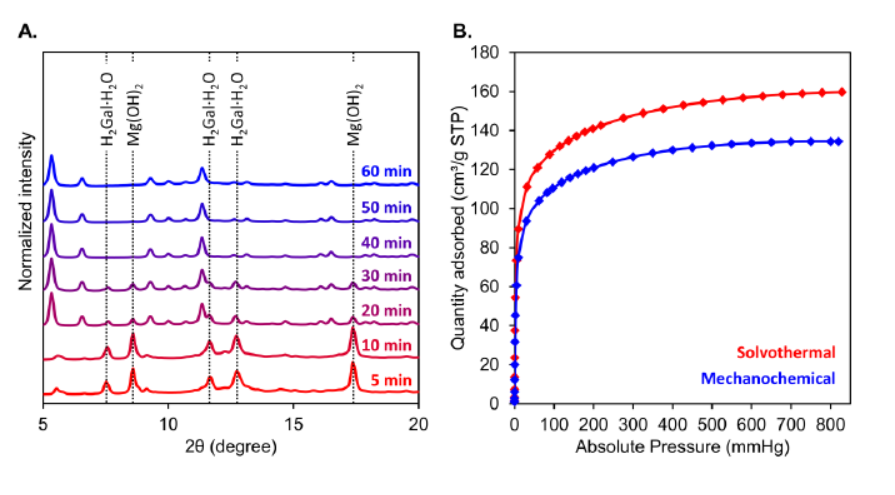
Mechanochemical ball-milling of Mg(OH)₂ + gallic acid·H₂O (1 h, 500 rpm) → MgGal·2H₂O; 100 % yield, 605 kg m⁻³ day⁻¹ space-time yield.
2. Characterizations:
1) BET 424 m² g⁻¹; CO₂ (195 K) confirms ultramicropores ≈0.5 nm.
2) SEM/TEM: solvothermal 2–6 µm plates vs mechano 50–200 nm nodules.
3) In-situ synchrotron PXRD & neutron diffraction track phase I→II dehydration (120 °C) and four D₂ adsorption sites.
3. Application:
Volumetric H₂ capacity 1.4 wt % (77 K, 1 atm); equilibrium ≤2 min; 10 cycles without loss; beats most open-site-free MOFs.
4. Mechanism:
Constant Qst 8.6 kJ mol⁻¹ arises from van-der-Waals confinement inside 0.5 nm channels; no metal-H₂ binding; four crystallographic D₂ sites fill progressively.
Outlook:
Green, rapid mechanosynthesis of MgGal delivers a low-cost, metal-site-free H₂ store that rivals best-performing ultramicroporous MOFs, guiding sustainable porous materials for cryogenic hydrogen tanks.
A sustainable ultramicroporous MOF for hydrogen storage
Authors: Timothy Steenhaut, Guillaume Esser, Nicolas Malherbe, Loïc Rochez-Ladeuze, Christos Tampaxis, Lauraleen Barremaecker, Georgia Charalambopoulou, Theodore Steriotis, Sophie Hermans, Yaroslav Filinchuk
DOI: 10.26434/chemrxiv-2025-bd252
Link: https://doi.org/10.26434/chemrxiv-2025-bd252
The above review is for academic progress sharing. For any errors or copyright issues, please contact us for correction or removal.

