Home >
News > Adsorptive Separation of Acetylene from Ethylene in Isostructural Gallate-Based Metal–Organic Frameworks
Adsorptive Separation of Acetylene from Ethylene in Isostructural Gallate-Based Metal–Organic Frameworks
Summary:
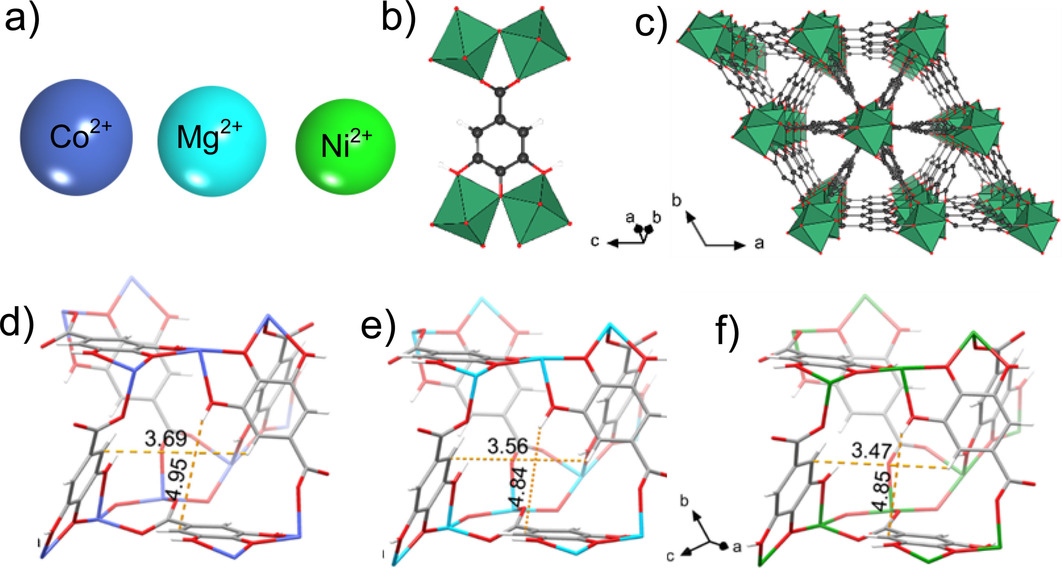
The authors from Zhejiang University developed a series of isostructural gallate-based MOFs (Ni-, Mg-, Co-gallate) with ultra-microporous zig-zag channels (3.47–3.69 Å) that enable record-high C₂H₂/C₂H₄ selectivity (up to 44) and polymer-grade C₂H₄ productivity (85.6 mol L⁻¹), achieving efficient removal of trace acetylene from ethylene streams.
Background:
1. To remove 1 % C₂H₂ from C₂H₄ feed (< 40 ppm required), prior partial hydrogenation or solvent absorption suffers from noble-metal cost, volatile organics and energy penalty; current MOF adsorbents still lack simultaneous high selectivity, capacity and scalable synthesis.
2. The authors proposed a metal-ion-substitution strategy to fine-tune aperture size within 0.3 Å in one gallate topology, delivering benchmark C₂H₂ capture under mild conditions.
Research Content:
1. Synthesis:
Hydrothermal reaction of MCl₂·6 H₂O (M = Ni, Mg, Co) with gallic acid in KOH at 120 °C for 24 h; scaled-up reflux route (80 °C, 250 mL) gives identical phase.
2. Characterizations:
1) BET 424–559 m² g⁻¹; CO₂ isotherms (195 K) confirm ultra-microporosity.
2) SEM shows uniform sub-micron plates; PXRD proves isostructural P31 phase.
3) Neutron powder diffraction locates three C₂D₂ binding sites with multiple C–H···O hydrogen bonds (2.07–2.76 Å); C₂D₄ exhibits weaker, off-center interactions.
3. Application:
Single-component C₂H₂ uptake 80.4 cm³ g⁻¹ (Ni-gallate, 298 K, 1 bar); 0.01 bar uptake 54.2 cm³ cm⁻³ (Co-gallate) outperforms SIFSIX-2-Cu-i. Breakthrough of 1:99 C₂H₂/C₂H₄ gives polymer-grade C₂H₄ (> 99.99 %) with Ni-gallate retention time 408 min g⁻¹. Ten-cycle tests maintain capacity; moisture exposure (75 % RH, 5 weeks) shows no loss.
4. Mechanism:
Smaller Ni²⁺ (83 pm) shortens M–O bonds, narrowing aperture to 3.47 Å—just above C₂H₂ kinetic diameter (3.3 Å)—creating strong confinement and 46 kJ mol⁻¹ Qst. DFT-level IAST selectivity reaches 112 at 1 kPa. Larger C₂H₄ (4.16 Å) is size-excluded, enabling molecular-sieving-like separation.

Outlook:
Metal-ion substitution in gallate MOFs affords a tunable, inexpensive, water-tolerant platform for challenging C₂H₂/C₂H₄ separation, providing an energy-saving alternative to hydrogenation and a blueprint for ultra-microporous adsorbent design.
Adsorptive Separation of Acetylene from Ethylene in Isostructural Gallate-Based Metal–Organic Frameworks
Authors: Jiawei Wang, Liangying Li, Lidong Guo, Yingcai Zhao, Danyan Xie, Zhiguo Zhang, Qiwei Yang, Yiwen Yang, Zongbi Bao, Qilong Ren
DOI: 10.1002/chem.201903952
Link: https://chemistry-europe.onlinelibrary.wiley.com/doi/10.1002/chem.201903952
The above review is for academic progress sharing. For any errors or copyright issues, please contact us for correction or removal.

