Home >
News > Evaluating metal–organic frameworks for post-combustion carbon dioxide capture via temperature swing adsorption
Evaluating metal–organic frameworks for post-combustion carbon dioxide capture via temperature swing adsorption
Summary:
The authors from UC Berkeley & University of Amsterdam developed Mg₂(dobdc) (Mg-MOF-74) featuring open Mg²⁺ sites, achieving a record 17.6 wt % CO₂ working capacity at 200 °C via temperature-swing adsorption (TSA) for post-combustion flue-gas capture.
Background:
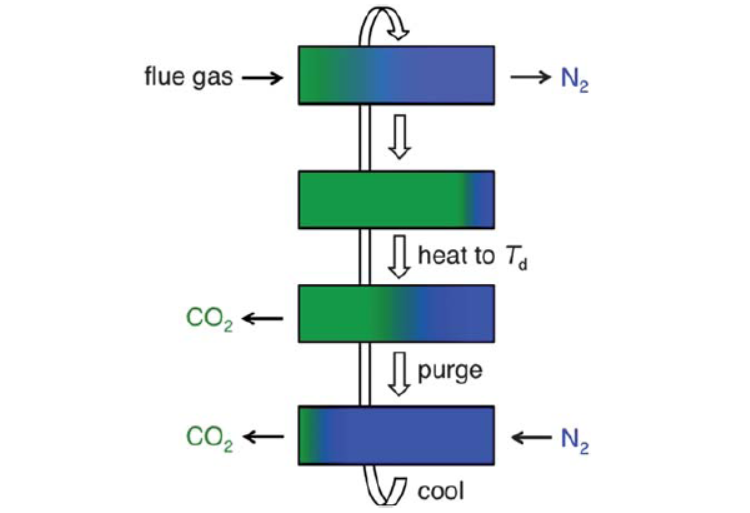
1. To replace energy-intensive amine scrubbing, prior MOF studies focused on high CO₂ uptake, yet most lacked high-temperature (≥ 120 °C) isotherms essential for TSA design, leading to over-estimated regeneration energy.
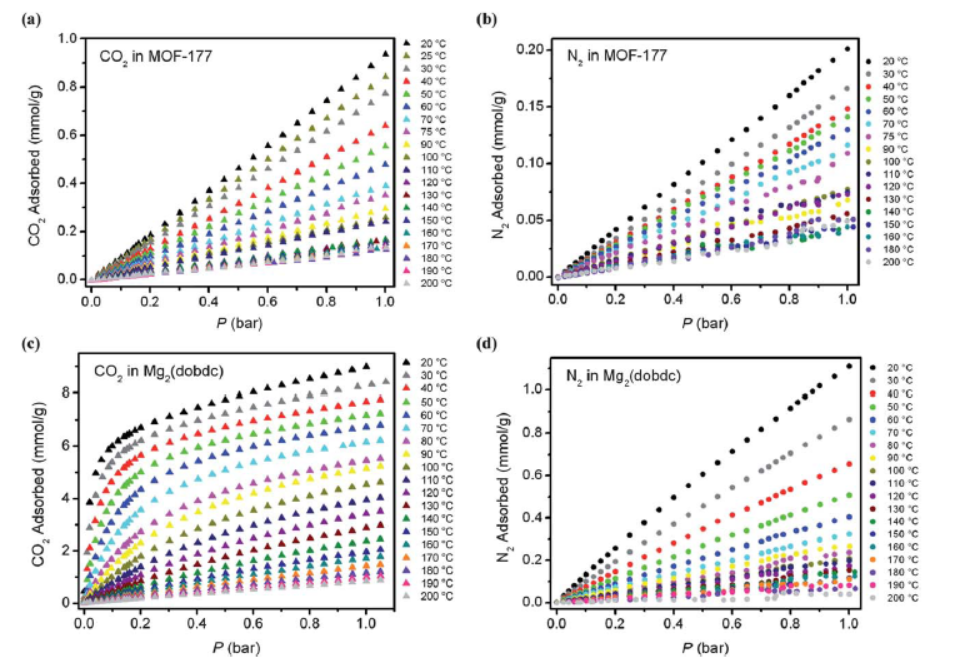
2. The authors measured full 20–200 °C isotherms, applied dual-site Langmuir/IAST models, and validated breakthrough performance, proving strong binding sites are mandatory for positive TSA working capacity.
Research Content:
1. Synthesis: Solvothermal reaction of Mg(NO₃)₂·6H₂O with 2,5-dihydroxyterephthalic acid in DMF, followed by hot DMF/methanol washes and 180 °C vacuum activation.
2. Characterizations:
1) BET 1 800 m² g⁻¹; micropore volume 0.57 cm³ g⁻¹.
2) SEM shows 1–2 µm rod-like crystals; PXRD confirms phase purity.
3) CO₂/N₂ isotherms 20–200 °C; isosteric heat drops from 42 to 24 kJ mol⁻¹ after Mg²⁺ saturation (8.24 mmol g⁻¹).
3. Application: In simulated TSA (adsorption 40 °C, 0.15 bar CO₂; desorption 200 °C, 1 bar) Mg₂(dobdc) delivers 4.85 mmol g⁻¹ working capacity, doubles breakthrough time vs zeolite NaX, and retains capacity over cycles.
4. Mechanism: Open Mg²⁺ sites form strong σ-complex with CO₂ quadrupole; above 1 CO₂ per Mg²⁺ weaker physisorption dominates, enabling sharp uptake roll-off at high T and low regeneration energy.
Outlook:
The study establishes the first high-temperature TSA benchmark for MOFs, demonstrating that strong, tunable adsorption sites and low heat capacity (1.6 J g⁻¹ K⁻¹) of Mg₂(dobdc) can cut regeneration energy vs amines, guiding next-generation solid sorbents for carbon capture.
Evaluating metal–organic frameworks for post-combustion carbon dioxide capture via temperature swing adsorption
Authors: Jarad A. Mason, Kenji Sumida, Zoey R. Herm, Rajamani Krishna, Jeffrey R. Long
DOI: 10.1039/C1EE01720A
Link: https://pubs.rsc.org/en/content/articlelanding/2011/ee/c1ee01720a
The above review is for academic progress sharing. For any errors or copyright issues, please contact us for correction or removal.

