Home >
News > Effect of Water Adsorption on Retention of Structure and Surface Area of Metal–Organic Frameworks
Effect of Water Adsorption on Retention of Structure and Surface Area of Metal–Organic Frameworks
Summary:
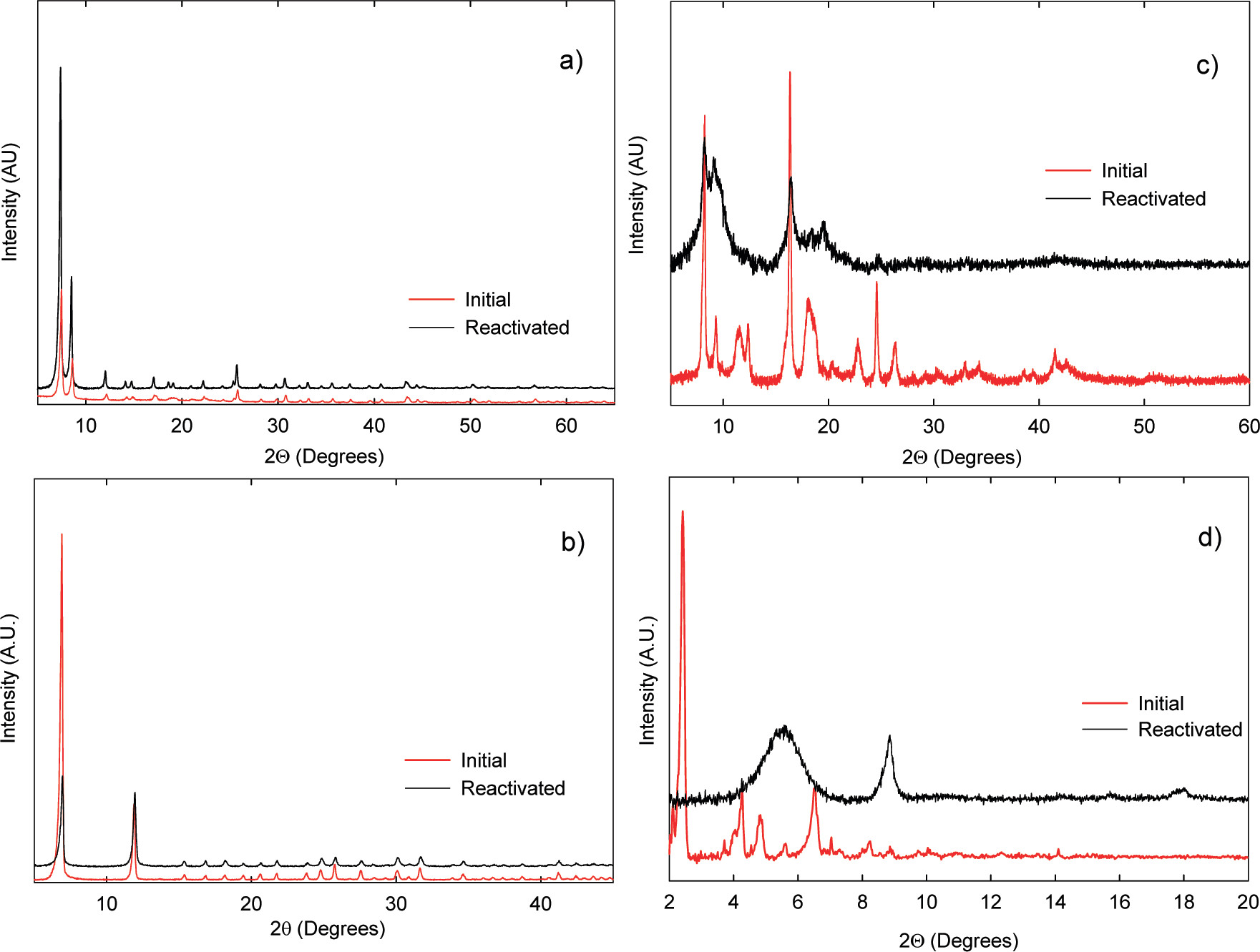
The authors from Georgia Institute of Technology systematically evaluated the water-vapor stability of seven prototypical MOFs, revealing that open-metal-site frameworks (HKUST-1, Mg-MOF-74) and Zr-cluster UiO-66 retain crystallinity yet suffer 26–83 % BET-area loss after 90 % RH exposure/regeneration, whereas Zn-carboxylate DMOF-1 and UMCM-1 completely collapse, providing quantitative design rules for humid-gas applications.
Background:
1. To address unpredictable MOF failure in flue-gas CO₂ capture and air purification, prior studies reported isolated hydro-stability cases but lacked comparative surface-area metrics and regeneration protocols.
2. The authors proposed a standardized humidity/isotherm/reactivation protocol (298 K, 0–90 % RH, vacuum/thermal regeneration) and quantified structure–surface-area correlations across diverse topologies.
Research Content:
1. Synthesis: Solvothermal protocols were adopted to prepare HKUST-1, Mg-MOF-74, UiO-66, UiO-66-NH₂, DMOF-1, DMOF-1-NH₂ and UMCM-1 without further modification.
2. Characterizations:
1) BET surface area, pore volume (0.52–2.41 cm³ g⁻¹) and pore diameter (6–32 Å) catalogued before/after water exposure.
2) SEM/XRD confirm micro-crystalline powders; reactivation preserves PXRD peaks for stable phases while degraded samples show amorphous halos.
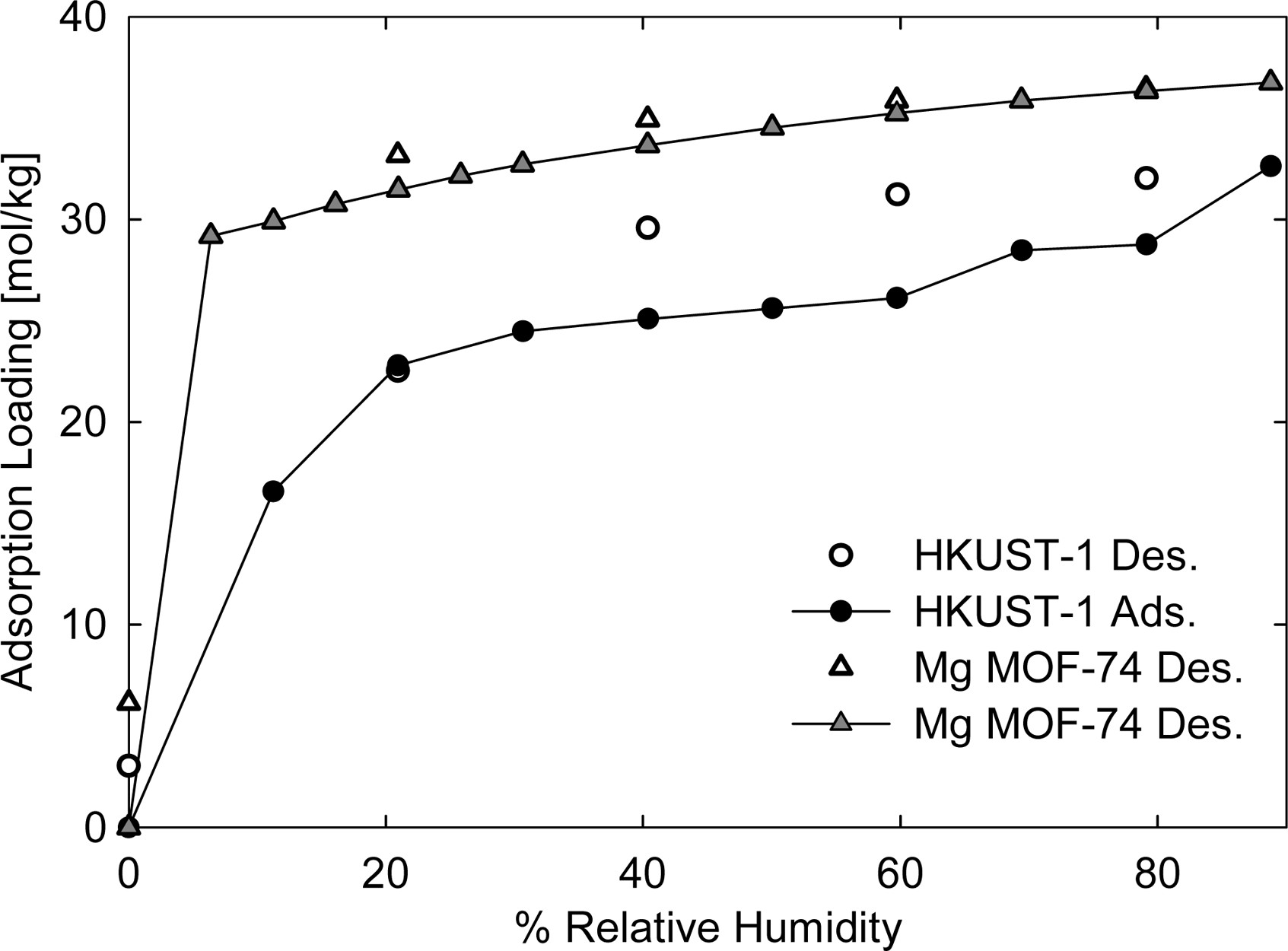
3) Dynamic water adsorption/desorption isotherms (IGA-003, 298 K) reveal Type I (open-metal), Type V (hydrophobic) and step-wise pore-filling behaviors.
3. Application: Materials were tested as reversible water sorbents; HKUST-1 and Mg-MOF-74 deliver 33–37 mol kg⁻¹ uptake but retain only 17–74 % surface area after regeneration, limiting cyclic use.
4. Mechanism: Zr₆O₄(OH)₄ clusters (UiO-66) resist hydrolysis via high (7–8) coordination; Cu-paddlewheel and Mg-chains survive crystallographically but undergo subtle metal-ligand cleavage/oxygen-assisted degradation, whereas Zn-carboxylate (DMOF-1, UMCM-1) rapidly hydrolyzes to Zn(OH)₂, causing complete area loss.
Outlook:
The work establishes a benchmark database linking water-adsorption profiles, reactivation conditions and surface-area penalties, guiding the selection of moisture-tolerant MOFs (UiO-66 ≫ HKUST-1 > Mg-MOF-74) and highlighting the need for protective coatings or hydrophobic linkers in real humid streams.
Effect of Water Adsorption on Retention of Structure and Surface Area of Metal–Organic Frameworks
Authors: Paul M. Schoenecker, Cantwell G. Carson, Himanshu Jasuja, Christine J. J. Flemming, Krista S. Walton
DOI: 10.1021/ie202325p
Link: https://pubs.acs.org/doi/10.1021/ie202325p
The above review is for academic progress sharing. For any errors or copyright issues, please contact us for correction or removal.

