Home >
News > MOFs Conferred with Transient Metal Centers for Enhanced Photocatalytic Activity
MOFs Conferred with Transient Metal Centers for Enhanced Photocatalytic Activity
Summary:
The authors from Shanghai Normal University, Fudan University and UCLA developed Cu–NH₂-MIL-125(Ti) MOF disks (847 m² g⁻¹, 2.4 nm pores) that incorporate transient Cu²⁺/Cu⁺ redox centers, achieving 490 mmol g⁻¹ h⁻¹ visible-light H₂ evolution—27-fold higher than the parent MOF and 10-fold superior to 1 wt % Pt/MOF.
Background:
1. To replace scarce Pt co-catalysts, previous MOF photo-catalysts showed modest activity because photo-electrons were ineffectively trapped and rapidly recombined.
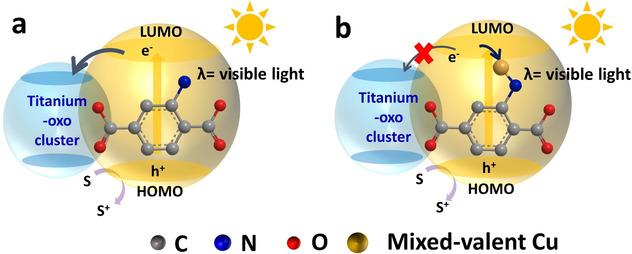
2. The authors now propose a one-step post-coordination strategy that docks earth-abundant Cu ions onto NH₂-linkers, creating reversible Cuᴵᴵ/Cuᴵ centers for ultrafast electron storage and proton reduction.
Research Content:
1. Synthesis: NH₂-MIL-125(Ti) (NM) was obtained by microwave solvothermal reaction of Ti(OBu)₄ and 2-aminoterephthalic acid in DMF/MeOH; Cu-NM was prepared by simply stirring NM in 3 mM Cu(OAc)₂ ethanol solution at room temperature.
2. Characterizations:
1) BET surface 847 m² g⁻¹, pore volume 0.52 cm³ g⁻¹, uniform 2.4 nm mesopores.
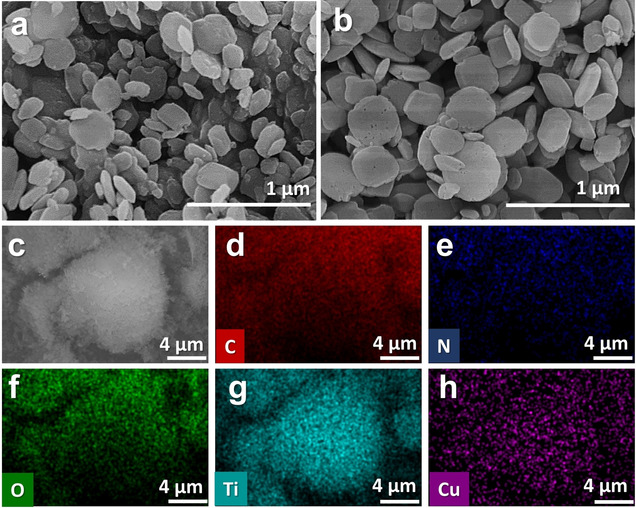
2) SEM/TEM show intact 200–300 nm disk morphology; EDX mapping reveals homogeneous Cu dispersion (0.90 wt %).
3) UV-vis DRS gives band-gap 2.85 eV; PL quenching and EIS show 7000× higher carrier density (2.87×10²⁴ cm⁻³) and 27× longer lifetime (801 ps).
3. Application: Under 420 nm LED (32 W) and TEA sacrificial agent, Cu-NM evolves 490 mmol g⁻¹ h⁻¹ H₂ with 6.6 % apparent quantum yield and >48 h stable operation; activity exceeds Pt-loaded benchmark (51 mmol g⁻¹ h⁻¹).
4. Mechanism: XPS/EXAFS confirm square-planar CuN₄ sites; femtosecond TA spectroscopy evidences continuous electron flow from photo-excited linkers to Cuᴵᴵ→Cuᴰ→Cuᴵ cycle, suppressing Ti-oxo cluster recombination and enabling efficient H⁺→H₂ conversion.
Outlook:
This linker-metalation route furnishes a noble-metal-free, low-cost MOF photocatalyst with commercial-scale synthetic simplicity and record H₂ productivity, offering a general blueprint for designing transient-metal-functionalized frameworks toward sustainable solar fuels.
MOFs Conferred with Transient Metal Centers for Enhanced Photocatalytic Activity
Authors: Xiaolang Chen, Shuning Xiao, Hao Wang, Wenchao Wang, Yong Cai, Guisheng Li, Minghua Qiao, Jian Zhu, Hexing Li, Dieqing Zhang, Yunfeng Lu
DOI: 10.1002/anie.202002375
Link: https://onlinelibrary.wiley.com/doi/10.1002/anie.202002375
The above review is for academic progress sharing. For any errors or copyright issues, please contact us for correction or removal.

