Home >
News > Metal–Organic Frameworks with Potential Application for SO₂ Separation and Flue Gas Desulfurization
Metal–Organic Frameworks with Potential Application for SO₂ Separation and Flue Gas Desulfurization
Summary:
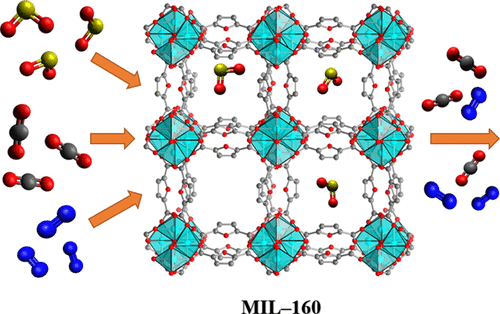
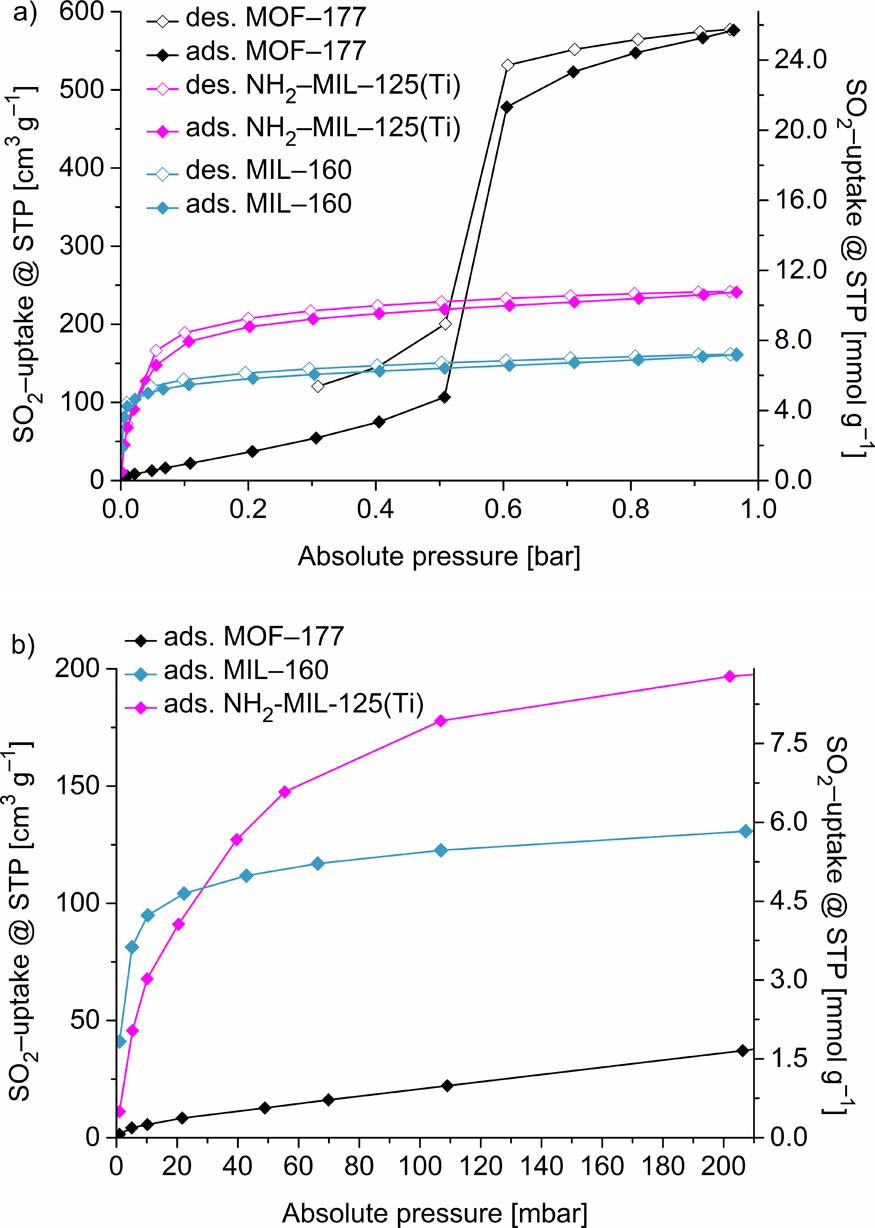
The authors from Heinrich-Heine-Universität Düsseldorf, Leipzig University and Shenzhen Polytechnic developed three metal–organic frameworks (MOF-177, NH₂-MIL-125(Ti), MIL-160) featuring ultra-high BET surface (up to 4100 m² g⁻¹) and 5 Å-scale micropores, achieving record SO₂ uptake of 25.7 mmol g⁻¹ and excellent SO₂/CO₂ selectivity up to 128 for deep flue-gas desulfurization.
Background:
1. To remove residual SO₂ (<500 ppm) after limestone scrubbing, prior MOFs either lacked low-pressure capacity or suffered humid-SO₂ instability.
2. The authors now propose a comparative study combining green reflux synthesis, DFT-guided binding-site analysis and humid-stress tests to screen practically viable sorbents.
Research Content:
1. Synthesis: MIL-160 was prepared by aqueous reflux of Al(OH)(CH₃COO)₂ and 2,5-furandicarboxylic acid; NH₂-MIL-125(Ti) and MOF-177 were solvothermally obtained from Ti/NH₂-BDC and Zn/BTB/DEF, respectively.
2. Characterizations:
1) BET 1170–4100 m² g⁻¹; narrow 5 Å channels in MIL-160.
2) SEM shows 100–300 nm MIL-160 rods; PXRD confirms phase purity.
3) Virial & Sips analyses yield Qst(SO₂) 42–53 kJ mol⁻¹; DFT identifies Ofuran···SSO₂ (40 kJ mol⁻¹) and Ofuran/carboxylate···SSO₂ (60 kJ mol⁻¹) sites.
3. Application: Dynamic breakthrough with 0.1 % SO₂/N₂/CO₂ at 293 K retains SO₂ for 600 min g⁻¹; capacity drops <5 % after five humid cycles (75 % RH, 175 ppm h SO₂).
4. Mechanism: Pore aperture (5 Å) matches SO₂ kinetic diameter (4.11 Å) enabling kinetic sieving; cooperative H-bond and π-stacking produce stepwise SO₂ binding with rising Qst, explaining the unique low-pressure uptake.
Outlook:
MIL-160 delivers the best combination of low-pressure SO₂ capture, high SO₂/CO₂ selectivity, fast N₂-regeneration at 293 K and outstanding humid-SO₂ stability, offering a readily scalable sorbent for deep flue-gas desulfurization.
Metal–Organic Frameworks with Potential Application for SO₂ Separation and Flue Gas Desulfurization
Authors: Philipp Brandt, Alexander Nuhnen, Marcus Lange, Jens Möllmer, Oliver Weingart, Christoph Janiak
DOI: 10.1021/acsami.9b00029
Link: https://pubs.acs.org/doi/10.1021/acsami.9b00029
The above review is for academic progress sharing. For any errors or copyright issues, please contact us for correction or removal.

