Home >
News > Design and syntheses of MOF/COF hybrid materials via postsynthetic covalent modification: An efficient strategy to boost the visible-light-driven photocatalytic performance
Design and syntheses of MOF/COF hybrid materials via postsynthetic covalent modification: An efficient strategy to boost the visible-light-driven photocatalytic performance
Summary:
The authors from Nanchang Hangkong University & ECUST developed hierarchical MOF/COF hybrid photocatalysts (15TBC & 15ZBC) with amide-bridged interfaces, achieving 360 µmol h⁻¹ g⁻¹ H₂ evolution under visible light, 2.2× higher than parent COF.
Background:
1. To boost visible-light H₂ production, previous MOF-COF blends were linked by weak forces, giving low stability and charge separation.
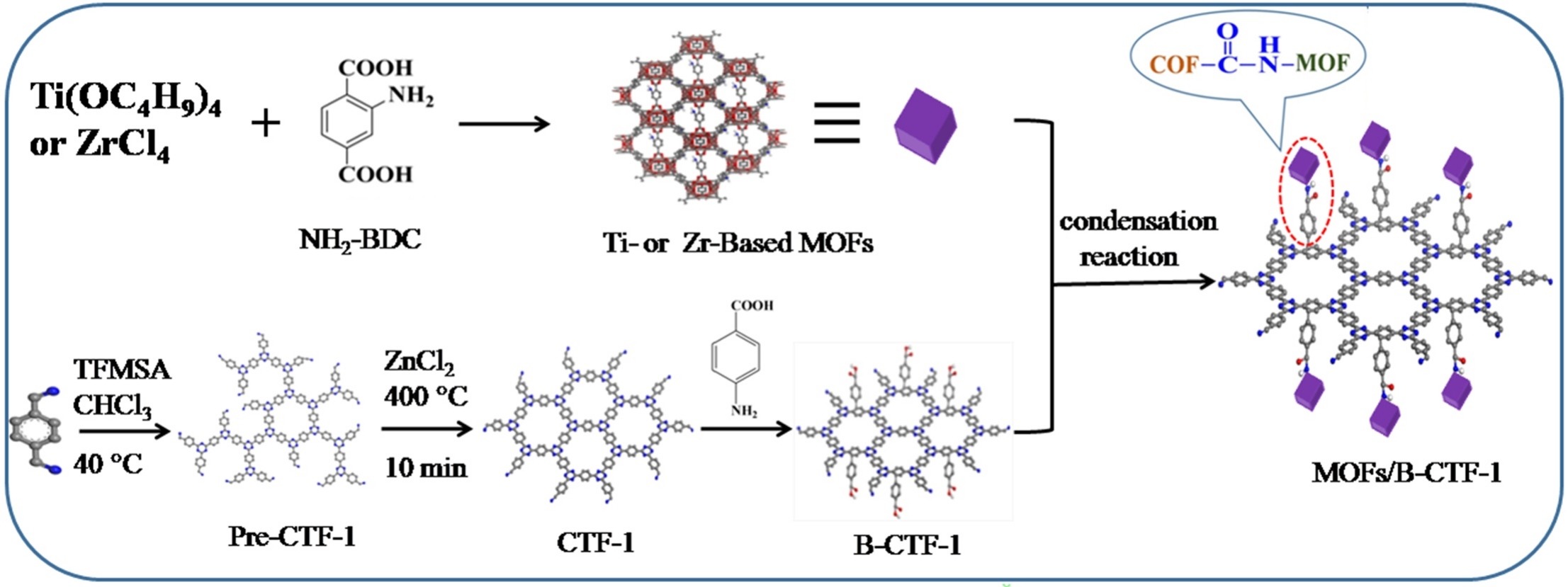
2. The authors proposed postsynthetic covalent modification to anchor NH₂-MIL-125(Ti) or NH₂-UiO-66(Zr) on benzoic-acid-grafted CTF-1, obtaining robust amide-bonded hybrids.
Research Content:
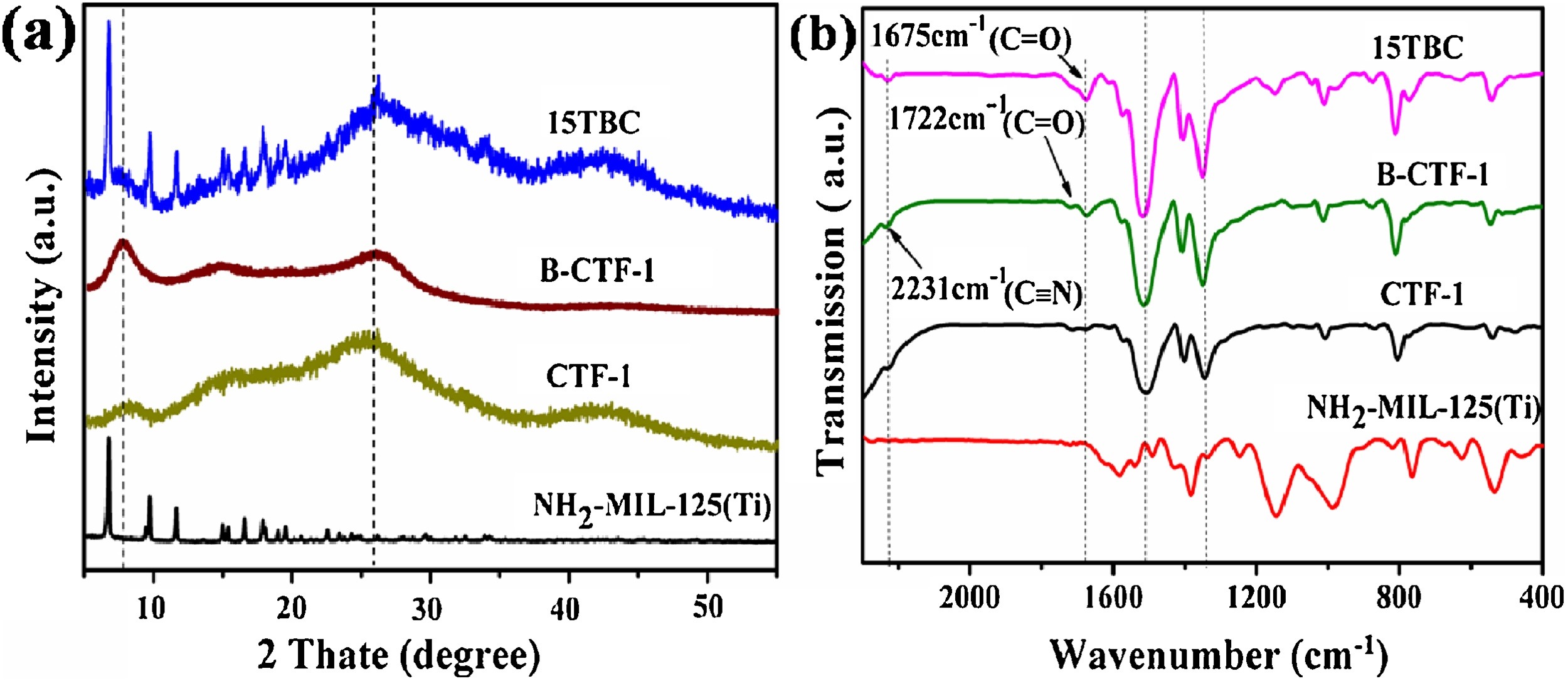
1. Synthesis: Diazotization grafted 4-aminobenzoic acid onto CTF-1 → B-CTF-1; EDC/HOBt coupling with NH₂-MOFs gave xTBC/xZBC powders (x = 10–20 wt %).
2. Characterizations:
1) BET—hierarchical micro-/mesopores retained after coupling.
2) SEM/TEM—MOF nanoparticles (~50 nm) uniformly decorate 2D CTF nanosheets.
3) UV–vis DRS—enhanced 200–680 nm absorption; Mott–Schottky shows matched CB positions (−1.33 V vs NHE for Ti-MOF, −0.80 V for B-CTF-1); transient photocurrent ↑ 3×, PL quenched, EIS arc ↓.
3. Application: 20 mg catalyst, 3 % Pt, TEOA sacrificial agent, λ ≥ 420 nm; 15TBC reaches 360 µmol h⁻¹ g⁻¹ H₂ (AQY 0.87 %), stable over 4 cycles.
4. Mechanism: Amide bridges mediate electron transfer from MOF CB to COF CB → Pt → H⁺ reduction; holes migrate to MOF VB and are scavenged by TEOA, suppressing recombination.
Outlook:
This work first demonstrates covalent amide-linking of MOFs on COFs, furnishing stable, efficient H₂-evolving photocatalysts and a general blueprint for MOF/COF energy devices.
Design and syntheses of MOF/COF hybrid materials via postsynthetic covalent modification: An efficient strategy to boost the visible-light-driven photocatalytic performance
Authors: Fei Li, Dengke Wang, Qiu-Ju Xing, Gang Zhou, Shan-Shan Liu, Yan Li, Ling-Ling Zheng, Peng Ye, Jian-Ping Zou
DOI: 10.1016/j.apcatb.2018.10.043
Link: https://doi.org/10.1016/j.apcatb.2018.10.043
The above review is for academic progress sharing. For any errors or copyright issues, please contact us for correction or removal.

