Home >
News > Adsorption and Degradation of the G-type Nerve Agent Soman and Its Simulant Dimethyl 4-Nitrophenylphosphate by Metal-Exchange-Modified MFU-4l Metal–Organic Frameworks
Adsorption and Degradation of the G-type Nerve Agent Soman and Its Simulant Dimethyl 4-Nitrophenylphosphate by Metal-Exchange-Modified MFU-4l Metal–Organic Frameworks
Summary:
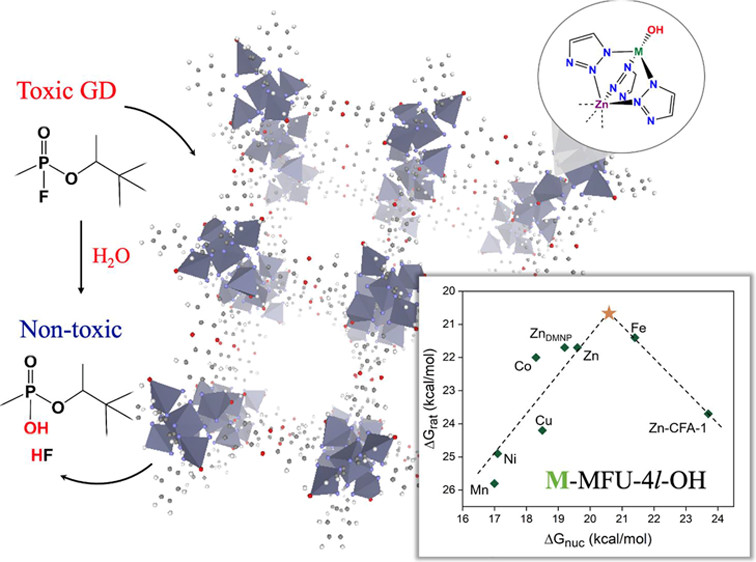
The authors from Xiamen University developed a series of metal-exchanged MFU-4l MOFs (M-MFU-4l-(OH), M = Mn, Fe, Co, Ni, Cu, Zn) featuring single-atom active sites, achieving efficient adsorption and degradation of the G-type nerve agent soman (GD) and its simulant DMNP under ambient conditions.
Background:
1. To address the persistent threat of organophosphorus chemical warfare agents, previous researchers have explored enzymes and Zr-MOFs, achieving fast hydrolysis rates, yet suffered from product inhibition, high cost, and poor stability.
2. The authors herein proposed a post-synthetic metal-exchange strategy to engineer MFU-4l MOFs with tunable Lewis-acidic M–OH sites and obtained superior catalytic activity and stability.
Research Content:
1. Synthesis:
The authors synthesized M-MFU-4l-(OH) via post-synthetic metal and ligand exchange of the parent Zn-MFU-4l under basic aqueous conditions, yielding isostructural frameworks with single-atom M–OH centers.
2. Characterizations:
1) BET: Microporous structure retained after exchange; large pores (~18.6 Å) dominate adsorption.
2) SEM/TEM: Crystalline octahedral particles ~200–500 nm remain intact across metal variants.
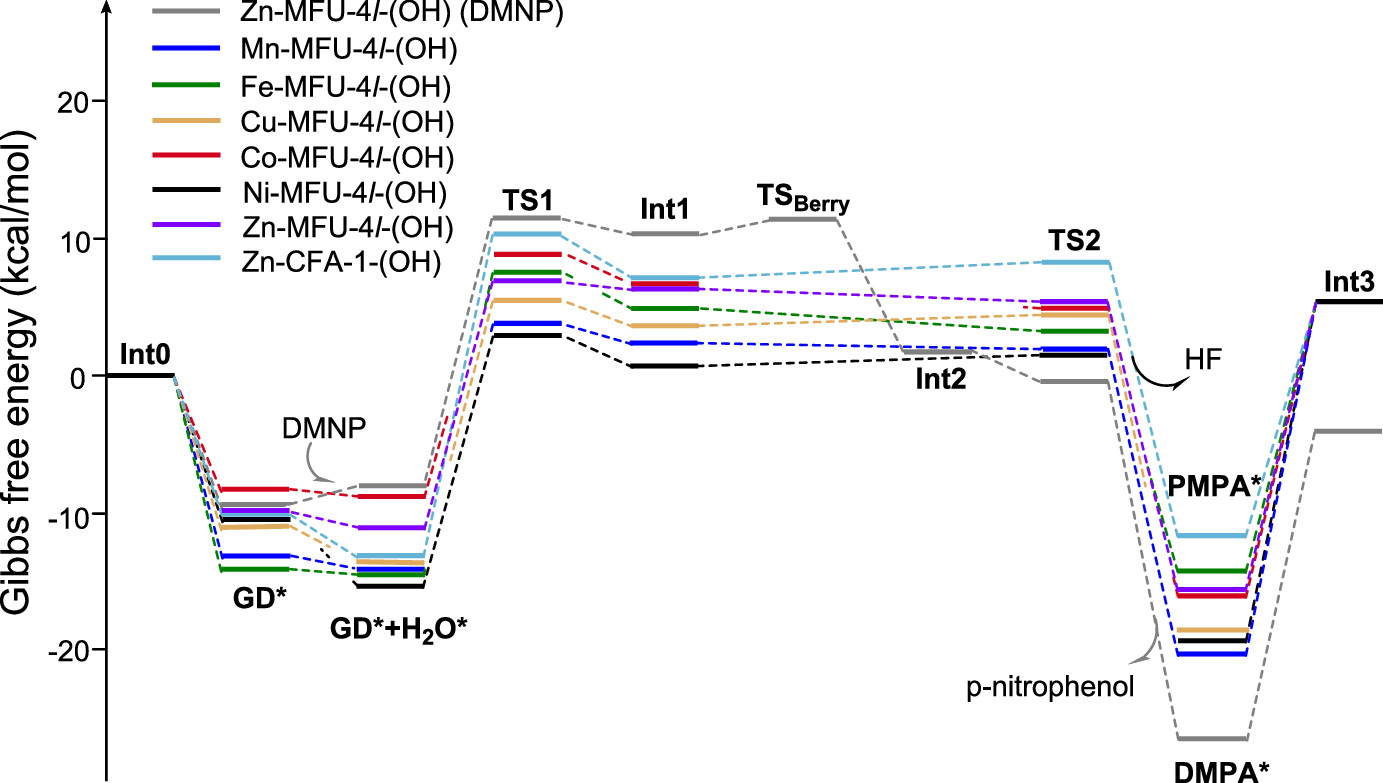
3) DFT & MD: Calculated adsorption free energy of GD on Fe-MFU-4l-(OH) = –13.6 kcal mol⁻¹; volcano plot identifies Fe derivative as optimal catalyst.
3. Application:
GD (1 µg mL⁻¹) and DMNP were completely hydrolyzed within minutes at 25 °C; Fe-MFU-4l-(OH) exhibits the lowest rate-limiting barrier (21.4 kcal mol⁻¹) and half-life < 3 min, outperforming Zr-MOFs and enzymes.
4. Mechanism:
Water-triggered Lewis-acid activation: M–OH abstracts H from H₂O, generating M–OH₂ that nucleophilically attacks P=O to form a pentacoordinate intermediate; subsequent F⁻ elimination releases non-toxic PMPA. BEP relations predict activity from ΔGₙᵤc and ΔGᵈᵉˢ, enabling rapid screening.
Outlook:
The work delivers a stable, low-cost, single-atom MOF platform for real-time detoxification of nerve agents, establishes quantitative BEP descriptors for catalyst design, and paves the way for protective filters and decontamination textiles.
Adsorption and Degradation of the G-type Nerve Agent Soman and Its Simulant Dimethyl 4-Nitrophenylphosphate by Metal-Exchange-Modified MFU-4l Metal–Organic Frameworks
Authors: Denghui Ma, Zexing Cao
DOI: 10.1021/acs.jpcc.2c05943
Link: https://doi.org/10.1021/acs.jpcc.2c05943
The above review is for academic progress sharing. For any errors or copyright issues, please contact us for correction or removal.

