Home >
News > 1D Axial HOF-MOF Heterostructures via Metalation
1D Axial HOF-MOF Heterostructures via Metalation
Summary:
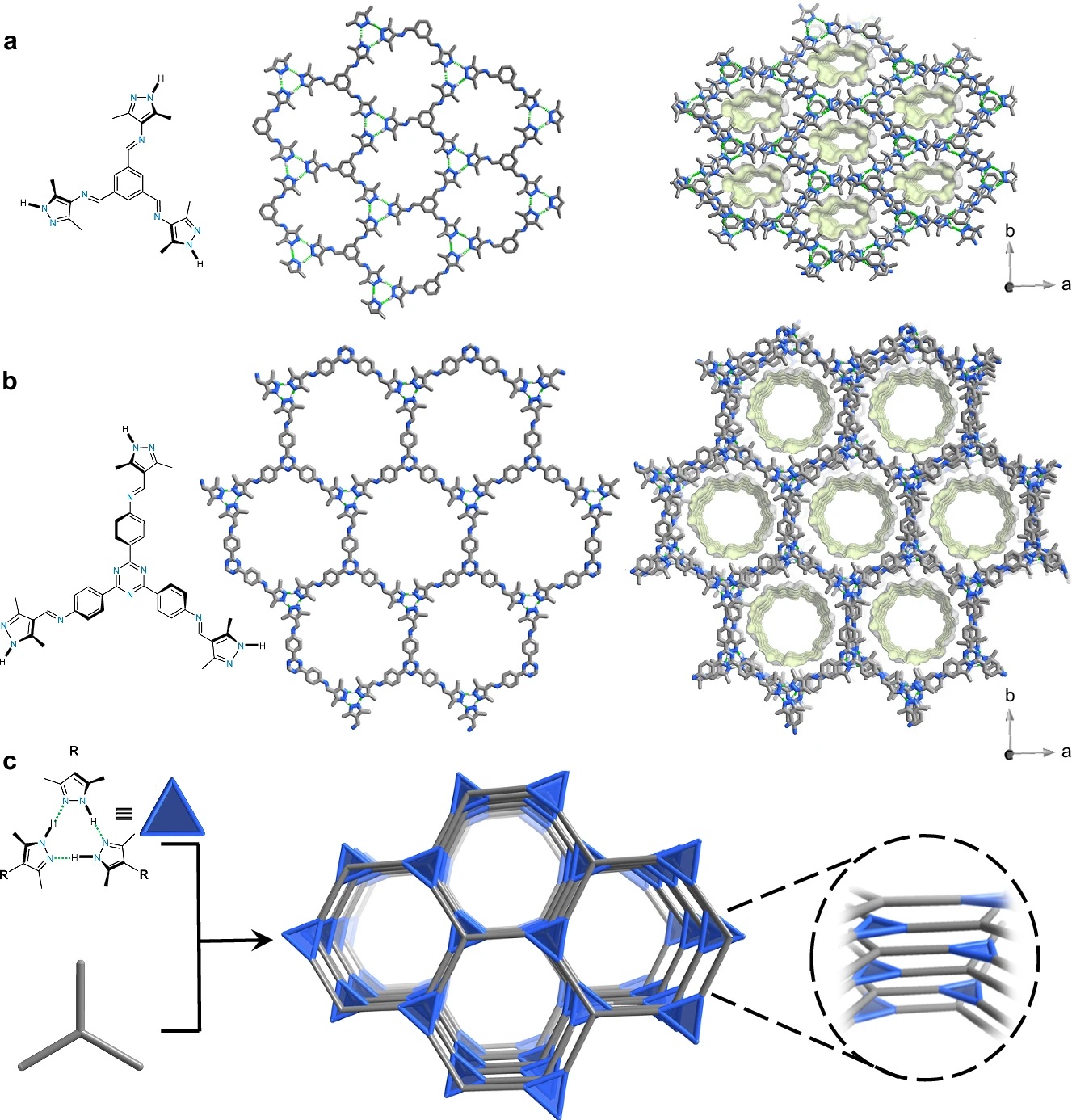
The authors from Kyoto University (Department of Synthetic Chemistry and Biological Chemistry, Institute for Integrated Cell-Material Sciences, etc.) developed MOF|HOF|MOF one-dimensional axial heterostructures and their component materials (HOF-a, HOF-b, MOF-b-Cu, etc.) with characteristics of adjustable domain distribution, high specific surface area, and stable photoluminescence, achieving breakthroughs in the application of porous framework heteromaterial design and functional regulation field.
Background:
1. To address the problem that hydrogen-bonded organic frameworks (HOFs) and metal-organic frameworks (MOFs) are difficult to construct one-dimensional axial heterostructures due to significant differences in chemical bonding properties, previous researchers conducted work on core-shell HOF-MOF heterostructures, achieving success in simple assembly, yet there are problems of inability to realize directional assembly and domain size regulation, and lack of one-dimensional axial structural designs.
2. The authors in this study proposed an innovative metalation reaction method (exchanging H with monovalent metal cations) and obtained MOF|HOF|MOF one-dimensional axial heterostructures with precise spatiotemporal control, solving the bonding mismatch problem between HOFs and MOFs.
Research Content:
1. Synthesis:
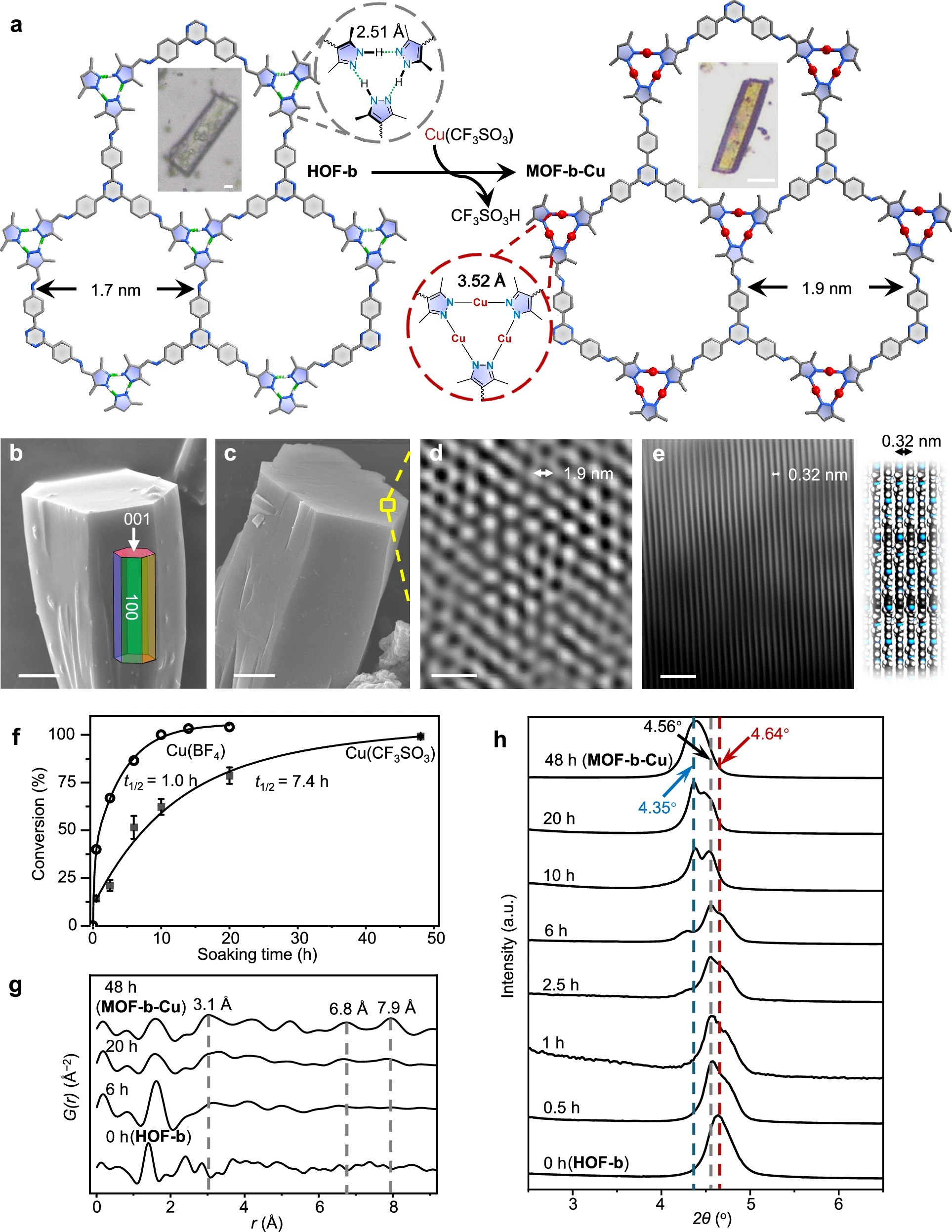
The authors synthesized HOF-a and HOF-b via Schiff-base reaction; prepared MOF|HOF|MOF heterostructures by soaking rod-shaped HOF-b single crystals in Cu(CF₃SO₃) methanol solution at 298 K, with metalation time controlled (0.5-48 h) to adjust domain distribution.
2. Characterizations:
1) BET results: HOF-b has a BET surface area of 2105 m²/g, MOF-b-Cu up to 2900 m²/g; pore size distribution: HOF-b (1.6 nm), MOF-b-Cu and heterostructures (1.9 nm).
2) SEM/TEM tests show the particle size of the material: HOF-b and MOF-b-Cu are hexagonal prism-like crystals, with HOF-b crystal length around 35 μm, and 60 μm crystals achieving 100% metalation.
3) Other tests: PXRD confirms MOF-b-Cu crystallizes in P3 space group; FT-IR verifies the conversion of [N-H···N] to [N-Cu-N]; TGA shows MOF-b-Cu is stable below 500 °C in Ar; photoluminescence tests reveal HOF-b (QY 2.8%), MOF-b-Cu (QY 4.9%) with characteristic emission peaks.
3. Application:
The material was tested in gas adsorption and photoluminescence applications: heterostructures show adjustable N₂ adsorption capacity with MOF domain ratio; MOF-b-Cu exhibits solvatochromism for solvent identification; heterostructures have spatially resolved luminescence for potential photonic devices.
4. Mechanism:
- Experimental result analysis: SEM-EDS line scans confirm metalation starts from HOF crystal ends and spreads to the center, forming axial heterostructures; time-course PXRD shows gradual peak shift from HOF to MOF, indicating structural transformation.
- Performance mechanism: Cu⁺ and CF₃SO₃⁻ diffuse along HOF 1D channels (diffusion coefficient 3.24×10⁻¹¹ cm²/s); MOF's coplanar structure and longer [N-Cu-N] bonds expand pores, enhancing adsorption; metal-to-ligand charge transfer (MLCT) causes MOF's luminescence.
Outlook:
This research innovatively constructs the first HOF-MOF one-dimensional axial heterostructure via metalation, realizing precise regulation of porous framework domains. The materials' excellent stability and tunable functions provide a new strategy for heteromaterial design, promoting applications in gas separation, optoelectronics, and information storage.
One-dimensional axial heterostructure of hydrogen-bonded framework and metal-organic framework by metalation reaction
Authors: Siquan Zhang, Yong-Sheng Wei, Ellan K. Berdichevsky, Loris Lombardo, Zeyu Fan, Cheng Luo, Masahiko Tsujimoto, Nao Horike, Satoshi Horike
DOI: 10.1038/s41467-025-64715-1
Link: https://www.nature.com/articles/s41467-025-64715-1
The above review is for academic progress sharing. For any errors or copyright issues, please contact us for correction or removal.

