Home >
News > MOF-Templated Porous Co₃O₄ for Gas Sensing
MOF-Templated Porous Co₃O₄ for Gas Sensing
Summary:
The authors from State Key Laboratory of Physical Chemistry of Solid Surfaces & Department of Chemistry, College of Chemistry and Chemical Engineering, Xiamen University (China) developed porous Co₃O₄ concave nanocubes with high specific surface area (120.9 m²·g⁻¹), achieving excellent performance in the application of volatile organic compounds (VOCs) gas sensing, especially for ethanol.

Background:
1. To address the issues that most porous Co₃O₄ nanostructures have low specific surface area (<50 m²·g⁻¹), fail to maintain precursor morphology, and tend to aggregate, previous researchers synthesized various Co₃O₄ porous structures via thermal decomposition of Co-based compounds (carbonates, hydroxides, MOFs), yet problems like low surface area and poor morphology retention remained.
2. The authors in this study proposed an innovative MOF-templated synthesis method (using Co-MOF, ZIF-67 as template) with optimized calcination temperature (300 °C), obtaining porous Co₃O₄ concave nanocubes with high specific surface area and stable morphology.
Research Content:
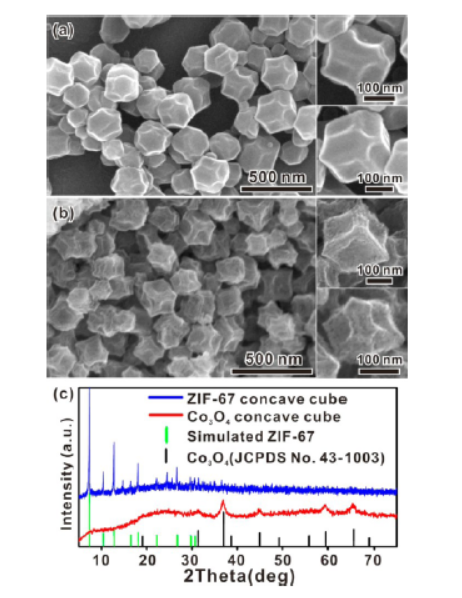
1.Synthesis: The authors synthesized the porous Co₃O₄ concave nanocubes via a two-step method: first, preparing ZIF-67 concave nanocubes by mixing Co(NO₃)₂·6H₂O and 2-methylimidazole aqueous solutions (stirring 6 h at room temperature, centrifuging, washing with alcohol 3 times, drying at 80 °C for 24 h); second, calcining ZIF-67 in a ceramic crucible (heating rate 5 °C·min⁻¹, 3 h in air) at 300/350/400 °C to get Co₃O₄-300, Co₃O₄-350, Co₃O₄-400 samples respectively.
2.Characterizations:
1) BET results: Co₃O₄-300 has a specific surface area of 120.9 m²·g⁻¹, Co₃O₄-350 55.1 m²·g⁻¹, Co₃O₄-400 22.6 m²·g⁻¹; pore size distribution (BJH method): Co₃O₄-300 (2-4 nm, centered at 3.6 nm), Co₃O₄-350 (13-15 nm, centered at 14.2 nm), Co₃O₄-400 (29-32 nm, centered at 30.7 nm).
2) SEM/TEM tests show the particle size of Co₃O₄-300 is ~200 nm with concave cubic morphology; primary crystallite size: Co₃O₄-300 (5-8 nm, XRD: 7 nm), Co₃O₄-350 (14-16 nm, XRD: 15 nm), Co₃O₄-400 (26-28 nm, XRD: 27 nm).
3) XRD confirms pure spinel Co₃O₄ (JCPDS Card No. 43-1003); XPS: Co 2p peaks at 794.8 eV (Co 2p₁/₂) and 779.8 eV (Co 2p₃/₂), O 1s splits into O_L (lattice oxygen, 530±0.2 eV), O_V (oxygen vacancies, 531±0.1 eV), O_C (chemisorbed oxygen, 532±0.2 eV), Co₃O₄-300 has 19.5% O_C; Raman spectra: five active modes (A₁g, E_g, 3F₂g) of spinel Co₃O₄, Co₃O₄-300 peaks at 187.8, 468.9, 509.2, 606.7, 674.6 cm⁻¹.
3.Application: The material was tested in gas sensing (ethanol, acetone, toluene, benzene) on a WS-30A system (aged 24 h at 300 °C, bias voltage 5 V): Co₃O₄-300 has highest sensitivity to ethanol (2x higher than acetone, 4x than toluene, 13x than benzene at same concentration), fast response/recovery (<10 s), low detection limit (≥10 ppm), optimal operating temperature 300 °C.
4.Mechanism: High porosity and specific surface area of Co₃O₄-300 provide abundant adsorption sites and shorten analyte diffusion path; rich chemisorbed oxygen enhances surface reaction (reducing gas reacts with adsorbed O to release electrons, neutralizing Co₃O₄ holes and increasing resistance); higher calcination temperature accelerates Co atom migration, leading to larger crystallites, lower surface area, and worse sensing performance.
Outlook:
This research successfully synthesizes porous Co₃O₄ concave nanocubes with excellent gas sensing performance, provides an effective MOF-templated strategy for porous transition metal oxides, and has potential in catalysis, lithium-ion batteries, supercapacitors, etc.
MOF-Templated Synthesis of Porous Co₃O₄ Concave Nanocubes with High Specific Surface Area and Their Gas Sensing Properties
Authors: Yinyun Lu, Wenwen Zhan, Yue He, Yiting Wang, Xiangjian Kong, Qin Kuang*, Zhaoxiong Xie, Lansun Zheng
DOI: 10.1021/am405858v
Link: https://pubs.acs.org/doi/10.1021/am405858v
The above review is for academic progress sharing. For any errors or copyright issues, please contact us for correction or removal.

