Home >
News > Flexible Solid-State Supercapacitor Based on a Metal−Organic Framework Interwoven by Electrochemically-Deposited PANI
Flexible Solid-State Supercapacitor Based on a Metal−Organic Framework Interwoven by Electrochemically-Deposited PANI
Summary:
The authors from Beijing Institute of Technology, Tianjin University, etc. developed **PANI-ZIF-67-CC flexible conductive porous electrode** with high capacitance, good conductivity, and flexibility, achieving excellent performance in flexible solid-state supercapacitor applications.
Background:
1. To address the problem of poor conductivity of MOFs limiting their supercapacitor performance, previous researchers used pristine, decomposed, or pyrolyzed MOFs as electrodes, yet faced low capacitance and poor cycling stability.
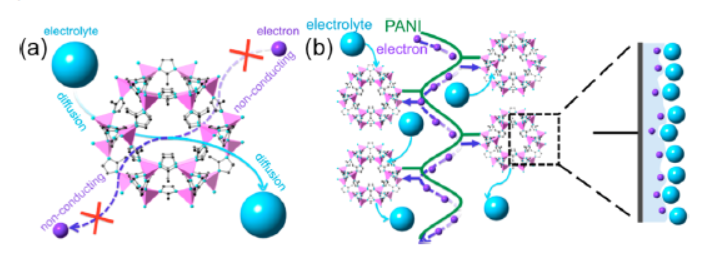
2. The authors proposed an innovative strategy of electrochemically depositing PANI to interweave ZIF-67, synergizing MOF’s EDLC and PANI’s pseudocapacitance to enhance electrode performance.
Research Content:
1. Synthesis
- ZIF-67-CC preparation: 70 wt% ZIF-67, 20 wt% Super P, 10 wt% PVDF were mixed in NMP to form a slurry, coated on carbon cloth, and dried.
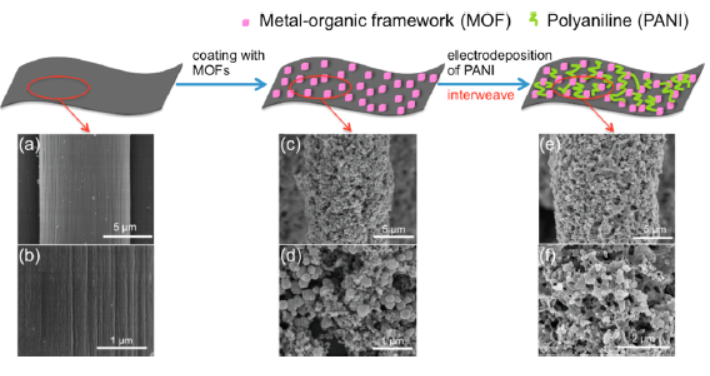
- PANI-ZIF-67-CC preparation: ZIF-67-CC was used as the substrate for electrochemical polymerization of aniline, washed, and dried at 80°C (1×2 cm² carbon cloth loaded with ~7.0 mg ZIF-67 and ~1.0 mg PANI).
2. Characterizations
1) BET and pore size: ZIF-67 BET = 1717 m²·g⁻¹, ZIF-67-CC = 450 m²·g⁻¹, PANI-ZIF-67-CC = 73 m²·g⁻¹; micropores of ZIF-67 decreased after PANI modification.
2) SEM: ZIF-67 crystals (~300 nm) uniformly distributed on carbon cloth; PANI chains interweaved ZIF-67 particles.
3) Other tests: PXRD confirmed ZIF-67 structure retention; XPS showed PANI’s N⁺/N ratio >0.1; EIS revealed internal resistance reduced from 4.428 Ω to 3.582 Ω.
3. Application
- Three-electrode system: PANI-ZIF-67-CC had areal capacitance of 2146 mF·cm⁻² (10 mV·s⁻¹), 1466 mF·cm⁻² (50 mV·s⁻¹), 901 mF·cm⁻² (100 mV·s⁻¹), and specific capacitance of 371 F·g⁻¹.
- Flexible solid-state supercapacitor: Areal capacitance 35 mF·cm⁻², power density 0.833 W·cm⁻³, 80% capacitance retention after 2000 cycles; powered LED successfully.
4. Mechanism
- PANI acts as electron transport bridges, improving MOF conductivity and wettability, enabling electrolyte access to MOF internal surfaces.
- Synergistic effect: MOF provides high surface area for EDLC, PANI contributes pseudocapacitance, jointly enhancing supercapacitor performance.
Outlook:
This research solves MOF’s conductivity problem via PANI interweaving, achieves high-performance flexible solid-state supercapacitors, and provides a new path for MOF-based electrochemical energy storage devices.
Flexible Solid-State Supercapacitor Based on a Metal−Organic Framework Interwoven by Electrochemically-Deposited PANI
Authors: Lu Wang, Xiao Feng, Lantian Ren, Qiuhan Piao, Jieqiang Zhong, Yuanbo Wang, Haiwei Li, Yifa Chen, Bo Wang
DOI: 10.1021/jacs.5b01613
Link: https://pubs.acs.org/doi/10.1021/jacs.5b01613
The above review is for academic progress sharing. For any errors or copyright issues, please contact us for correction or removal.

