Home >
News > MOF-Biopolymer Hybrid for Advanced Anticancer Therapy
MOF-Biopolymer Hybrid for Advanced Anticancer Therapy
Summary:
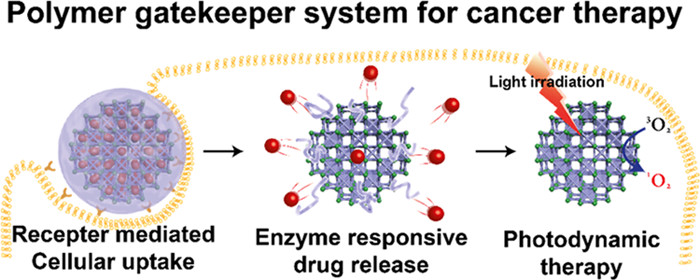
The authors from Ulsan National Institute of Science and Technology (UNIST) developed HA-Dox-PCN with targeted delivery, enzyme-responsive drug release and photodynamic therapy (PDT) properties, achieving efficient chemo-PDT combined anticancer effect in advanced anticancer therapy field.
Background:
1. To address the problem that MOF-based drug delivery systems have poor colloidal stability and premature drug release, previous researchers developed drug-encapsulated MOFs, achieving certain drug delivery effects, yet there are problems of insufficient water stability and uncontrollable drug release.
2. The authors in this study proposed an innovative method of coating HA (as gatekeeper) on PCN-224 loaded with Dox, obtained a system with targeted, enzyme-responsive and PDT functions for efficient anticancer therapy.
Research Content:
1.Synthesis:
- PCN-224: Solvothermal method—mixed TCPP, ZrOCl₂·8H₂O, benzoic acid in DMF, heated at 90°C for 5h, centrifuged, washed and dried.
- Dox-PCN: Stirred PCN-224 (4mg) with Dox (8mg) in DMSO for 24h, centrifuged, dried and redispersed in DI water.
- HA-Dox-PCN: Stirred Dox-PCN (1mg) with HA (2mg) in DI water for 24h, centrifuged, washed and redispersed.
2.Characterizations:
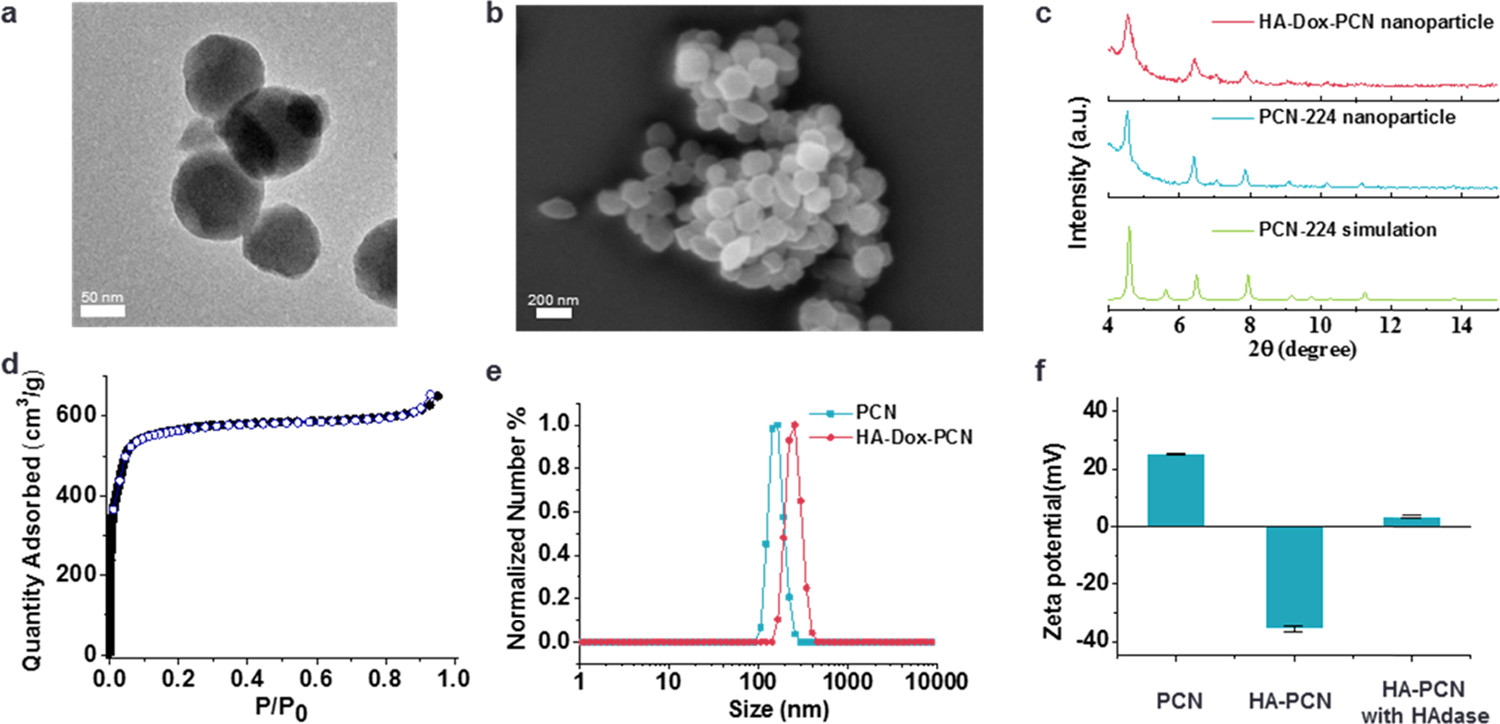
1) BET: PCN-224 BET surface area 2296(8) m²/g; Dox-PCN 1353(5) m²/g; pore size of PCN-224 ~1.9nm.
2) SEM/TEM tests show PCN-224 and HA-Dox-PCN have spherical morphology, particle size ~90nm; DLS shows HA-Dox-PCN hydrodynamic radius ~250±20nm.
3) ζ-potential: PCN-224 +27mV, HA-Dox-PCN -34mV; ABDA assay confirms singlet oxygen generation by PCN-224 and HA-Dox-PCN.
3.Application:
- Drug release: HA-Dox-PCN releases Dox only when HAdase (400U/mL) is added, no premature release.
- Cell tests: Selective uptake by CD44-positive MDA-MB-231/SCC-7 cells; under light, HA-Dox-PCN reduces viability of MDA-MB-231/SCC-7 and MCF-7/ADR (drug-resistant) cells.
4.Mechanism:
- HA binds to PCN-224 via multivalent coordination (not just electrostatic interaction), blocking pores to prevent premature drug release.
- In cancer cells, HAdase degrades HA, triggering Dox release; PCN-224’s porphyrin generates singlet oxygen under light for PDT, synergizing with chemotherapy.
Outlook:
This research solves MOF’s drug release and stability issues, realizes targeted chemo-PDT combined therapy, provides a new strategy for precise anticancer treatment, especially for drug-resistant cancers.
MOF × Biopolymer: Collaborative Combination of Metal−Organic Framework and Biopolymer for Advanced Anticancer Therapy
Authors: Kibeom Kim, Sungmin Lee, Eunji Jin, L. Palanikumar, Jeong Hyeon Lee, Jin Chul Kim, Jung Seung Nam, Batakrishna Jana, Tae-Hyuk Kwon, Sang Kyu Kwak, Wonyoung Choe, Ja-Hyoung Ryu
DOI: 10.1021/acsami.9b05736
Link: https://pubs.acs.org/doi/10.1021/acsami.9b05736
The above review is for academic progress sharing. For any errors or copyright issues, please contact us for correction or removal.

