Home >
News > Light-Promoted CO₂ Conversion from Epoxides to Cyclic Carbonates at Ambient Conditions over a Bi-Based Metal–Organic Framework
Light-Promoted CO₂ Conversion from Epoxides to Cyclic Carbonates at Ambient Conditions over a Bi-Based Metal–Organic Framework
Summary:
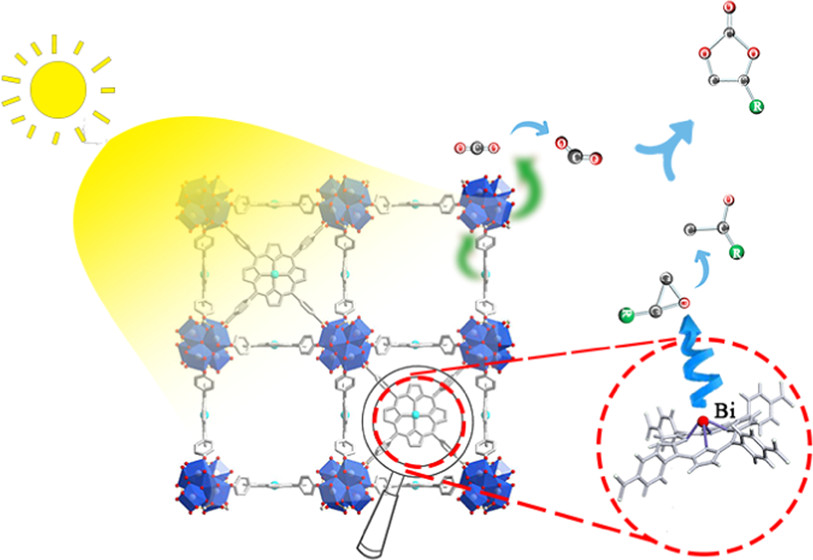
The authors from State Key Laboratory of Crystal Materials, Shandong University and School of Physics, Shandong University developed a Bi-based metal–organic framework (Bi-PCN-224) with Lewis acidity and light responsiveness, achieving 99% conversion of CO₂ and propylene oxide to propylene carbonate at ambient conditions in the application of CO₂ cycloaddition field.
Background:
1. To address the problem that traditional CO₂ cycloaddition with epoxides requires high temperature and pressure, previous researchers developed catalysts like bimetallic aluminum (salen) and Zn-based ionic liquids, achieving certain catalytic effects, yet there are problems of high energy consumption and poor cost-effectiveness.
2. The authors in this study proposed an innovative method of introducing Bi (Lewis acid) into PCN-224 and using light irradiation, obtained efficient CO₂ cycloaddition at room temperature and 1 atm.
Research Content:
1.Synthesis:
- PCN-224: Dissolved ZrCl₄ (100mg), H₂TCPP (40mg) and benzoic acid (2400mg) in DMF, hydrothermally treated at 393K for 12h, then washed and dried.
- Bi-PCN-224: Mixed PCN-224 (50mg) and Bi(NO₃)₃·5H₂O (50mg) DMF solutions, refluxed at 373K for 5h under N₂, washed and dried.
- Bi-TCPP: Refluxed H₂TCPP (50mg) and Bi(NO₃)₃·5H₂O (50mg) DMF solutions at 373K for 5h under N₂, washed and dried.
2.Characterizations:
1) BET: PCN-224 has a BET surface area of 2249.4 m²/g, Bi-PCN-224 is 1842.3 m²/g; CO₂ adsorption capacity of PCN-224 is 32 cm³/mg (dark), Bi-PCN-224 is 27 cm³/mg (dark).
2) SEM tests show PCN-224 and Bi-PCN-224 have cube morphology, with PCN-224 size of 600 nm.
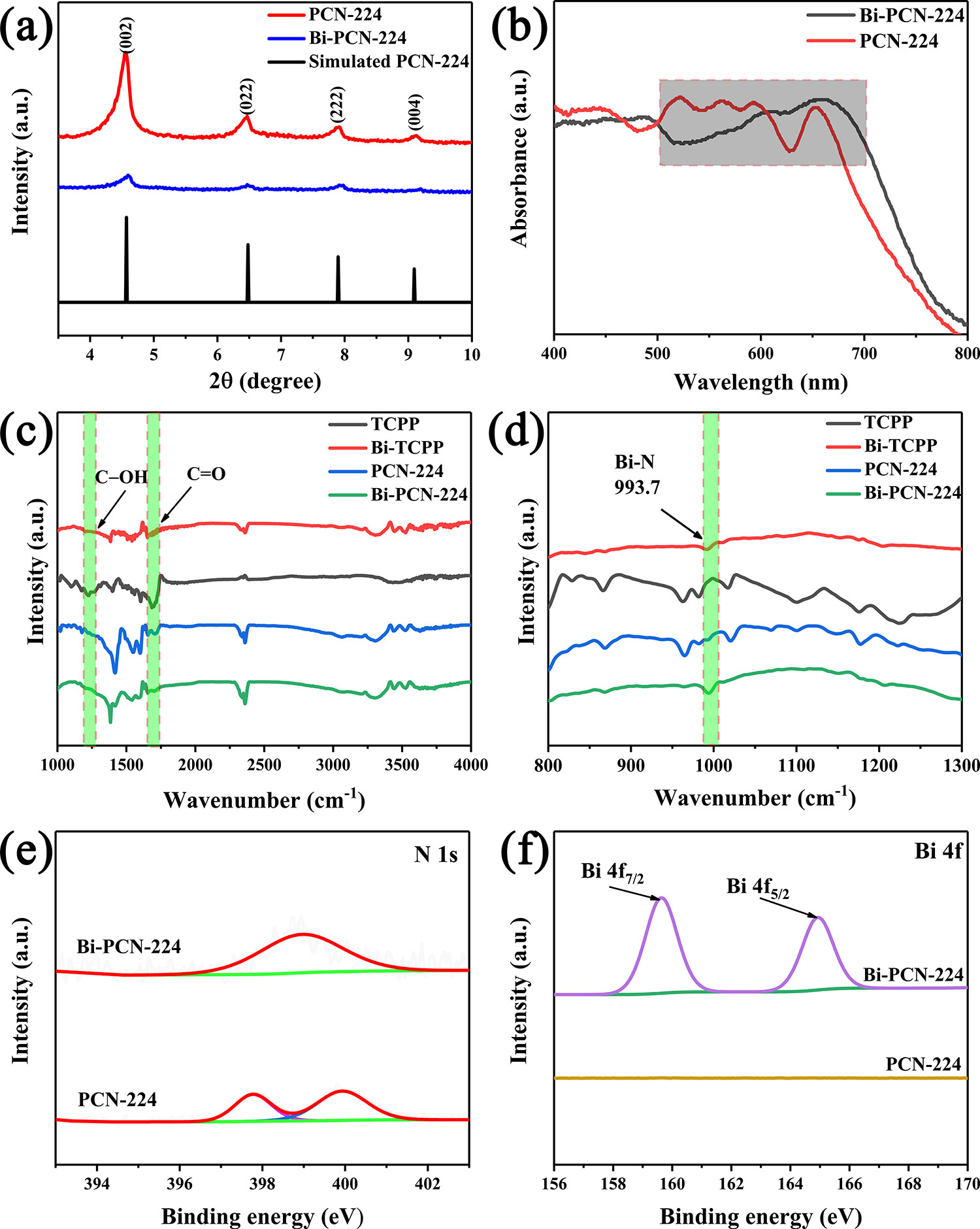
3) UV-vis DRS: Bi-PCN-224 shows 2 Q bands (vs 4 for PCN-224); XPS: Bi⁴f peaks at 165 and 159.6 eV (Bi³⁺), Zr³d peaks of Bi-PCN-224 shift negatively.
3.Application:
Tested in CO₂ cycloaddition with propylene oxide: 30mg catalyst, 0.5mmol TBAB, 4.5mmol epoxide, 1 bar CO₂, 300W xenon lamp for 6h. Bi-PCN-224 achieves 99% conversion (light), 36% (dark); PCN-224 gives 31% conversion.
4.Mechanism:
- Light induces LMCT from Bi porphyrin to Zr, converting Zr⁴⁺ to Zr³⁺ which activates CO₂.
- Bi (Lewis acid) coordinates with epoxide O to weaken C-O bond; photogenerated holes promote epoxide ring-opening. TBAB attacks epoxide C, forming cyclic carbonate via ring closure.
Outlook:
This research realizes efficient CO₂ cycloaddition at ambient conditions, provides a cost-effective CO₂ conversion strategy, and the stable Bi-PCN-224 has potential for industrial CO₂ resource utilization.
Light-Promoted CO₂ Conversion from Epoxides to Cyclic Carbonates at Ambient Conditions over a Bi-Based Metal–Organic Framework
Authors: Guangyao Zhai, Yuanyuan Liu, Longfei Lei, Jiajia Wang, Zeyan Wang, Zhaoke Zheng, Peng Wang, Hefeng Cheng, Ying Dai, Baibiao Huang
DOI: 10.1021/acscatal.0c05145
Link: https://pubs.acs.org/doi/10.1021/acscatal.0c05145
The above review is for academic progress sharing. For any errors or copyright issues, please contact us for correction or removal.

