Home >
News > Cu-doped MOFs for Antibacterial Wound Healing
Cu-doped MOFs for Antibacterial Wound Healing
Summary:
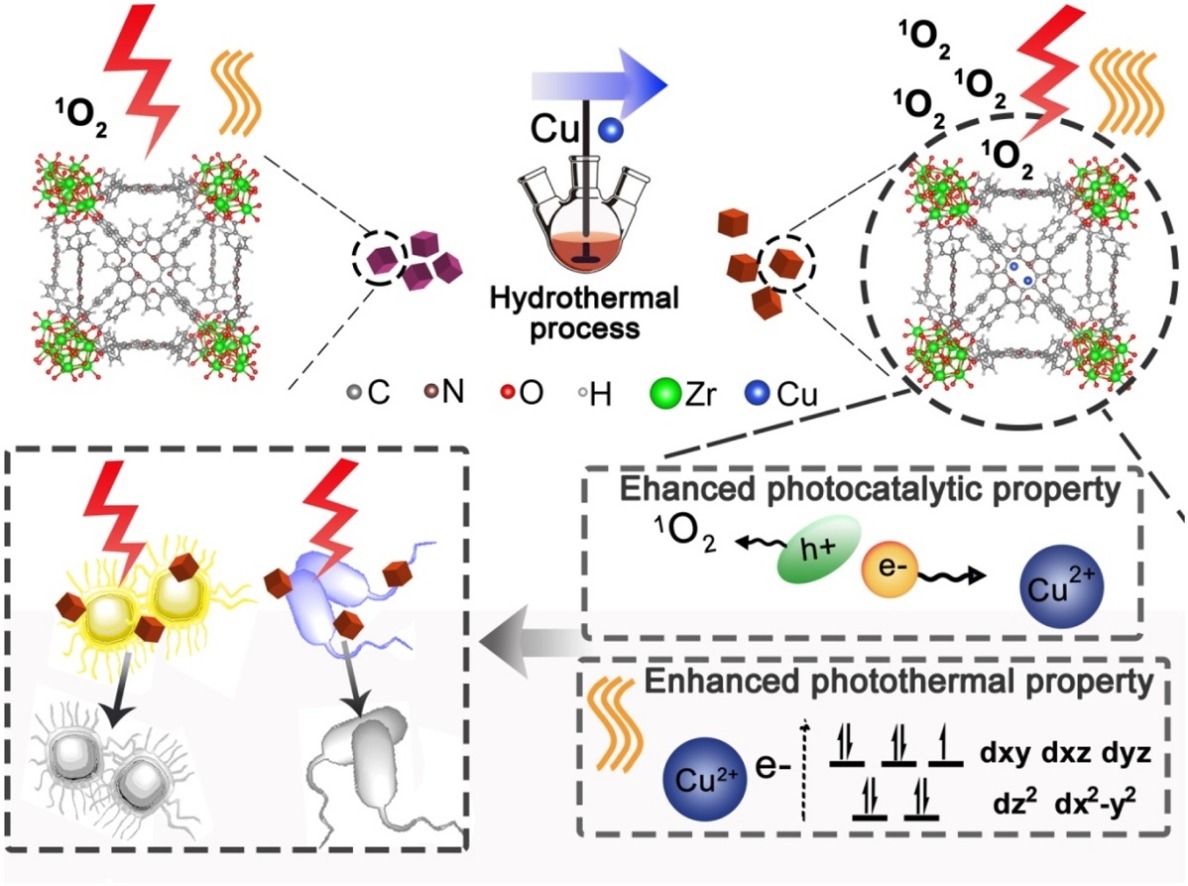
The authors from Tianjin University, Hubei University, The University of Hong Kong, Peking University, and Huazhong University of Science and Technology developed Cu-doped PCN-224 metal-organic frameworks (MOFs, e.g., Cu₁₀MOF) with enhanced photocatalytic activity, photothermal effect, and good biocompatibility, achieving efficient antibacterial performance and accelerated wound healing in the application of bacterial-infected wound treatment.
Background:
1. To address the problem of drug-resistant bacteria caused by excessive use of antibiotics in bacterial-infected wound treatment, previous researchers proposed antibacterial mechanisms like ROS-based PDT and hyperthermia-based PTT, and used MOFs as antibacterial agents (mainly via metal ion release), yet these MOFs have biotoxicity issues; PCN-224 (Zr₆ clusters + TCPP ligand) has good biocompatibility but few antibacterial application studies.
2. The authors in this study proposed an innovative method of doping Cu²⁺ into the porphyrin ring of PCN-224 via hydrothermal reaction to form metalloporphyrin MOFs, which enhanced photocatalytic and photothermal properties simultaneously, obtaining excellent antibacterial effects and wound healing promotion without biotoxicity.
Research Content:
1. Synthesis
-PCN-224: Ultrasonically dissolved ZrOCl₂·8H₂O (120mg), H₄TCPP (40mg), and benzoic acid (1200mg) in 8mL DMF, reacted at 120°C for 24h, and harvested dark purple crystals by centrifugation .
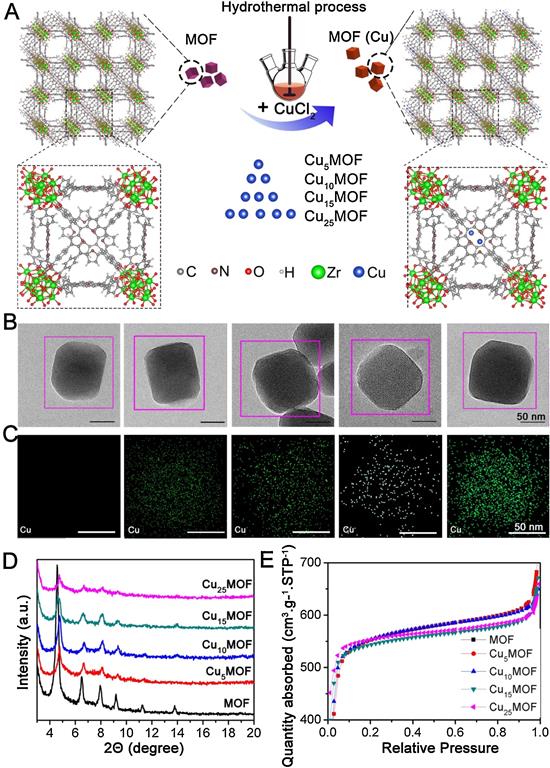
-Cu-doped MOFs (Cu₅MOF, Cu₁₀MOF, Cu₁₅MOF, Cu₂₅MOF): Mixed PCN-224 (100mg) with different amounts of CuCl₂·2H₂O (2.5/5/7.5/12.5mmol) in 10mL DMF, heated at 130°C for 10h under stirring, and harvested dark red crystals by centrifugation .
2. Characterizations
1) BET, pore size distribution: Nitrogen adsorption isotherms of MOF and Cu-doped MOFs showed similar trends, indicating preserved structure regardless of Cu²⁺ doping content .
2) SEM/TEM tests: MOF particles were cubic crystals with smooth surfaces, average size ~100nm; Cu²⁺ doping did not change particle shape/size; Cu element was uniformly distributed in Cu-doped MOFs .
3) Other tests:
-XRD: MOF had strong peaks at 4.6°, 6.5°, 7.9°, 9.2°; Cu-doped MOFs peaks weakened with increasing Cu²⁺ content but retained PCN-224 structure .
-UV-vis: Cu₁₀MOF had the highest absorbance at 660nm (order: Cu₁₀MOF > Cu₁₅MOF > Cu₅MOF > MOF > Cu₂₅MOF) .
-Photocurrent: Cu₁₀MOF generated the most electrons under light .
3. Application
-Antibacterial: At 500ppm, 660nm light (0.4W/cm²) for 20min, Cu₁₀MOF had 99.71% antibacterial efficacy against S. aureus and 97.14% against E. coli .
-Wound healing: In rat S. aureus-infected wound models, Cu₁₀MOF group showed almost no infection at day 2, nearly healed wound at day 8, and complete healing at day 14, with fewer inflammatory cells .
4. Mechanism
-Photocatalysis: Cu²⁺ traps photogenerated electrons, suppresses electron-hole recombination, accelerates carrier transfer, enhancing ROS (¹O₂) production under 660nm light .
-Photothermal: Cu²⁺’s d-d transition enhances light absorption, converting light energy to heat .
-Antibacterial: Synergistic ROS (destroys bacterial membrane) and heat (enhances membrane damage) kill bacteria; slow Cu²⁺ release accelerates wound healing .
Outlook:
This research successfully synthesizes Cu-doped PCN-224 MOFs with enhanced dual functions (photocatalysis/photothermal), solving biotoxicity and poor antibacterial efficiency of traditional MOFs. It provides a novel antibiotic-free strategy for bacterial-infected wound treatment, promoting the development of biomedical MOFs.
Enhanced photocatalytic activity and photothermal effects of cu-doped metal-organic frameworks for rapid treatment of bacteria-infected wounds
Authors: Donglin Han, Yajing Han, Jun Li, Xiangmei Liu, Kelvin Wai Kwok Yeung, Yufeng Zheng, Zhenduo Cui, Xianjin Yang, Yanqin Liang, Zhaoyang Li, Shengli Zhu, Xubo Yuan, Xiaobo Feng, Cao Yang, Shuilin Wu
DOI: 10.1016/j.apcatb.2019.118248
Link: https://www.sciencedirect.com/science/article/pii/S0926337319309956
The above review is for academic progress sharing. For any errors or copyright issues, please contact us for correction or removal.

