Home >
News > Cancer Cell Membrane-Camouflaged Bioreactor for Cancer Therapy
Cancer Cell Membrane-Camouflaged Bioreactor for Cancer Therapy
Summary:
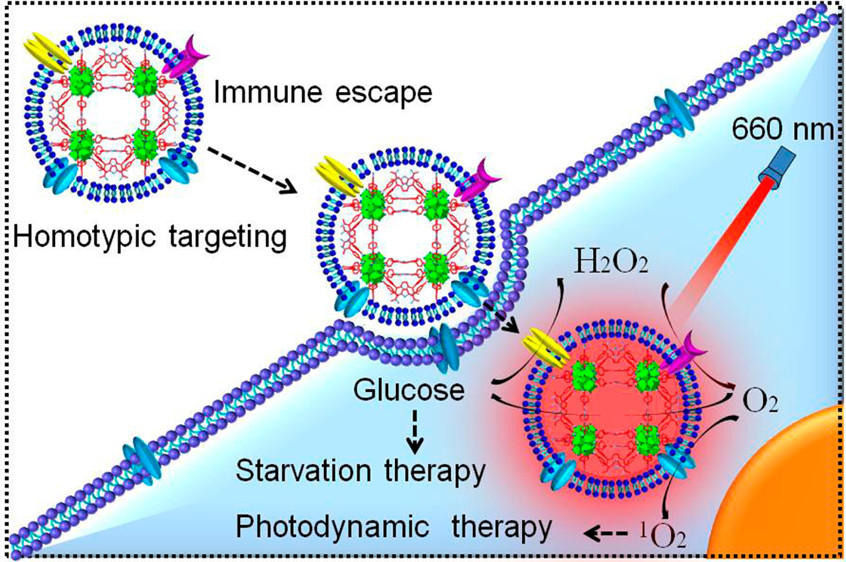
The authors from Wuhan University developed a cancer cell membrane-camouflaged cascade bioreactor (mCGP) with immune escape, homotypic targeting and cascade catalytic characteristics, achieving efficient synergistic starvation and photodynamic therapy (PDT) in cancer treatment.
Background:
1. Traditional cancer starvation therapy lacks targeting, leading to off-target effects, and adaptive up-regulation of cancer cells may cause treatment failure. PDT is limited by hypoxic tumor microenvironment, low photosensitizer loading efficiency and premature leakage, as well as poor immune escape and targeting.
2. The authors proposed a strategy of camouflaging porphyrin metal-organic framework (PCN-224) loaded with glucose oxidase (GOx) and catalase with cancer cell membrane, constructing mCGP to achieve synergistic starvation therapy and PDT with enhanced targeting and therapeutic efficiency.
Research Content:
1. Synthesis
The authors synthesized PCN-224 by dissolving tetrakis(4-carboxyphenyl)porphyrin (TCPP), ZrOCl₂·8H₂O and benzoic acid in N,N-dimethylformamide (DMF) and stirring at 90 °C for 5 h. Then GOx and catalase were loaded onto PCN-224 via electrostatic interactions to form CGP, which was further coated with 4T1 cancer cell membrane fragments by extrusion through a polycarbonate porous membrane to obtain mCGP.
2. Characterizations
1) BET and pore size distribution: Not explicitly reported in the literature.
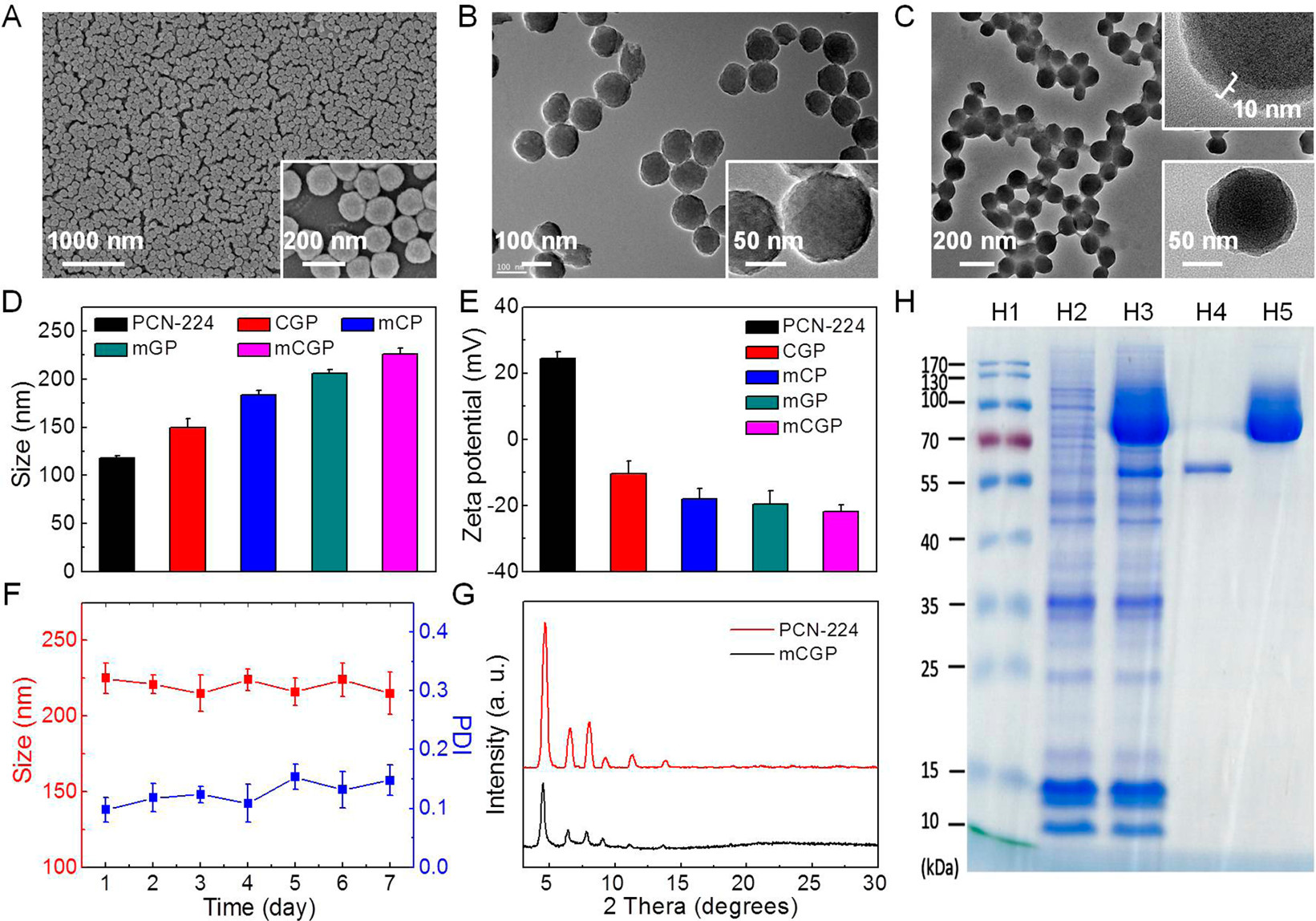
2) SEM/TEM tests show that PCN-224 has a monodispersed size of about 105 nm, and mCGP has a core-shell structure with a uniform outer lipid bilayer shell of about 10 nm and a hydrodynamic size of about 227.5 nm.
3) Other tests: Zeta potential of mCGP is nearly -20.9 mV and stable for 7 days; PXRD shows mCGP retains PCN-224's crystal structure; SDS-PAGE confirms the presence of cancer cell membrane proteins, GOx (80 kDa) and catalase (62 kDa) in mCGP.
3. Application
- In vitro: mCGP shows the highest phototoxicity against 4T1 cells under normoxic (21% O₂) and hypoxic (2% O₂) environments, with 38.82% of dead and apoptotic cells after light irradiation; it has lower toxicity to normal COS7 cells.
- In vivo: In 4T1 tumor-bearing mice, a single administration of mCGP combined with light completely suppresses tumor growth for 14 days, with a tumor inhibition rate of 97.1%, and no obvious systemic toxicity.
4. Mechanism
After mCGP accumulates in tumors through homotypic targeting and immune escape, catalase catalyzes the decomposition of endogenous H₂O₂ in tumors to produce O₂, which alleviates hypoxia. O₂ promotes GOx-catalyzed glucose decomposition, cutting off nutrient supply for starvation therapy and producing H₂O₂ and gluconic acid. Meanwhile, O₂ enhances the production of cytotoxic singlet oxygen (¹O₂) by PCN-224 under 660 nm light irradiation, realizing synergistic starvation therapy and PDT.
Outlook:
This research successfully constructs a biomimetic cascade bioreactor mCGP, solving key problems such as poor targeting, immune escape and hypoxic limitation in traditional cancer therapy. It provides a new idea for the development of spatiotemporally controlled complementary cancer treatment modes, and has important significance for promoting the progress of cancer synergistic therapy.
Cancer Cell Membrane Camouflaged Cascade Bioreactor for Cancer Targeted Starvation and Photodynamic Therapy
Authors: Shi-Ying Li, Hong Cheng, Bo-Ru Xie, Wen-Xiu Qiu, Jing-Yue Zeng, Chu-Xin Li, Shuang-Shuang Wan, Lu Zhang, Wen-Long Liu, Xian-Zheng Zhang*
DOI: 10.1021/acsnano.7b02533
Link: https://pubs.acs.org/doi/10.1021/acsnano.7b02533
The above review is for academic progress sharing. For any errors or copyright issues, please contact us for correction or removal.

