Home >
News > Construction of Ultrastable Porphyrin Zr Metal−Organic Frameworks through Linker Elimination
Construction of Ultrastable Porphyrin Zr Metal−Organic Frameworks through Linker Elimination
Summary:
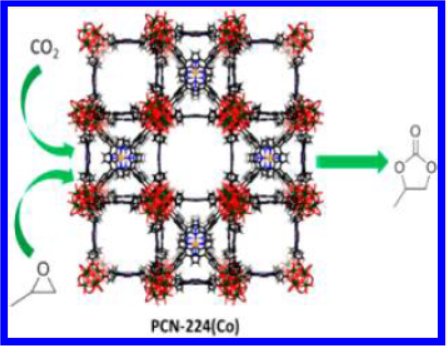
The authors from Department of Chemistry, Texas A&M University, United States developed PCN-224 series porphyrin Zr metal-organic frameworks (MOFs) with characteristics of ultrahigh chemical stability (stable in pH=0-11 aqueous solution), high BET surface area (2600 m²/g), and 3-D nanochannels, achieving high catalytic activity and recyclability in the application of CO₂/propylene oxide coupling reaction field.
Background:
1. To address the problem that most porphyrinic MOFs have weak chemical stability (constructed by soft acids and hard bases, limiting application under harsh catalytic conditions) and few highly stable MOFs (most based on high-oxidation-state metals with carboxylates or nitrogen-containing ligands with divalent metals, while Zr(IV)-based MOFs are less explored), previous researchers conducted work on immobilizing porphyrin catalysts in polymers/zeolites and developing porphyrinic MOFs via linker extension/encapsulation, achieving success in exploring catalytic/optical properties, yet there are problems of poor stability and restricted application conditions.
2. The authors in this study proposed an innovative linker elimination strategy, adjusting reaction conditions to tune the coordination environment of Zr₆ clusters, and obtained PCN-224 series MOFs with D₃d symmetry Zr₆ clusters, high stability, and excellent catalytic performance.
Research Content:
1. Synthesis:
The authors synthesized PCN-224 (no metal, Ni, Co, Fe) using the method of ultrasonic dissolution of ZrCl₄, corresponding metalloporphyrin ligands (H₂TCPP, Ni-TCPP, Co-TCPP, FeTCPPCl) and benzoic acid in DMF, followed by heating at 120°C (24 h for no metal/Ni/Co, 12 h for Fe precursor) and post-treatment (filtration, washing, drying; postsynthesis for pure PCN-224(Fe)).
2. Characterizations:
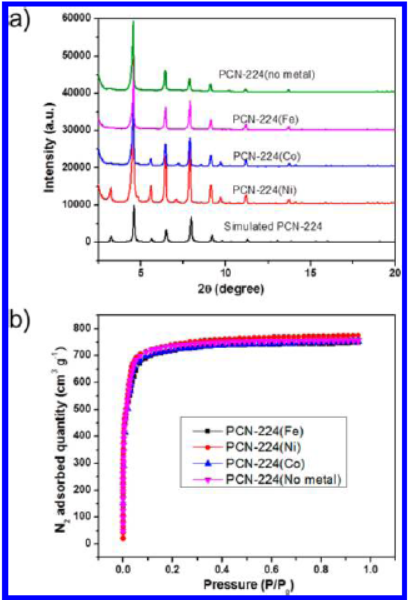
1) BET result: PCN-224(Ni) has a BET surface area of 2600 m²/g and a total pore volume of 1.59 cm³/g; N₂ adsorption shows a typical type-I isotherm. Pore size distribution: 3-D channels as large as 19 Å.
2) SEM/TEM tests: Not mentioned in the literature.
3) Other tests: Powder X-ray diffraction (PXRD) confirmed good crystallinity (retained after pH stability tests); Elemental analysis (e.g., PCN-224(Co): calcd C 42.21%, H 2.36%, N 4.10%; found C 46.74%, H 2.57%, N 3.73%); FTIR recorded characteristic peaks (e.g., PCN-224(no metal): 1664 cm⁻¹, 1406 cm⁻¹ (vs)); Thermogravimetric analysis (TGA) evaluated thermal stability.
3. Application:
The material PCN-224(Co) was tested in CO₂/propylene oxide coupling reaction: with 0.0321 mmol PCN-224(Co), 0.0716 mmol tetrabutylammonium chloride, 35.7 mmol propylene oxide, at 2 MPa CO₂, 100°C for 4 h. Results: Run 1-3 conversions 42%-39%, TON 419-518, TOF 104-129 h⁻¹; recyclable 3 times with retained crystallinity.
4. Mechanism:
- Structural mechanism: Linker elimination reduces Zr₆ cluster connectivity (6-connected vs 12-connected in UiO-66, 8-connected in PCN-222) and symmetry to D₃d, increasing free space for 3-D nanochannels (facilitating substrate/product diffusion) and introducing terminal OH groups (strengthening framework bonding, enhancing stability).
- Catalytic mechanism: Evenly distributed Co-porphyrin catalytic centers in PCN-224(Co) and 3-D channels (avoiding diffusion control) enable high catalytic activity; ultrahigh stability ensures recyclability.
Outlook:
This research successfully synthesized PCN-224 series MOFs via linker elimination, breaking through the stability limitation of porphyrinic MOFs. It provides a recyclable catalyst for CO₂ conversion, promoting MOFs' application in harsh catalytic conditions.
Construction of Ultrastable Porphyrin Zr Metal−Organic Frameworks through Linker Elimination
Authors: Dawei Feng, Wan-Chun Chung, Zhangwen Wei, Zhi-Yuan Gu, Hai-Long Jiang, Ying-Pin Chen, Donald J. Darensbourg, Hong-Cai Zhou*
DOI: 10.1021/ja408084j
Link: https://pubs.acs.org/doi/full/10.1021/ja408084j
The above review is for academic progress sharing. For any errors or copyright issues, please contact us for correction or removal.

