Home >
News > Adsorption-based atmospheric water harvesting device for arid climates
Adsorption-based atmospheric water harvesting device for arid climates
Summary:
The authors from Massachusetts Institute of Technology, University of California–Berkeley, Lawrence Berkeley National Laboratory, and King Abdulaziz City for Science and Technology developed the metal−organic framework MOF-801 with high water adsorption capacity, hydrothermal stability, and low regeneration temperature, achieving ~14% thermal efficiency and over 0.25 L/kg MOF daily water production in arid climate (10–40% RH) atmospheric water harvesting.
Background:
1. To address water scarcity in arid regions, previous researchers developed refrigeration-based and solar-thermal-driven atmospheric water generators (AWGs); refrigeration-based AWGs are energy-intensive at low RH, while solar-thermal AWGs lacked validation in extreme arid conditions.
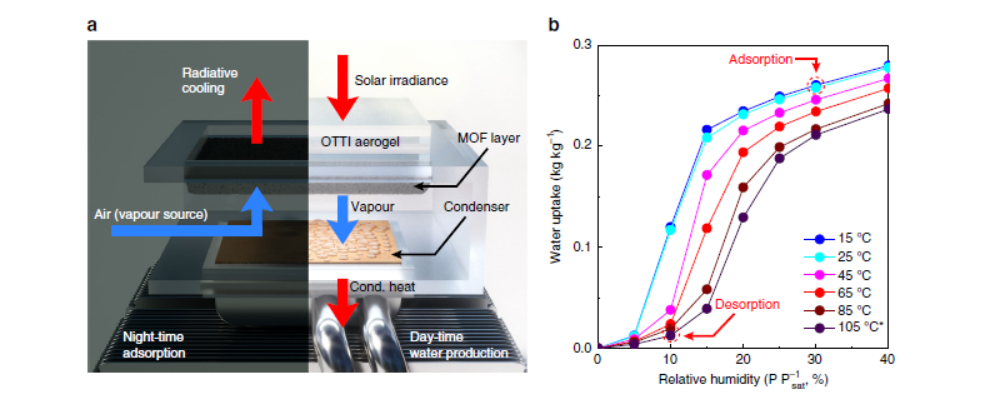
2. The authors proposed an air-cooled MOF-801-based AWG, integrating night radiative cooling and optical concentration, realizing efficient water harvesting in 10–40% RH and sub-zero dew points.
Research Content:
1. Synthesis:
The authors dissolved fumaric acid (5.8 g, 50 mmol) and ZrOCl₂·8H₂O (16 g, 50 mmol) in DMF (200 mL) and formic acid (70 mL), heated at 130 °C for 6 h; the precipitate was washed (DMF, methanol), air-dried, and vacuum-activated (70 °C for 12 h, 150 °C for 48 h) to synthesize MOF-801.
2. Characterizations:
1) BET test showed MOF-801 had a pore volume of 0.3425 cm³/g; pycnometer gave a particle density of 1400±20 kg/m³, skeletal density of 2.6991 g/cm³.
2) SEM/TEM (Supplementary Fig. 4) characterized MOF-801 particle size; inter/intra-crystalline diffusion was analyzed (Supplementary Notes 2-3).
3) Optical test: 8-mm OTTI aerogel (synthesized via TMOS sol-gel) had solar transmittance ~0.94, thermal conductivity <0.03 W·m⁻¹·K⁻¹; Pyromark paint on MOF layer had solar absorptivity ~0.95.
3. Application:
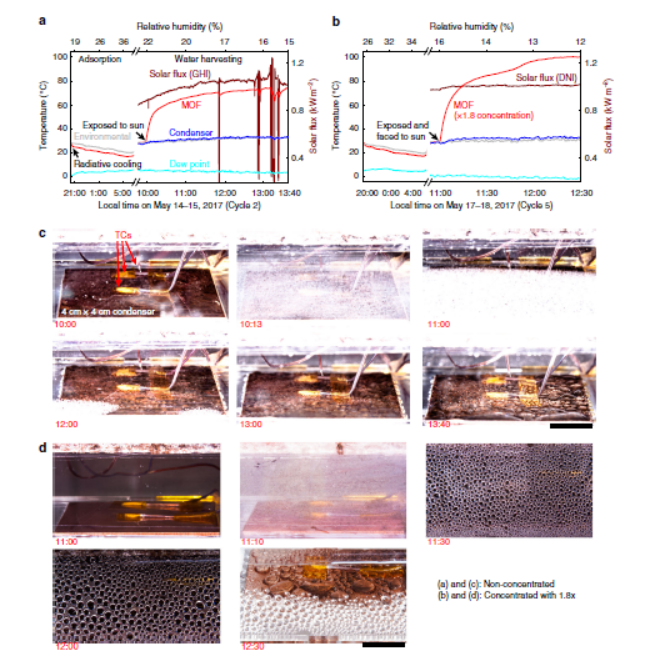
The MOF-801-based AWG was tested in Tempe, AZ (May 2017, 5 cycles): non-concentrated cycle produced ~0.12 L/kg MOF, 1.8× optical concentration cycle produced ~0.28 L/kg MOF; water had Zr²⁺ <1 ppb, no organic linkers.
4. Mechanism:
MOF-801’s step-like isotherm (20% RH adsorption step) enabled large water uptake/release with small changes; night radiative cooling (3 K temp drop) raised effective RH by 5–7%; optical concentration boosted desorption temp, overcoming kinetic limitations for full regeneration.
Outlook:
This research validated MOF-based AWGs in extreme arid climates, optimized device design (radiative cooling, optical concentration), and proved MOF-801’s safety, providing a viable solution for arid-region water scarcity and promoting MOF applications in atmospheric water harvesting.
Adsorption-based atmospheric water harvesting device for arid climates
Authors: Hyunho Kim, Sameer R. Rao, Eugene A. Kapustin, Lin Zhao, Sungwoo Yang, Omar M. Yaghi, Evelyn N. Wang
DOI: 10.1038/s41467-018-03162-7
Link: https://www.nature.com/articles/s41467-018-03162-7
The above review is for academic progress sharing. For any errors or copyright issues, please contact us for correction or removal.

